
Updated June 17
When Miriam Stampfer moved to the Bay Area in the 1970s for her postdoctoral degree, she went in search of a Jewish community with the “juice” of her Orthodox upbringing that could also feed her free spirit. She found that unconventional mix — what she called “Chabad and California off-the-wall” — in a Jewish hippie community in Berkeley called the Aquarian Minyan.
It became her spiritual home, so much so that the Oakland resident has stuck around for more than four decades.
The Aquarian Minyan, founded in 1974, was the Bay Area’s first Jewish Renewal congregation, a movement influenced by 1960s counterculture that emphasizes personal and collective transformation. Its Jewish practice is drawn from the traditions of mysticism, meditation and Hasidic thought, blended with egalitarianism, joyful prayer and socially progressive values.
Today half of Aquarian Minyan members are over age 80 (Stampfer herself is 77), with younger members mostly in their 60s, and yet the community is experiencing a charge of new energy as it looks forward to celebrating its 50th anniversary “jubilee” celebration, set for June 21 to 23 in Berkeley.
Longtime members are rejoicing in the fact that their prayer community has lasted this long and that their ethos has taken root in other Jewish organizations and congregations — which they consider “renewal” in the truest sense of the word. The community is more active than it’s been in years, members say.

“It’s pretty vibrant right now,” said Rabbi Jonathan Seidel, 68 and a longtime Minyanite who formally became its part-time spiritual leader in 2019. “It’s in a new wave of energy.”
Fifty years ago, Aquarian Minyan was one of only a few Renewal congregations in the United States. Today the movement is still small: 42 congregations are affiliated with the ALEPH Alliance for Jewish Renewal; of the 11 in California, five are in the Bay Area. But its influence cannot be overstated. Renewal’s impact is seen today in Jewish theology, worship and other spiritual practices across denominations.
“We’ve been around for 50 years, and we’ve given rise to many offspring, and those offspring have given rise to offspring. So there’s a lot of life that we have generated in many ways, and I feel good about that,” said Stampfer, who has volunteered for many Minyan roles over the decades, including coordinating the jubilee celebration.
Some of the offspring include Kehilla Community Synagogue in Piedmont, whose founding rabbi, Burt Jacobson, was once an Aquarian Minyanite, as well as Chochmat HaLev in Berkeley, founded in the mid-1990s by Avram Davis, another former Minyanite.
Stampfer said the Aquarian Minyan also sees itself reflected in the Earth-based practices of Wilderness Torah and Urban Adamah, both in Berkeley and popular with young adults. Other local Jewish Renewal communities include Berkeley’s Beyt Tikkun and Santa Cruz’s Chadeish Yameinu.
Rabbi Zelig Golden of Wilderness Torah will be a main speaker at the 50th celebration, in conversation with Rabbi Shlomo Barya Nadiv Schachter about a “paradigm shift” — or a renewal in human consciousness — and the actions that can contribute to that shift.

Schachter is the son of the late Rabbi Zalman Schachter-Shalomi, who with the late Rabbi Shlomo Carlebach co-founded Jewish Renewal and helped guide the Aquarian Minyan in its early years. Schacter is considered the Minyan’s spiritual founder; it was he who suggested the name based on “Aquarius,” an age reflecting expanded consciousness.
Barry Barkan, 81, one of the founding members of the Minyan, said he hopes the 50th anniversary “will seed a movement” in the Jewish spiritual tradition that shifts all faith communities to a spiritual practice, similar to how yoga is rooted in Hinduism and mindfulness in Buddhism.
“In a way, I feel like it’s taken us 50 years to get to this point,” Barkan said of the celebration’s theme, “Seeding a Sacred Future.”
With their decidedly aging congregation, Minyan members are focusing on their own community rather than on seeking young blood. “We’ve had some great times,” Barkan said. At the same time, “We’ve matured. We’ve become wise in a sense as a community. And now we’re ready for the future.”
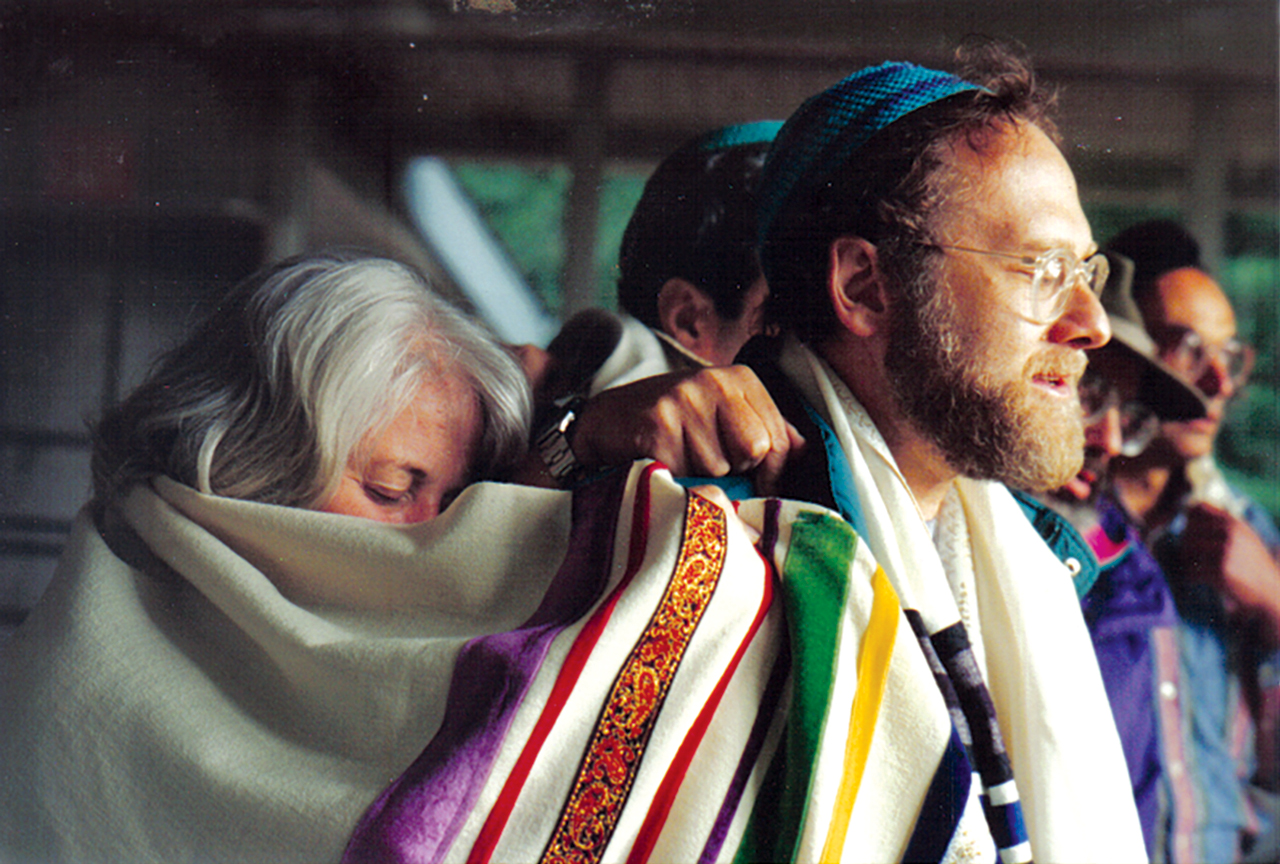
When the Aquarian Minyan formed in June 1974, the egalitarian group of about 20 people held Shabbat services in their homes and hosted retreats in the California redwoods. The Minyan has never had a permanent building, instead relying on rented spaces to hold services as it grew. In the 1980s and ’90s, High Holiday worshippers soared to about 600 people, according to Barkan and Yehudit Goldfarb, 80, another of the Minyan’s founders.
By the mid-1990s, there were differences of opinion about how the Minyan should operate. Should it hire a rabbi to take on a more formal leadership role, rather than the informal “rabbi-chaver,” or teacher among peers, to which the Minyan was accustomed?
Those questions over the community’s identity, and differences about what leadership should look like, ultimately led to a significant dropoff in people participating in the Minyan throughout the ’90s and early 2000s, said Goldfarb.
She met her husband Reuven, 79, at Aquarian Minyan services in 1975. They’ve been married for 47 years. In 1999 they relocated to Israel, officially making aliyah in 2003 and settling in Tsfat, considered the birthplace of Kabbalah, or Jewish mysticism. Close to a dozen other past participants of the Aquarian Minyan made aliyah after them, according to Goldfarb.

Even living in Israel, the Goldfarbs have maintained a strong connection to the Minyan, paying for long-distance phone calls for years to attend leadership meetings and joining services when they returned to Berkeley in the summers.
Unexpectedly, the Covid-19 pandemic helped revive the Minyan after it began hosting online services on Friday evenings and Saturday mornings, reaching far-flung former Minyanites.
The shift online also brought in new devotees. When Stampfer used Zoom in 2020 to connect with friends from her New York high school, she rekindled a friendship with Robert Stang after more than 50 years. Stampfer soon invited Stang, who was then living in Woodstock, New York, to join her for the Minyan’s Zoom services. He got hooked.
“I came home to my roots,” Stang, 77, said of the intense feelings he had when he began praying with the Minyan.
He’s now a regular at the hybrid services for Shabbat and High Holidays. Meanwhile, the pair have become life partners, splitting time between their homes in Oakland and Arizona.
Throughout the last four years, Seidel said Zoom services have reached more than 1,000 people in the U.S., Europe and Israel. “Our group is pretty savvy,” he said. “Some of them are pretty darn good on the computer and tablet.”
Virtual services have been a blessing for Seidel, too. While he still makes trips to the Bay Area, his primary residence for 23 years has been in Oregon, where he’s an adjunct professor of theology at the University of Portland, a Catholic institution.
Seidel also leads the Minyan’s Yeshiva Academy, which he helped create during the pandemic, offering dozens of online courses in Jewish Renewal studies, Kabbalah and Israeli history.
The 50th anniversary celebration in Berkeley will bring virtual attendees from out of state and some of the Minyan’s earliest worshippers, even from Israel, Stampfer said. In addition to Friday night services and special programs throughout the weekend, a party on Saturday night will include live music and dancing and a cabaret show by the “Minyanaires.” The celebration closes Sunday with a drum circle and chanting of blessings.
Seidel hopes the Minyan’s current boost of energy will help secure grant money for more yeshiva classes and the development of intergenerational programming with other Bay Area Jewish spiritual communities. There’s also an effort underway to archive the Minyan’s history and photos to pass on to future generations, Seidel said.
“I don’t know that we’re going to be here in another 50 years,” Stampfer said, “but I sure hope that the things that we have created that are innovated that have spread around, that they will continue to grow and lead to the vision that we’ve always had of a world renewed.”