

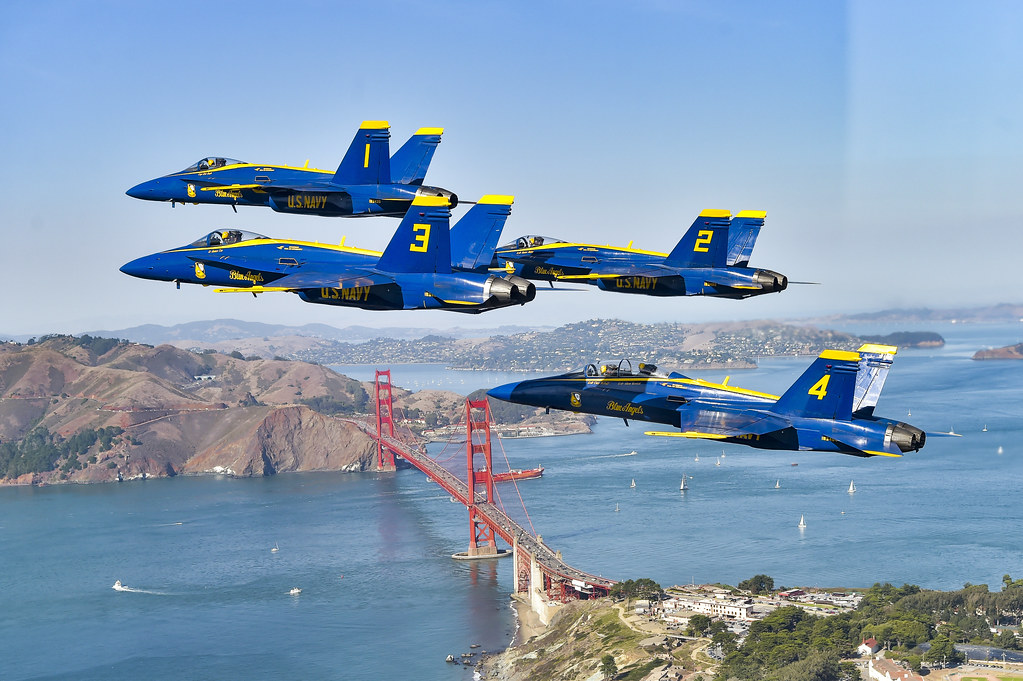
While many of us are in synagogue on Saturday for Yom Kippur, pounding our chests and seeking forgiveness, fighter jets will be flying across San Francisco’s skies for Fleet Week, creating an enormous racket and intruding on a sacred Jewish holiday. But this year it’s more than just a disturbance; it’s a time for some uncomfortable reflection.
SF Fleet Week, which happens to be the largest of its kind in the country, began Monday, and the air show, which includes performances by the Blue Angels, is scheduled for the afternoons of Friday, Saturday and Sunday.
Many in the Bay Area enjoy Fleet Week and the air show and see them as good, family fun. Others have long advocated against the whole thing for many reasons, including the cost and the message it sends about military power.
The event, now an institution, started in 1981 when then-Mayor Dianne Feinstein sought to strengthen business relations with the U.S. Navy by offering San Francisco as a ship repair center. In the years since, it has evolved to include public ship tours, a parade of ships sailing under the Golden Gate Bridge, military band concerts, theater performances, demonstrations by the Marine Corps Silent Drill Platoon and, of course, the (in)famous air show, beloved by some and dreaded by others.
I come from a family of U.S. veterans. My father served in the Air Force, my paternal grandfather and one uncle served in the Army, my maternal grandfather served in the Navy, and another uncle served in the Coast Guard. So I do not say this lightly: I believe war should be condemned, not glorified. Especially this year — as many of us mourn the tragic events of Oct. 7, 2023, and the tragedies that have followed, with war raging in and around Israel and thousands of innocents killed alongside military targets — I think it is grotesque to use war machines as entertainment.
Regardless of your personal take, this year is different.
Yom Kippur is a time to take accountability not only for our individual misdeeds, but also for our collective wrongdoings. So let us lean in. Let us use this as an opportunity to reflect. Let us take the sounds of the F/A-18 Super Hornets, F-22 Raptors and F-35s overhead this year and hear them for what they truly are: the sounds of war.
It’s easy, as Americans who have always lived on safe soil, to get caught up in awe at the sheer might of these fighter jets, the same ones that wowed movie audiences in “Top Gun: Maverick.” It’s easy to marvel at the perfectly executed aerial acrobatics — and it’s easy to forget their true purpose. It’s also hard to acknowledge how much harm they can, and do, cause. But remembering this, especially when it is done in our name, is our responsibility as Jews and as Americans.
Veterans have raised concerns about the triggering sound of the Blue Angels for those who suffer from PTSD. According to a USC study, more than 23,000 veterans live in San Francisco, and many of the almost 300,000 veterans who live in the Greater Bay Area travel to the city to receive services. As a sanctuary city, San Francisco is also home to countless refugees, including people from Afghanistan, Bosnia, Iraq, Kosovo, Kuwait and Libya — all countries where U.S.-made war planes have been deployed.
Experts have warned that the sound can reach dangerous levels of 100-110 decibels, with some reports as high as 130 decibels, putting people at risk of hearing damage. Children, the elderly, people with disabilities and neurodivergent individuals are particularly at risk because they can be more sensitive to sound.
There is also the environmental impact. According to a 2022 San Francisco Chronicle investigation, each jet burns roughly 1,600 gallons of fuel per show. With six jets on the Blue Angels team performing three shows and one practice, the total amount of pollution emitted by the Blue Angels for Fleet Week equals about 825,600 pounds of carbon dioxide. Or, as the Chronicle put it, the equivalent of driving from San Francisco to Atlanta 375 times.
Then there is the money. In 2016, SFGate reported that the cost of putting on Fleet Week is “somewhere north of $1.26 million.” While that might seem like chump change compared with the rest of the city’s spending, let alone the U.S. military budget, the figure does not include the cost of the jets themselves, which the Navy estimates to be about $55.7 million per plane, plus more for operating costs such as fuel, maintenance and personnel. When the Blue Angels’ team of six performs, we’re witnessing over $334.2 million in federal spending fly in circles over a city that suffers from constantly growing income inequality and an acute housing crisis.
Of course, even as we’re wowed by the aerial maneuvers, we know that’s not what the F/A-18 Super Hornet, F-22 Raptor and F-35 stealth fighter were created for. Israel has 39 F-35s, and in June reached an agreement to acquire an additional fleet of 25, according to the Times of Israel. The F/A-18 and its variants are standard planes for the Navy and Marine Corps that have been deployed in combat since 1986. A single craft can carry up to four 2,000-pound bombs, and we all know what bombs are used for.
As we surround ourselves in holiness this Yom Kippur, let us remember the Talmudic teaching that “every life is a whole world,” and let us consider how many worlds a 2,000-pound bomb can end.