

For Jews around the world who grow up with the responsibility of remembering the Holocaust, Kristallnacht — the Nazi-organized anti-Jewish pogroms that took place in Germany and Austria in 1938 — serves as a case study of hateful rhetoric turning into deadly physical violence.
For Linda Hirschhorn, it’s even more personal.
Less than two weeks after Kristallnacht (“The Night of Broken Glass”), her aunt and uncle, Polish Jews living in Vienna, were arrested by Nazi authorities (although, later, they did manage to sneak out of the police station).
One year later, Hirschhorn’s maternal grandfather also was taken in for questioning by the Nazis. When they released him, they tied him to a moving trolley, forcing him to run behind it. A few days later, Leib Fischer died.
This year, on the 86th anniversary of Kristallnacht, Temple Beth Sholom in San Leandro will host a concert and multimedia exhibit on Nov. 10. “Music of the Holocaust” is being facilitated by the East Bay Holocaust Education Center (EBHEC) and members of the musical trio Veretski Pass.
Hirschhorn, Beth Sholom’s cantor for nearly 36 years, sees the event as an opportunity to honor her relatives’ memory.
“I think, especially in these times, people need this education,” Hirschhorn said. “For teens in particular, for them it’s like ancient history. For me it’s my personal history. You have to bring this kind of thing everywhere. People need to know, otherwise you lose the history.”
Founded in 2021 by Holocaust-focused artist Larry Lagin (the organization’s president) and Chabad of the Tri-Valley Rabbi Raleigh Resnick, the EBHEC aims to educate East Bay residents of all faiths about the Holocaust, and also honor its victims.
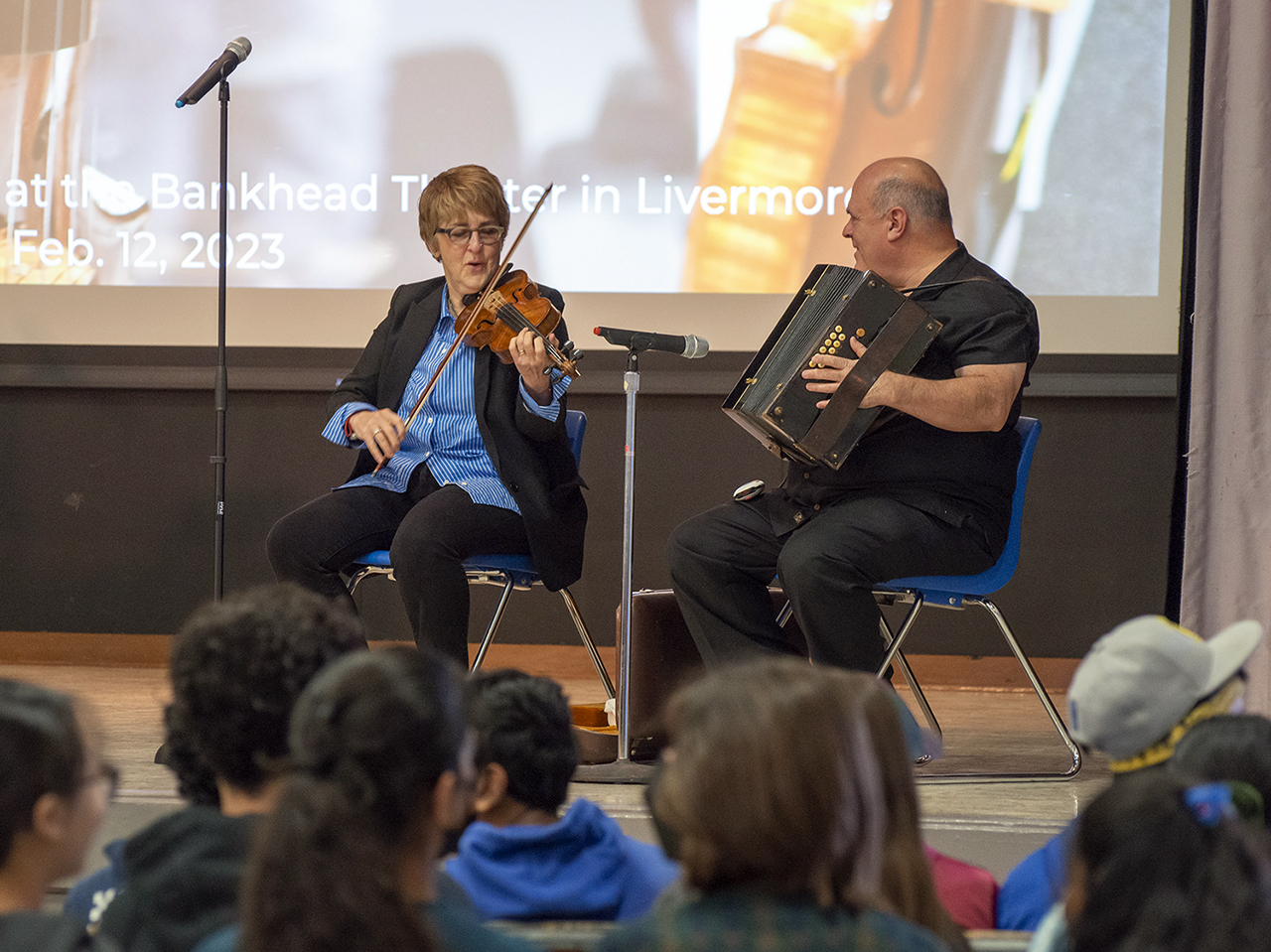
The free concert will include traditional Jewish folk music from Eastern Europe and songs played in concentration camps performed by violinist Cookie Segelstein and accordionist Joshua Horowitz of Veretski Pass. There will also be recordings of songs played on Nazi radio, and those designated by Hitler’s regime as “degenerate music,” such as jazz or Roma music.
Segelstein thinks of the presentation as a lecture punctuated by live demonstrations.
“We will basically show what was in place before World War II,” said Segelstein, a daughter of Holocaust survivors from an area that is now Ukraine. “And to understand the loss, you kind of have to know what was in place before.”
The art exhibit will be open for viewing a half hour before and after the 2-3 p.m. concert. Then it will stay on display at the temple for at least another week.

Featuring paintings by Lagin — a retired nuclear fusion scientist–turned-artist — that were inspired by photographs from the archives of the U.S. Holocaust Memorial Museum in Washington, D.C., the exhibit also includes testimony videos from survivors archived by the USC Shoah Foundation.
Lagin said his artistic process involves close study of devastating scenes and pained faces. Many of the photographs are of children who were either killed during the war or managed to survive and escape — and looking at them was grueling, he said.
“It took me three to four years to actually do the series, and it was very difficult … very emotional,” Lagin said. “I oftentimes would recite the Mourner’s Kaddish before painting.”
“Every war and every tragedy has personal stories,” Hirschhorn added. “I think if you make the stories personal, that has an impact on people. I think that’s the importance. If you read and talk to people and get the personal element in it, not just the historical facts. Then your heart is more open.”