
Books coverage is supported by a generous grant from The Milton and Sophie Meyer Fund.
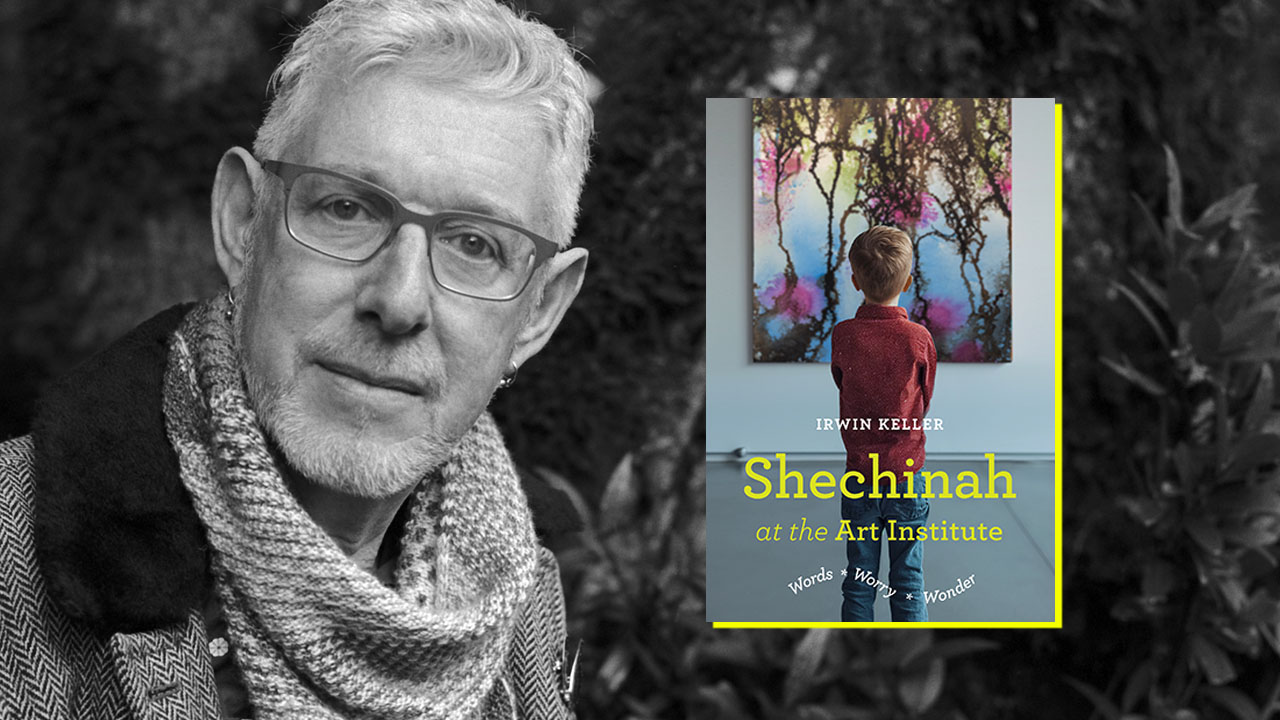
In the title story of his first book, Rabbi Irwin Keller describes his initial encounter with the Shechinah during a visit to the Art Institute of Chicago as a child.
The Shechinah, described in Jewish holy texts as God’s indwelling female presence in the world, walks slowly from canvas to canvas in a room of Impressionist paintings.
“She knew the paintings and she knew the artists. She was, after all, their muse in a way,” he writes in “Shechinah at the Art Institute,” published in August. The story relates his unfolding conversation with the Shechinah, who transports them to a cafe in the courtyard of the museum, where they continue to talk about art, beauty and the meaning of life, particularly of Jewish life, while nibbling on a light lunch and a dessert of rainbow sherbet.
The Shechinah dances her way through this dreamy, mystical, nonlinear memoir filled with stories and poems about angels, ancestors, coincidences, music and prayers. Along the way, he folds in his insights into Jewish life with the aim of helping us heal our damaged world.
Keller, the spiritual leader of Congregation Ner Shalom in Cotati in Sonoma County since 2008, was ordained in 2021 through the Renewal movement’s Aleph rabbinical school. He is also a co-founder of the Bolinas-based Taproot Community for Jewish spiritual seekers and artists.
The path Keller took to this iteration of his identity informs to a great extent his inventive, sometimes playful approach to Judaism as represented in his writing.
From a young age, Keller felt called to the rabbinate but came out as gay in 1982, before any rabbinic school would accept him. Instead, called by the challenges of the AIDS epidemic, he went to law school, became a social justice advocate and was the primary author of Chicago’s first gay rights legislation.
In 1988, he moved to San Francisco and worked as a lawyer with the AIDS Legal Referral Panel of the San Francisco Bay Area for eight years, including five as its executive director. He met his husband, started a family and took the next step in his activism by becoming a co-founder of the Kinsey Sicks, which the group describes as “America’s favorite dragapella beautyshop quartet.” For 21 years Keller performed in drag as Winnie. After he stepped down from that role, his formal journey to the rabbinate began.
The Shechinah dances her way through this dreamy, mystical, nonlinear memoir filled with stories and poems about angels, ancestors, coincidences, music and prayers.
Keller’s stories weave together the personal and universal. We meet his mother and Talmudic rabbis. We learn of his encounters with Hasidism and the Chicago Cubs. We follow his journey to coming out as gay and how that got in the way of his intention to go to rabbinic school.
In many of his stories, we find remarkable synchronicities that open doors to new ways of thinking and being in the world. In “Such Stuff as Dreams Are Made Of,” Irwin comments that “coincidence is the Esperanto of Divine communication.” (Esperanto is the international language created by L.L. Zamenhof, a Polish Jewish pacifist in the late 1800s.) The story is an invitation to look at coincidences in our lives as having a deeper meaning than just chance events or accidents — by looking at where they come from and what they’re telling us, sometimes clearly and sometimes in symbolic language.
In “Evening Prayer,” which begins with the words “Blessed are You, Great Mother,” he provides an opportunity to examine what the Divine means to us: God, Goddess, Nature, the Universe, All That Is and the Ain Sof — without end — of the Jewish mystics.
Several times Keller mentions leading Shabbat services in a skirt. To me, this is his request to all of us, in these troubling times, to step out of what is ordinary, expected and required, so we can craft for ourselves Jewish identities that emerge from the soul, from our deepest nature. But how do we do this?
In “Angels and Airports” Keller rewinds us back to the moments when God called out to Abraham and Moses and when they called back to God, “Hineni,” or “Here I am.” We can do the same, he suggests, by showing up in our own lives with all of our wisdom and gifts.
In “Journey of Return,” Keller describes a trip to a cemetery in Germany, where many of his ancestors are buried. “These people had erected stone markers not facing toward Jerusalem but toward the future,” he writes. Here, too, I hear the rabbi in a skirt inviting us to find within ourselves our own personal inner Torah as a path toward a better future.
A famous ad for Levy’s rye bread launched in 1961 asserted: “You don’t have to be Jewish to love Levy’s.” Similarly, you don’t have to be queer or even religious in any way to be moved by Keller’s book, which is his teaching, his Torah, for our times.
His story “Unlikely, Inevitable You” begins, “You were meant to read these words.”
I know that I was. In fact, as soon as I finished the book, I started to read it again, which is rare for me. I believe that you, too, are meant to read these words welcoming us to a new era in Jewish history, amid a challenging time for our people and for all the world.