

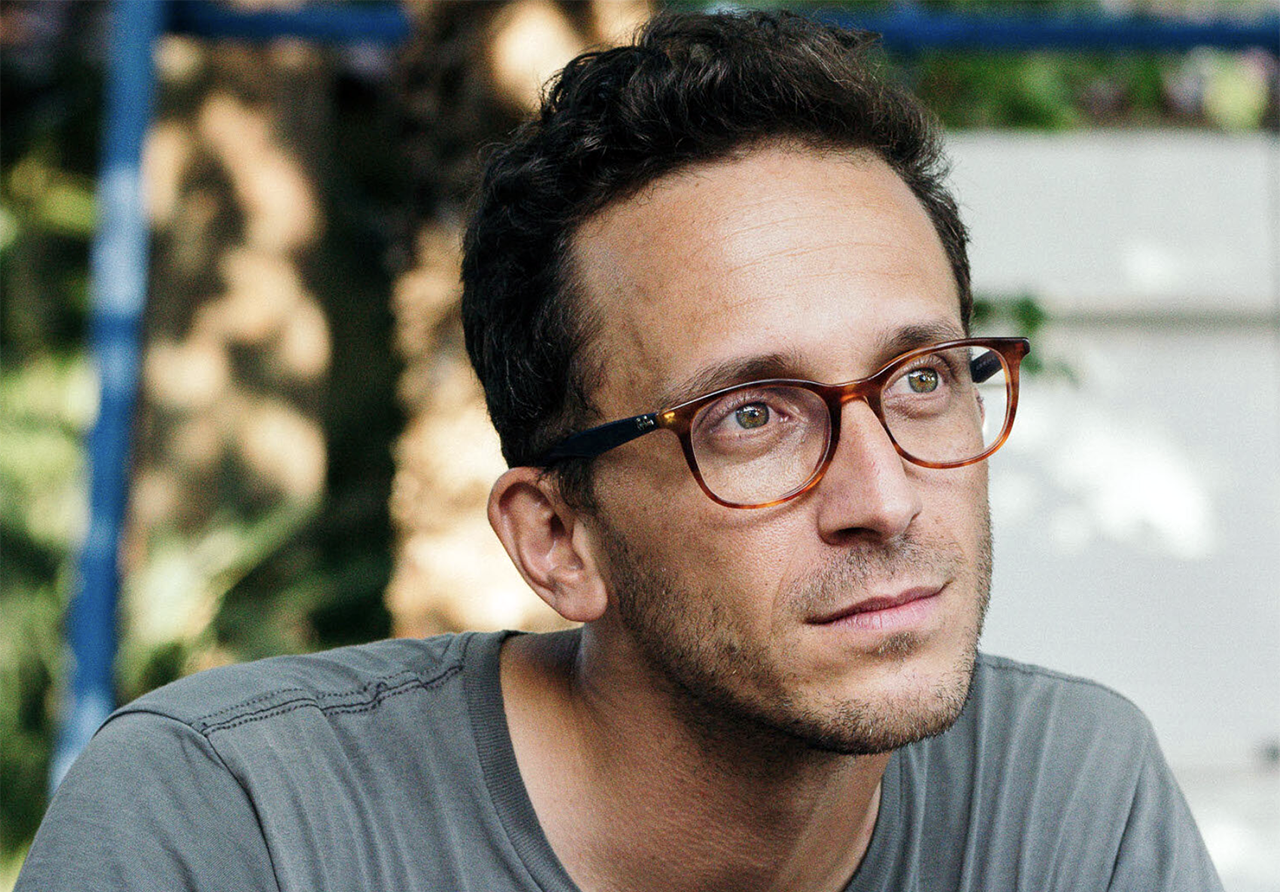
Before Oct. 7, 2023, Columbia Business School professor Shai Davidai was no activist.
“I’d drop my kids at school. Work, teach, have lab meetings with Ph.D. students, close my laptop at 5:00, then be with the kids. Rinse and repeat,” he told J. last week.
Davidai will visit the Bay Area to tell his story at a Hillel of Silicon Valley fundraising event on March 9 in San Jose.
Nothing has been the same for Davidai since Oct. 7. After the worst terrorist attack in Israel’s history and the onset of war in Gaza, Columbia became a hotbed of intense anti-Israel activism, reaching its apex last spring when protesters pitched tents on Columbia’s main quad, spearheading a national movement.
Shortly after the Hamas massacre, Davidai began speaking out. Since then, he has amassed 105,000 followers on X and 128,000 followers on Instagram by documenting what he sees as rampant antisemitism and expressions of support for terrorism from Columbia protesters — as well as the university’s response, of which he has been unsparingly critical.
In the process, Davidai has become a household name for those paying close attention to the post-Oct. 7 debate surrounding anti-Israel activism on college campuses.
Davidai testified on Capitol Hill on June 13, speaking before the House Committee on Ways and Means at a hearing titled “The Crisis on Campus: Antisemitism, Radical Faculty, and the Failure of University Leadership.”
“I am here to speak up for every decent American who believes that antisemitism and support for terrorism have no place on campus,” Davidai said. “Yes, I have paid a personal price for speaking up, but I would rather pay the price for speaking up than the price for staying silent.”
He has continued to pay a price. The most recent and most public one: suspension.
In October, Davidai was temporarily suspended and barred from campus because of what the university described as the harassment of Columbia leadership. The suspension remains in place and he has no classes this semester.
Davidai will tell his story when he appears as the keynote speaker at L’Dor v’Dor 2025, a fundraiser for Hillel of Silicon Valley.
His appearance in San Jose will reflect his current role and focus. From the moment he was suspended, Davidai said, he transitioned from college professor to what he calls “community organizer.”
“I’ve been speaking with as many audiences as I can, engaging in conversation,” he said of his efforts to sound the alarm on increased antisemitism. “I travel around the world telling people what’s happening on campus and city streets, and I help them organize.”
He has also turned to podcasting to spread his message with “Here I Am with Shai Davidai.”
A native of Kiryat Ono, just east of Tel Aviv, Davidai attended Hebrew University before earning a Ph.D. from Cornell in 2015. He earned a postdoctoral fellowship at Princeton and spent three years as an assistant professor of psychology at The New School for Social Research before joining Columbia Business School in 2019. He is currently an assistant professor in the school’s management division with a special focus on the psychology of decision-making,
Amid an anti-Israel protest at Columbia on Oct. 7, 2024, the first anniversary of the Hamas massacre, Davidai posted videos on social media of his public confrontations with Columbia administrators.
In one video, Davidai told Columbia COO Cas Holloway, “You are indifferent and you know what? Hatred happens when people like you are indifferent. You are the chief operating officer of Columbia. Do you realize that?”
Campus newspaper The Spectator referenced another video of Davidai telling assistant director of public safety Bobby Lau, “You are such a useless administrator. But you know what, there were so many useless administrators in Nazi Germany. And you know what, after the war, they said they did everything they could.”
After the confrontations, the administration alleged that Davidai “repeatedly harassed and intimidated University employees in violation of University policy,” a Columbia spokesperson told The Spectator.
Davidai categorically denies the accusations.
“For the past 16 months I’ve never broken any rule,” he told J. “I’m aware I get very close to the boundaries, but I never do anything that breaches a rule. There are numerous videos of [protesting] students supporting terrorism, confronting faculty, cursing them. I’ve experienced it, too. I did not put the administration in a comfortable situation, and I admit to that. But that doesn’t mean it’s harassment or intimidation.”
He said Columbia officials not only failed to provide him with definitions of the terms “harassment” and “intimidation,” they also “never replied to a few very basic questions asked by my lawyers: Who did I harass? How? What did I do? And who is in charge of this decision? I don’t know what the crime is. Given that, Columbia is the investigator, judge and executioner.”
Despite his suspension, Davidai remains a faculty member and still receives a paycheck. However, the university demanded he undergo a sensitivity training course before he will be allowed back in the classroom. The professor said he’s willing to do so, except for one requirement.
He will not sign a nondisclosure agreement.
“Columbia requires that I sign a gag order about the training,” he said. “I refuse to sign. I’m completing this [training] for a crime I did not commit. So I want to be able to talk about it. I’m contesting this with a lawyer, but they refuse to work with us.”
According to his Columbia Business School bio, Davidai studies “people’s everyday judgments of themselves, other people, and society as a whole…. His topics of expertise include the psychology of judgment, economic inequality and social mobility, social comparisons, and zero-sum thinking.”
He finds it ironic that, given his research into the psychology of judgment and decision-making, his teaching career has been “placed in purgatory,” as he put it.
“We’re never going back to normal,” he said regarding Columbia. “Now that we have unearthed how deep the problems go, the goal is to create a normal future. That has nothing to do with me. It’s a bigger issue with Columbia, the faculty, the administration and student organizations.”
He hasn’t been totally abandoned. In November, a few weeks after his suspension, more than 400 university professors, staff, students, alumni and parents signed a letter addressed to Columbia’s interim president, Katrina Armstrong, blasting the decision to suspend him.
Earlier this month, after President Donald Trump issued an executive order titled “Additional Measures to Combat Anti-Semitism,” the Department of Education’s Office for Civil Rights opened antisemitism investigations into Columbia and other universities, including UC Berkeley.
But Davidai laments that few of his colleagues have stood by him as the only faculty member suspended amid the campus turmoil since Oct. 7.
“When there’s a rally, when I come to counterprotest, very few professors show up, in a university with 5,000 professors. I work with 30 [professors] in my department, and none have said anything. These are people training America’s future leaders, and they failed.”
Davidai said he has been forever changed by what has happened to him and by the explosion of Jew hatred. But he sees an even more insidious threat than the hatred alone.
“We focus so much on educating people on the problems of hatred,” he said, “but we really have to educate on the problem of indifference. I now see on an everyday level the dangers of hatred and the dangers of indifference. They work together.”
L’Dor V’Dor 2025, sponsored by Hillel of Silicon Valley, is set for 3 p.m. Sunday, March 9, at Scott’s Seafood Ballroom at the Rotary Summit Center, 88 S. Fourth Street, San Jose. Tickets, $72. $18 for students.