

Radicalized hate in Anytown, USA
I can’t get this story out of my head about the Brentwood man allegedly obsessed with shooting Jews and 3D-printing guns. (“Feds arrest East Bay man who ‘researched mass shootings’ targeting Jews,” March 25)
Part of it is proximity. My parents have lived in Brentwood since 2013. I’ve visited dozens of times. I was literally walking through its tiny downtown recently, taking my first-grader to the library.
What really disturbs me is that I know how ordinary Brentwood is. It screams Anytown USA. The only active Jewish presences are a small synagogue and a Chabad.
So what may have radicalized Noah Bauer, and why wasn’t he on anyone’s radar? It doesn’t take a genius to look at his online history and interest in guns to make conclusions. Had Bauer not chosen to go grocery shopping with his 3D-printed gun allegedly tucked into his pants, which led someone to call the police, he might never have become the focus of a criminal investigation. Much like the case of Concord man Ross Farca — who was convicted in 2021 of assembling and possessing an assault rifle while making threats online to commit a mass shooting of Jews — it appears the main thing that spared the East Bay from becoming the next Pittsburgh or Poway was dumb luck.
Hopefully Bauer and Farca get the help they need, but we also need to have serious conversations with our public officials and neighbors, reinforcing that we need their support to help keep everyone safe. As extremist messages are mainstreamed in podcasts and politics and as 3D printing offers yet another access point to firearms, stories like Bauer’s should be a blaring red alert. If self-radicalization is happening in Concord and Brentwood, it’s happening everywhere. These young men are indicative of a deep problem. We need to continue to identify the networks and voices promoting these beliefs and challenge them head on. Lives may literally depend on it.
Andrew Nusbaum
Denver, Colorado (formerly San Francisco)
More Sandler, less oversight
As a millennial, I was put off by the Feb. 26 article “Bill aims to increase oversight of Holocaust ed in state” not simply for its introduction bemoaning “kids these days,” but for its overall lack of insight regarding antisemitism. Alarmed by the ramping up of antisemitism, I agree with state Sen. Henry Stern that “it’s just so in our face,” but I think that Senate Bill 472 falls short.
Coming of age in the 1990s, there was no shortage of Holocaust learning for me. I learned it not just in Jewish settings, but in public school English class when reading Elie Wiesel’s “Night,” during 10th grade European history and while watching Spielberg’s “Schindler’s List.”
SB 472 exceptionalizes the Holocaust, leaning on our victimhood as Jewish people to prevent antisemitism. Pity alone clearly does not work, as there is no shortage of Holocaust stories in media, film, history and literature. Yet Nazi salutes are becoming commonplace. Not only does SB 472 highlight the Holocaust over other genocides, it uses government oversight in classrooms to do so.
My mother worked in California public schools. When she began, she wrote her own lesson plans. By the time she retired, she read from a script provided by the government. SB 472 follows in the footsteps of “No Child Left Behind,” which failed utterly. So why would we use that approach again today?
What did make me feel proud of my Jewishness in public school was not my victimhood, but rather Adam Sandler. Specifically, “The Chanukah Song.” Kids in my school loved it. They sang it delightedly. Why? Because it focuses on Jewish excellence. While the Holocaust must be taught in public school, leaning on it entirely to prevent antisemitism is not wise, nor is using the proven failure of government oversight to ensure it. We need more things like “The Chanukah Song” and less government oversight.
Marie Hoff
Redding
Today’s ‘wise men’ of Chelm
The Polish city of Chelm has been a source of Jewish humor since the 1700s. Chelm’s residents display “foolish wisdom.” By the way, it’s usually the wise men of Chelm, seldom the women.
Unfortunately, some of Chelm’s “wise men” are still around.
For example, Anti-Defamation League CEO Jonathan Greenblatt said he didn’t think Elon Musk’s gesture to the crowd was a Nazi salute. Another guy from Chelm seems to be Ted Deutch, CEO of the American Jewish Committee, who lauds Trump on fighting antisemitism. (“AJC leader sees antisemitism fight as a ‘test of democracy,’” March 28)
If Trump is against antisemitism, why doesn’t he dump Musk?
George Z. Banks
San Leandro
Don’t trust Trump on antisemitism
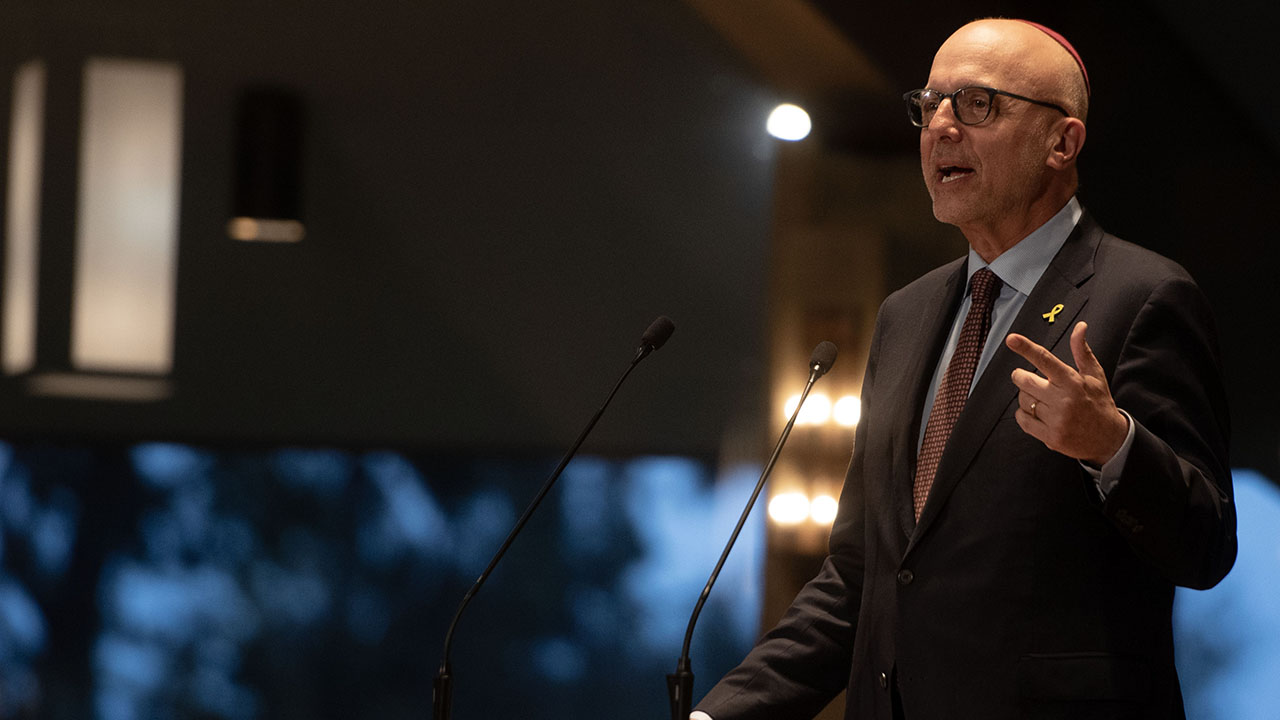
Ted Deutsch was very well received at Congregation Beth Am and made some very important statements about ways to fight antisemitism. To be clear, antisemitism is indeed a frightening and escalating issue both in the United States and worldwide. But the notion that President Donald Trump and his administration are genuinely committed to fighting antisemitism is completely contradicted by their words, actions and associations.
Not only has Trump himself repeatedly displayed hateful antisemitism, but he has filled his administration with people who have used antisemitic rhetoric and espoused conspiracy theories about the Jewish people. He associates with extremely antisemitic people, such as Kanye West and Nick Fuentes.
Trump is using antisemitism in service of justifying authoritarian actions such as curtailing freedom of speech, targeting universities, arresting students without due process and creating confusion and strife between communities.
Timothy Snyder, a renowned scholar of authoritarianism and tyranny, recently wrote in a Substack post that “Jews in the United States are being instrumentalized in an effort to build a more authoritarian American system. The real and continuing history of the oppression of Jews is transformed into a bureaucratic tool called ‘antisemitism’ which is used to suppress education and human rights — and so, in the end, to harm Jews themselves.”
How can anyone seriously say that Trump is making antisemitism a priority?
Gayle Donsky
Mill Valley
J.’s Deutch coverage disappointed
To put it mildly, very mildly, J.’s coverage of AJC CEO and six-term Democratic U.S. Rep. Ted Deutch’s presentation at Beth Am was sadly lacking, very sadly lacking. There were lots of questions asked that were very pertinent to the 250-plus attendees concerned about the dangerous increase in antisemitism in America and in our own backyard.
Some of the questions concerned California bills to put guardrails on the required ethnic studies curriculum, which has had serious antisemitic content put forth from the so-called Liberated Ethnic Studies group. Other questions concerned the funding of American universities by Qatar, a principal source of funding for Hamas.
Deutch answered these questions clearly and insightfully. Throughout his talk and in his answers to the questions posed, he forcefully pointed out the importance of the AJC’s nonpartisan approach in its work against antisemitism.
A 23-year-old named Ben Rubin asked a very partisan question. Somehow, Rubin and his question received almost as much coverage in your article as Deutch and his content. This was a terrible misdirection of focus away from an excellent presentation and an engaged crowd focused on AJC’s work against antisemitism.
One would expect a publication called J., where the “J” stands for “Jewish,” to focus on the good work that Deutch and the AJC are doing to fight antisemitism rather than a partisan narrative of the day.
Stuart Oremland
Portola Valley
Nuance in defining antisemitism
Stephen Rohde’s recent op-ed (“We can fight antisemitism without sacrificing free speech,” March 13) rejecting the International Holocaust Remembrance Alliance’s definition of antisemitism was grossly exaggerated, and I say this as someone who prefers the Jerusalem Declaration on Antisemitism to the IHRA definition.
Rohde cited many scholars who claimed that the IHRA definition silences speakers “who advocate for Palestinian rights or criticize Israeli policies.” However, the IHRA definition stipulates that “criticism of Israel similar to that leveled against any other country cannot be regarded as antisemitic.”
One of the scholars Rohde quoted, Rebecca Ruth Gould, published two books in 2023. One of them, “Prison Hunger Strikes in Palestine: A Strategic Perspective,” places Israeli prisons within “Palestine,” hence she doesn’t seem to recognize the existence of the State of Israel. Her other one, “Erasing Palestine: Free Speech and Palestinian Freedom,” posits that the entire goal of the IHRA definition is to silence the voices of Palestinians and their supporters.
Rohde called out three IHRA examples of antisemitic speech: (1) calling the State of Israel racist; (2) requiring of Israel behavior that is not required of other countries; and (3) comparing Israeli policies to those of the Nazis.
But does denying Palestinian supporters the right to make these specific arguments really silence them? Rohde noted that these arguments are protected by free speech and are not illegal in this country. His implication is that the IHRA definition is therefore incompatible with allowed speech in the U.S. Perhaps the IHRA definition is compatible, but U.S. law simply does not outlaw antisemitism. In fact, many famous Jew-haters both past and present (for example, Henry Ford, Louis Farrakhan and Kyrie Irving) have employed “protected” antisemitic speech. Just because their speech is First Amendment-protected does not mean that it is not antisemitic.
I found Rohde’s criticism of the IHRA definition to be decidedly unconvincing.
Todd Silverstein
San Rafael
‘All Israel, all the time’
Assemblymember Dawn Addis’ opinion piece on Assembly Bill 1468 is seriously flawed. (“As California legislators, we must create clear standards for ethnic studies,” March 18)
Under this bill, authored by leaders of the California Legislative Jewish Caucus, all ethnic studies course content would have to be blessed in advance by the state Department of Education. Although the bill is couched in the language of inclusivity, its true intent is to censor classroom discussion regarding the mass killing of civilians in Gaza and Israel’s brutal treatment of Palestinians in general. When criticism of Israel does occur, it is immediately called “antisemitic.” What self-serving sophistry. Incidentally, antisemitism in ethnic studies classrooms is already prohibited under California’s education code.
Addis says that the state’s oversight is necessary to prevent “promoting harmful stereotypes or debasing other cultures.” But the only examples cited are comments that are critical of Israel, not critical of Jews as members of a religion. It’s all Israel, all the time. They are afraid that students might hear the truth about what is happening in Israel/Palestine. They are afraid that Arab and Muslim students will describe the impact Zionism and Islamophobia have had on their lives. Perhaps the Jewish caucus should be called the Israel caucus.
We know Trump wants to silence all who disagree with him. It’s sad to see California legislators acting in a similar fashion. Ethnic studies is an eye-opening method of looking at society not through the lens of the dominant culture, but through the lens of nondominant groups. It is not racist or antisemitic. It is enlightening. Antisemitism will only end when Jews unite with victims of discrimination and persecution around the world instead of circling the wagons around Israel. It’s time we learned that.
Larry Hendel, Jewish Voice for Peace
Berkeley
Visit a Jewish museum online
For readers who want to celebrate Jewish American Heritage Month in May but don’t know what to do since the Contemporary Jewish Museum closed, I suggest that they visit the Jewish Museum in Cyberspace at amuseum.org. This award-winning website includes information about Kristallnacht, antisemitism depicted on ancient coins, medals and coins honoring Albert Einstein, Jewish crossword puzzles and much more. But the main attraction is the Jewish-American Hall of Fame, featuring over 50 biographies ranging from the Jews who made Columbus’ voyages possible to the iconic Supreme Court Justice Ruth Bader Ginsburg.
This year’s honoree is Julius Rosenwald, who has been called the “most important philanthropist you never heard of.” Rosenwald was born in 1862 just a few blocks from Abraham Lincoln’s residence in Springfield, Illinois. By his 16th year, Rosenwald was apprenticed by his parents to his uncles in New York City to learn the clothing trades. He later started a clothing manufacturing company. In 1895, he became a part owner of Sears, Roebuck & Co., and in 1908 Rosenwald was named president. In 1924, he resigned the presidency but remained as chairman; his goal was to devote more time to philanthropy.
After Rosenwald read Booker T. Washington’s biography “Up From Slavery,” a friendship ensued that resulted in the building of nearly 5,000 schoolhouses in Black communities across the South. Rosenwald contributed up to half the cost (totaling about $4.4 million, equivalent to $78 million today), and the community raised the balance. Graduates of those schools have included civil rights activists John Lewis and Maya Angelou.
The Jewish-American Hall of Fame is funded through the sales of commemorative medals. For information about the newest medal honoring both Julius Rosenwald and Booker T. Washington, visit the website.
Mel Wacks
Woodland Hills