

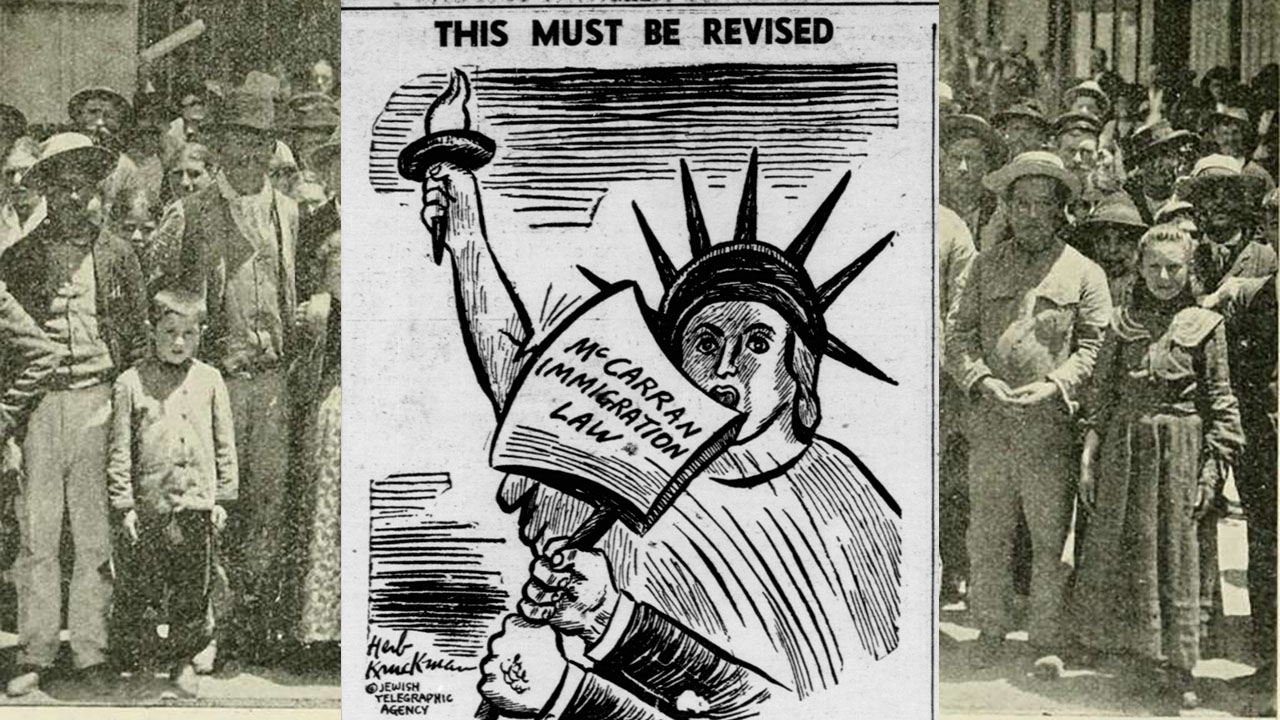
The Immigration and Nationality Act of 1952 has been in the news lately, with the Associated Press just last month calling it the “legal foundation of modern immigration law.”
The Trump administration has been using a provision of the act to justify its effort to deport Mahmoud Khalil, a green-card holder and a leader in the pro-Palestinian movement at Columbia University while he was a graduate student.
The 1952 law lays out legal grounds for the deportation of noncitizens for certain activities or crimes, which is why it comes into the Khalil case. But at the time of the bill’s passage, it was the act’s nationality quotas that made it wildly controversial. The always-fraught debate over whom to let in the country — and from where — was heightened by Cold War fears and existing racism.
Despite the public furor over the bill, known as the McCarran-Walter Act, it became law in December 1952 after Congress overrode President Harry Truman’s veto.
The act set up national quotas for immigration using a baseline of how many people were of a given nationality in the U.S. in 1920 — but the quotas were not applied equally to all nations. For example, although some direct exclusionary measures against Asian immigrants were ended, the government allowed only 100 visas per year per Asian country.
According to the U.S. Office of the Historian, the 1952 act meant that “85 percent of the 154,277 visas available annually were allotted to individuals of northern and western European lineage.”
While the bill did not specify the numbers of Jews who could enter, the system effectively limited immigration from Eastern Europe. Nevada Sen. Patrick McCarran, the bill’s co-author, was known to express antisemitic views in private. And Pennsylvania Rep. Francis Walter, the other co-author, was openly antisemitic. Addressing Congress not long after the bill’s passage, he said of its critics, “So many professionals, professional Jews, are shedding crocodile tears for no reason whatever.”
Four months before the bill became law, Jews seeking visas learned about a new requirement that would affect their applications, as we wrote in an August 1952 headline: “State Dept. Orders ‘Jewish’ Label on Immigrant Visas.”
“Jews seeking entry into the United States now are being required to identify themselves as Jews in their visa applications under the regulations introduced by the Visa Division of the State Department, the Jewish Telegraphic Agency established this week. Visa officials originally said that the new practices — a break with past usage — were dictated by McCarran-Walter Act requirements for ‘ethnic’ data.”
A month later: “The State Department continued this week to defend its new policy of requiring Jewish applicants for visas to identify themselves as ‘Jews’ in the face of mounting protests against the practice,” we wrote in September 1952.
On top of that, the act specified that communists couldn’t come to the U.S., but lifted a previous ban preventing fascists and (supposedly former) Nazis from entering. This was a particular concern for the Jewish community, still reeling from the Holocaust.
“It is believed here that many thousands of former Nazis who failed to apply previously for American visas — because of the automatic ban on all totalitarians — will make application when the new legislation enters effect,” we wrote in November 1952.
Milton Friedman’s January 1953 analysis of the new law, published in this paper, pointed out the incongruencies.
“While opening the doors wide to former Nazis, the new law makes admission to this country practically impossible for Jews and others born in countries [that] have a small immigration quota,” noted Friedman, writing for the Jewish Telegraphic Agency.
After the act took effect, there were many attempts to reform it.
“April 16 is a date every patriotic San Franciscan should circle on his calendar. It is the night set for the public mass meeting at Scottish Rite Auditorium to mobilize public opinion behind the nation-wide demand for revision of the Immigration and Nationality Act of 1952, better known perhaps as the McCarran-Walter Act,” we wrote in 1953.
“The meeting is sponsored by the Bay Area Committee for Revision of the Immigration and Nationality Act, an organization comprising representatives of religious, racial and nationality organizations in this area. Among those taking a leading part in the committee’s activities is the Jewish Community Relations Council…. The coming mass meeting will afford San Franciscans and their bay area neighbors an opportunity of joining in this growing movement. Already keen interest is being manifested in this gathering.”
Then in 1954, “The Bay Area Committee for Revision of the 1952 Immigration Act (McCarran-Walter) has called a meeting for June 15 to formulate plans for a continued campaign to correct the un-American injustices in the present law.”
And again in December 1955, the committee urged people to contact government officials about revamping the act: “Many such messages have been sent. All of them point to the national origins quota system and other features of the law which are held to be racist in nature, unfair and un-American in concept.”
That local committee was headed by J. Campbell Bruce, a San Francisco Chronicle reporter. Earl Raab, our columnist and the JCRC executive director from 1951 to 1987, wrote in February 1954 about Bruce’s book “The Golden Door,” which told the stories of people who suffered under the McCarran-Walter Act.
“This is a spine-chilling book all the more so because it is a true account of something that is happening today in twentieth century America!” wrote Raab.
“Here is a young Chinese woman who married an American citizen within a year of her arrival in this country, and for this reason was torn from her husband and deported to Hong Kong,” he wrote. “Here is a young German widow whose visa to this country was held up because a Nazi court had convicted her of theft. Her theft: the hospital diaper that was wrapped around her new-born child when she brought him home.”
Change eventually came, but it took a while.
The Immigration and Nationality Act of 1965, also known as the Hart-Celler Act, ditched the nationality quotas. There have been more revisions since then. Regardless, the 1952 act is a reminder that America’s policy on immigration is never set in stone. It has always been a delicate tissue of hopes and compromises, debated and challenged amid the fears and opportunities of the time.