

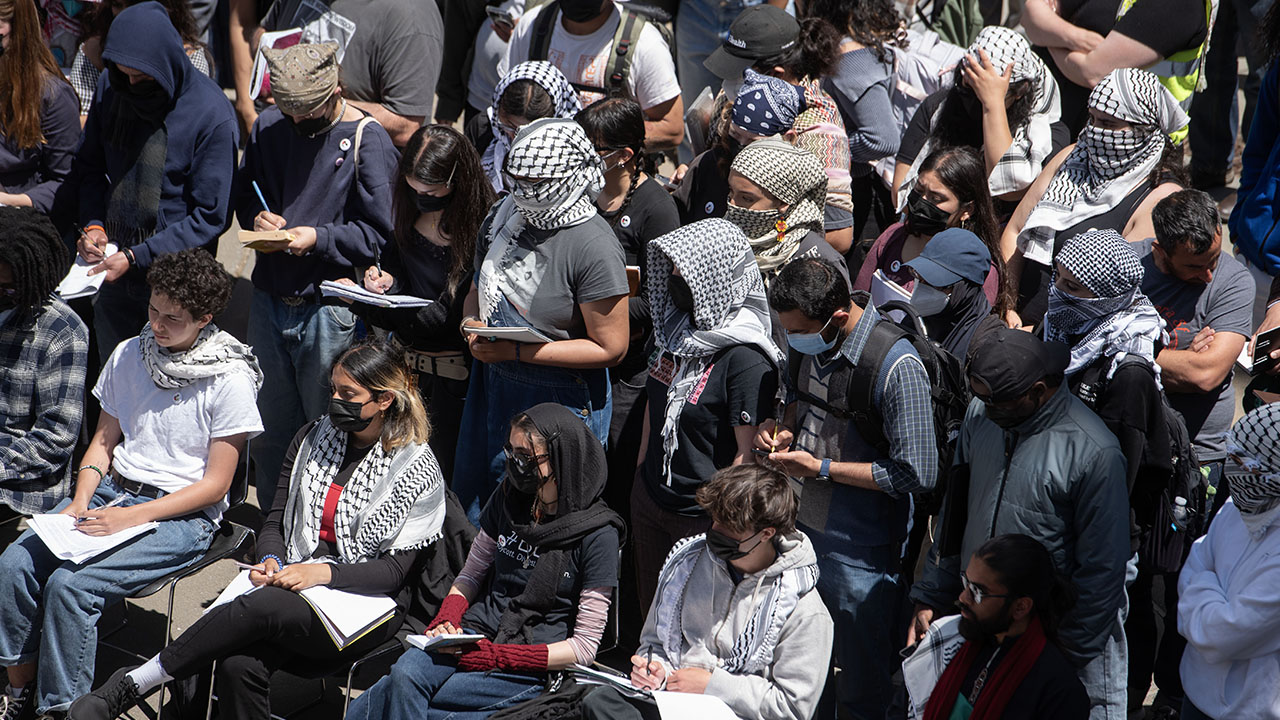
California State University delivered a firm response to a hunger strike announced by anti-Zionist student protesters this week. CSU will “not be altering its investment policies” due to student demands, the administration said Wednesday in a statement to J.
About two dozen students, protest groups said, are participating in a hunger strike against Israel’s two-month blockade of the Gaza Strip and are demanding their universities divest from weapons manufacturers and end all partnerships with “Zionist universities.”
Students at Cal State Long Beach, San Francisco State, Sacramento State and San Jose State announced the hunger strike in a series of videos posted to Instagram on Monday and Tuesday, stating they are participating in a “hunger strike for Gaza” and wearing white T-shirts with space to mark the number of days the strike lasts. Students drew a second hash mark on Tuesday, indicating the strike had entered its second day.
“As of May 5th, 23 students across California are beginning an indefinite hunger strike in protest of the blockade on food and aid from entering the Gaza Strip, and the CSU’s complicity in the genocide of the Palestinian people,” a female student with dark hair and a keffiyeh draped over her shoulders said in one of the videos.
In its statement emailed to J., CSU shared concern for the health of the demonstrators.
“We respect the diverse beliefs and personal convictions of our students, including those who have chosen to participate in a hunger strike,” said the statement, emailed from spokesperson Amy Bentley-Smith. “At the same time, we strongly urge our students to consider forms of expression that do not jeopardize their health and well-being.”
A spokesperson for S.F. State told J. on Wednesday that the university is “actively meeting with the students” involved in the hunger strike and is “concerned about their well-being.”
“We remain committed to our region-neutral investment policy which reflects our institution’s commitment to human rights,” S.F. State spokesperson Kent Bravo added in the statement sent to J.
The hunger strike, spearheaded by Students for Justice in Palestine and its affiliates at the various campuses, represents a significant development in the ongoing saga that has gripped university campuses since the outbreak of the Israel-Hamas war on Oct. 7, 2023. The new protest has drawn considerable social media attention, including from pro-Palestinian outlet Quds News Network, which has more than 570,000 followers on X. The Quds News Network called it a “mass hunger strike” in solidarity with Gazans.
This is not the first declaration of a hunger strike by American college students since war began. In April 2024, about a dozen Yale University graduate students refused food for eight days, according to the Yale News, calling on their university to divest from weapons manufacturers with ties to Israel. Some students lost up to 16 pounds, the protesters said in a statement.

On April 21, 10 students at Occidental College in Los Angeles announced a hunger strike tied to Israel’s blockade of Gaza, stating they were inspired by a recent hunger strike at Chapman University. Occidental students received medical attention during their protest, which lasted five days, according to Democracy Now.
The CSU hunger strike appears to have been initiated by the Cal State Long Beach chapter of SJP, which announced the protest on Monday and noted the three other campuses joining in.
“We refuse to be complicit in the Israeli occupation’s siege on Gaza, which has left countless Palestinians suffering from malnourishment, disease, and death,” its statement said.
Since a cease-fire between Israel and Hamas broke down in early March, Israel has blocked food and other aid from entering Gaza, aiming to isolate and degrade Hamas and to pressure the terrorist group into releasing the 21 hostages believed to remain alive as of Wednesday, as well as the bodies of 38 deceased captives.
The blockade has worsened an already dire humanitarian situation in Gaza, leading to international outcry.
Neither NorCal Students for Justice in Palestine nor SJP at Cal State Long Beach responded to requests for comment sent over Instagram.
The students involved in the strike consider themselves representatives of a “Student Intifada,” social media posts show, and want their universities to cut all ties with Israel. Among their demands is that CSU end its international study abroad program in Haifa, where students study either Arabic or Hebrew and take a variety of courses from Middle East studies to political science.
The students also called for the expansion of agreements reached between student protesters and administrators at select universities over the past year, bringing renewed attention to university negotiations with Gaza protesters.
In May 2024, following an encampment protest on the campus quad, Sacramento State announced it would no longer invest in companies that “profit from genocide, ethnic cleansing” and violations of human rights. In December, S.F. State amended its investment policy to divest from certain weapons manufacturers after negotiations with student protesters. Neither agreement named Israel. The university system has distanced itself from protesters’ demands to target the country and released a statement in April 2024 asserting that “the California State University does not intend to alter existing investment policies related to Israel or the Israel-Hamas conflict.”
Still, student protesters publicly assert that the investment decisions have marked a major win for their movement and vowed to continue fighting.
The hunger strikers called on Cal State universities to adopt S.F. State’s “human rights” investment screening policy across the CSU system.
Such agreements have come under fire from some Jewish organizations for legitimizing student protesters, many of whom consider Israel’s existence to be illegitimate, express support for violence and call for the ostracization of Zionists from campus life.
In October 2023, the Anti-Defamation League implored American universities to investigate Students for Justice in Palestine “for potential violations of the prohibition against materially supporting” a terrorist group.
“SJP is a network of student groups across the U.S., which disseminate anti-Israel propaganda often laced with inflammatory and combative rhetoric,” the ADL said at the time in a joint statement with the Louis D. Brandeis Center for Human Rights Under Law. “Many of the organization’s campus chapters have explicitly endorsed the actions of Hamas and their armed attacks on Israeli civilians.”