

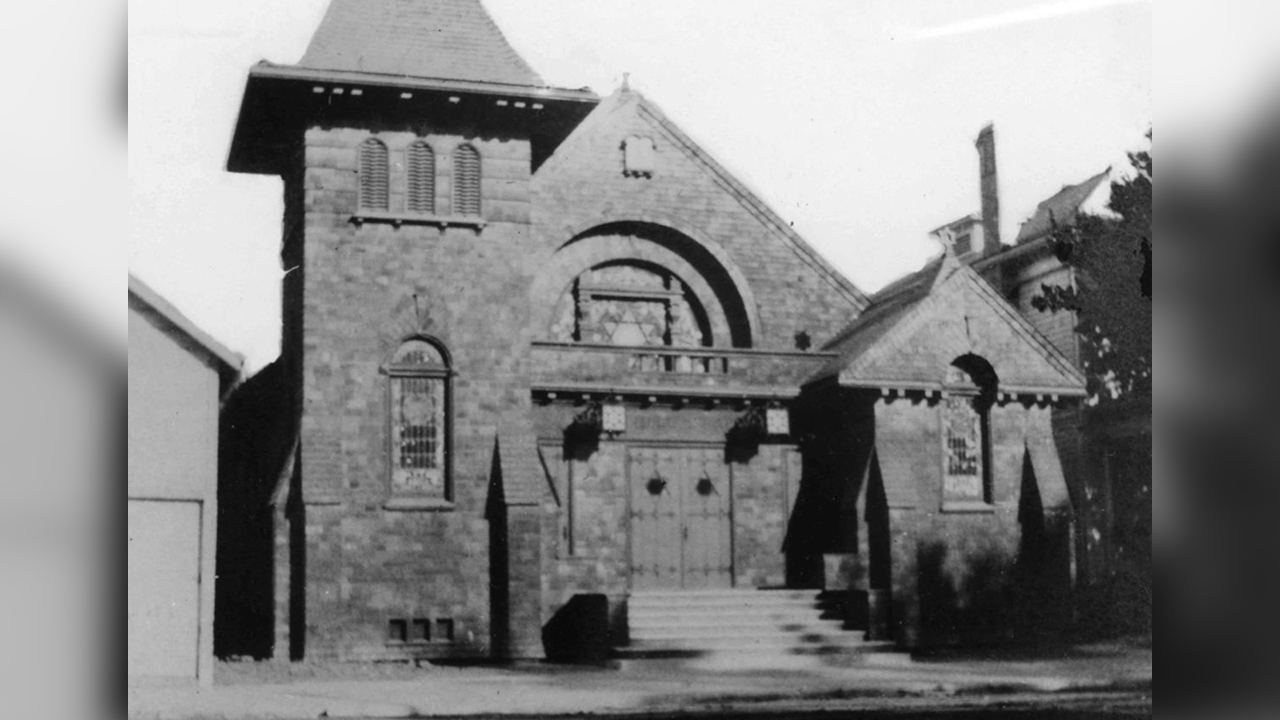
Temple Israel in Stockton just celebrated its 175th anniversary. Almost as old as the city itself, the congregation has an incredible history that’s been reflected in the pages of this publication from our earliest days.
Stockton was founded in 1849 and became a boom town amid the Gold Rush. Naturally, Jews moved there. They began to organize communal life in 1850 (or possibly late 1849) by establishing a benevolent society called Rhyim Ahoovim (Beloved Friends), which later became the congregation known today as Temple Israel.
Fast forward to 1912. Our pages mention that “Temple Israel, the present Reform congregation of Stockton, has the distinction of being one of the oldest three congregations in California.” (The other two are Congregation Emanu-El and Congregation Sherith Israel, both founded early in the Gold Rush in San Francisco.)
Originally Orthodox, the Stockton congregation changed affiliations in the early 1900s as the needs of the community shifted. Our publication, which was still young in those days, was founded by a Reform rabbi, so we didn’t lament the switch. But you can read between the lines and understand just how much it must have divided Stockton Jews.
“With the introduction of progressive religious thought, there followed a parting of the ways for many, as the result of which there exist today two smaller orthodox congregations beside Temple Israel, many years now the enthusiastic exponent of Reform Judaism,” we wrote.
“In 1906, a new synagogue was erected and — because of its simple harmonious beauty — creates a most restful and worshipful atmosphere and is looked upon by travelers as one of the most beautiful, in interior, of the smaller synagogues of the country.”

We also covered many of the temple’s rabbis, including the splashy arrival in 1914 of Rabbi Edgar Magnin, a “native son of California,” specifically San Francisco, who had recently graduated from rabbinical school. The event even drew two rabbis who traveled from San Francisco to show their support.
“On Friday evening, September 11th, and on Saturday morning, September 12th, impressive installation services were held at Temple Israel, Stockton. The temple was crowded to the doors, not only by the members of the congregation, but by several of its friends, many of whom attended services during the last fall holidays, and who made the acquaintance of Rabbi Magnin at that time.”
Magnin replaced Rabbi Louis Kopald, who wrote to our paper in 1913 to thank the congregation and say goodbye.
“May I take this method, therefore, of paying tribute to the officers and members of Temple Israel, Stockton, California, to which I have ministered since graduation, and for whose kindness, loyalty, encouragement and appreciation of efforts, I am and ever shall be deeply indebted.”
Magnin wrote a report from Stockton for our paper in 1915. He described the city’s Jewish organizations as “in a more than ideal condition.” Not only did the congregation have 64 members, he noted, but a new group had formed, “bringing together all of the young Jewish people of the town in a social way, at the same time affording them food for thought of a distinctly Jewish and educational nature.”
He also remarked on the wave of emigration from Russian lands to the U.S. that had reached Stockton.
“Let me mention in this connection our evening classes during the winter in the Sunday school rooms of the temple for the unnaturalized Jew who wanted to learn English,” Magnin wrote.
He didn’t end up staying long in Stockton, instead leaving for Los Angeles in 1915 and spending nearly seven decades at the large and prosperous Wilshire Boulevard Temple, where he was known as “rabbi to the stars.” (He was also related to the department store clan behind I. Magnin and J. Magnin.)

Keeping rabbis in Stockton seems to have been difficult at times.
We republished a 1927 article by Samuel Halperin from the Stockton Daily Independent titled “Stockton: A Typical Western Jewish Community.”
Halperin explained that Stockton was beset by common problems, such as “the change of rabbis, the periodical exodus of the retiring businessman to the larger city, an inevitable number of intermarriages and drifting away to Christian Science and other Christian denominations.”
He, too, mentioned immigrants, disparagingly noting “these parents think that a knowledge of Yiddish is an absolute requirement of being a Jew and that a mechanical knowledge of reading of Hebrew prayers is a sufficient education to insure the future of Judaism in Stockton.”
In 1942, we described the influx of Jewish men at the U.S. Air Force camp nearby who were attending both Temple Israel and Stockton’s Congregation Adath Yeshurun. “A large number of these men have just left civilian life and are more anxious to visit Houses of Worship,” we wrote amid World War II.
“Thanksgiving Day found many Jewish servicemen invited into the homes in Stockton. As a ‘highlight’ of the Thanksgiving Day service, Sgt. Harold Levine was married to Miss Judy Baskin at Temple Israel and at which time a number of servicemen were in attendance. For Chanukah, a special feast for all servicemen will be given by the entire Jewish community and all the old favorites, such as potato latkahs, will be featured.”
Over the decades, Stockton Jewish news showed up in our pages — from new rabbis and new buildings to social events and B’nai Brith luncheons. Around 70 miles from the newspaper’s offices in San Francisco, the Gold Country community has been and remains an integral part of Jewish Northern California.
Any issues with keeping rabbis in Stockton ended or at least took a very long pause in 1993 when Rabbi Jason Gwasdoff arrived. He and his wife, cantorial soloist Lindy Passer, will retire in mid-2026 after 33 years.
And as he said at Temple Israel’s 175th anniversary party on June 1, “To be part of that ongoing history of something that goes back to the very beginning of California, that was always an exciting thing.”