

Food coverage is supported by a generous donation from Susan and Moses Libitzky.
One of Chad Hyatt’s earliest food memories is eating shishlikis, a Hungarian potato dumpling fried in butter and breadcrumbs, made by his great-aunt Mona. He can easily recall not only the taste but the texture, too.
The recipe is included in his cookbook “The Mushroom Hunter’s Kitchen: A Culinary Homage to Wild and Cultivated Mushrooms,” published this month by The Experiment publishing company. (Hyatt self-published a version in 2018, but the new edition has been greatly expanded and rewritten.)
While the cookbook isn’t Jewish per se, the inclusion of family anecdotes shows how large a role Jewish food played in Hyatt’s early consciousness. Another food memory from childhood is his grandmother always serving chopped liver on a Triscuit. Perhaps it’s no surprise then, that whenever he thinks about beloved, late family members, he recalls in tandem what he ate with them.
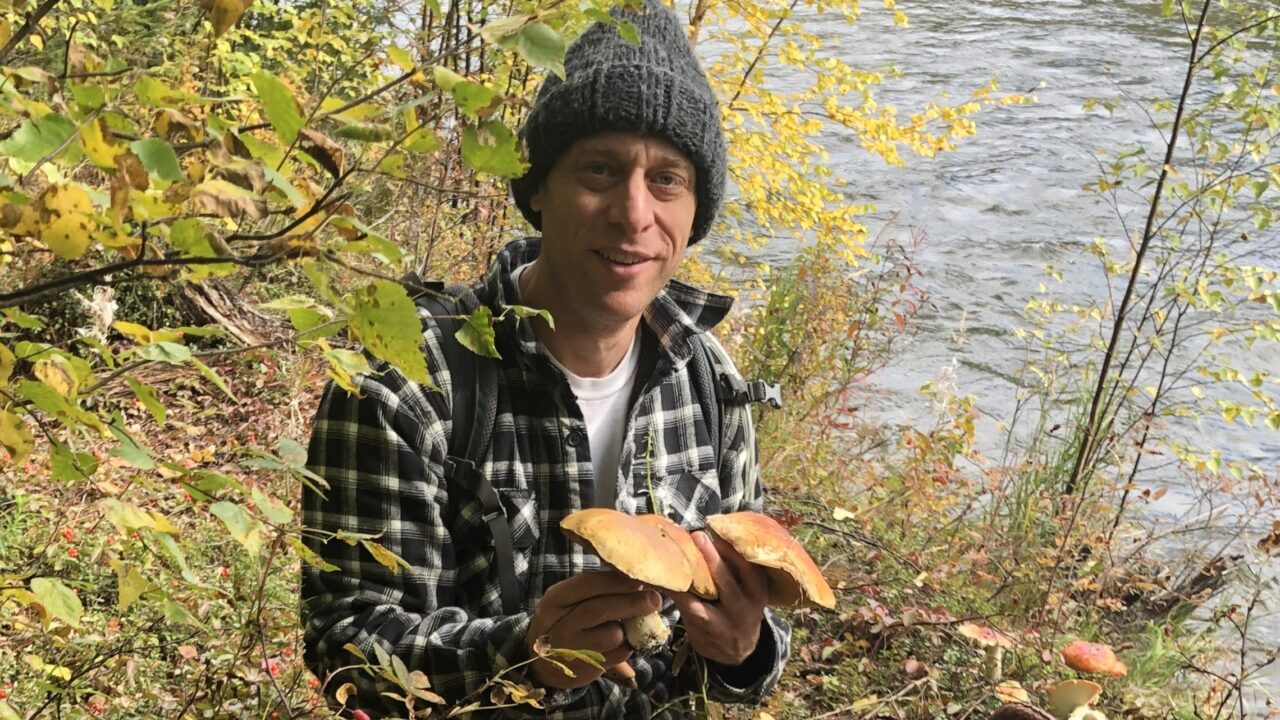
Hyatt, 50, is a San Jose chef who has two main, unrelated specialties: Spanish cuisine, and foraging and cooking with mushrooms. I first learned about him from another recent subject of my column who leads mushroom foraging walks, Carrie Staller.
Hyatt grew up in a semi-observant household in the Philadelphia suburb of Langhorne. Located in Bucks County, it wasn’t far from the “mushroom capital of the country” in Chester County.
Hyatt came to California to attend UC Davis and majored in physics. At first he worked as an engineer, but “I was always passionate about food,” he said. “I was often the best home cook you knew.”
More than a decade had passed when he had a vision of a different future. He followed it to culinary school and began working in restaurants, including Menlo Park’s Madera when it earned a Michelin star. Now Hyatt is a private chef and often cooks for large events.

His mushroom obsession began when he attended a mushroom-themed dinner at a restaurant, where he fell into conversation with the vendor who had supplied the mushrooms for the meal. “I already was very much an outdoors person,” he said. The only foraging book at the time in the mid-’80s was “Mushrooms Demystified” by David Arora, so he bought it and started looking.
“That first season was a really good year for porcini and chanterelles,” he said, “so I became hooked right away. I wanted an excuse to be outdoors, and was so into food already, so the two just paralleled each other. It just kind of spiraled into an obsession where I wanted to collect mushrooms to make something delicious to eat, and the search for one kind would lead to something else.”
As a mushroom novice, I found flipping through Hyatt’s book revelatory. Learning about the different kinds of mushrooms and their names is part of the fun — elfin saddles, turkey tails, shaggy parasols and golden robes among them. Hyatt wants home cooks to enjoy making the dishes, even if they’re not foragers. All call for a specific variety of mushroom, but come with a suggested substitute that’s more commonly found.
“The recipes use a mix, both cultivated and wild mushrooms, for the geeks like me who want to go chase it down. But at the same time, I wanted to be sure to make it usable for anyone, anywhere,” he said.
Hyatt’s palate is globally inspired, with dishes from cuisines around the globe, and the cookbook suggests ways to use mushrooms that the average cook would never think of.
“There are so many more things you can do than just sauté them and eat them with your eggs or put them on your pizza,” he said.
I was especially intrigued by the condiment and dessert sections, with recipes such as a matsutake mushroom fig preserve and a porcini and blueberry ice cream. Hyatt said it’s known among chefs that things that grow well together, like tomatoes and basil, for example, will often complement each other. Recalling a chef he once worked with who made a savory dish with chanterelles and blueberries, he decided to make ice cream with those two ingredients, and people loved it.
Hyatt’s litmus test for a successful dish is when people who don’t consider themselves mushroom enthusiasts like it. He once brought a galette with persimmons and candied chanterelles to a party, where people at first were reluctant to try it — until later when they ended up fighting over who got the last piece. That recipe is also in the book.
The dessert section is most surprising. While a sweet-flavored variety of mushrooms called candy caps frequently appear in sweet applications, Hyatt said there are other varieties of milder-tasting mushrooms that can be cooked in sweet syrup and then used in dessert dishes.
“People want to eat something good, and not be weirded out,” he said. “A lot of things can seem weird on the surface, but if the non-mushroom people love something I made, that’s my screening for whether something works or not.”

Among his Jewish recipes are the beloved shishlikis; stuffed cabbage with mushroom and kasha filling rather than meat; pierogi; porcini-potato latkes with salmon tartare; and a sweet noodle kugel based on his grandmother’s recipe. It’s a classic, with sour cream, raisins and sugar, but he swaps a cauliflower mushroom for the noodles. The pierogi with mushroom filling hold a special place in his memory. Once he became a chef, he made them for his elderly grandmother. Not only was it the last time he cooked for her, but she was eating very little by then, and she had seconds and thirds.
Hen-of-the-Woods and Broccoli Pierogi
Adapted from “The Mushroom Hunter’s Kitchen”
Serves 6
In this book full of sentimental recipes, this one may mean the most to me. Growing up, and even into my middle age, pierogi have always been a special treat for me and the rest of my family. Right before the first edition of this book went to print, I made pierogi for my 90-plus-year-old grandmother using this recipe and the very first wild hen-of-the-woods (Grifola frondosa) that I had ever collected. It was the last time I cooked for my grandmother, and she went back for seconds and thirds at a time in her life where she would rarely finish her first portion.
Pierogi dough
- 2¾ cups plus 1 Tbs. all-purpose flour
- Generous pinch of salt
- 1 cup sour cream
- 2 egg yolks
- 1 Tbs. canola oil
- 1 Tbs. unsalted butter, melted
Hen and broccoli filling
- ½ pound broccoli, cut into florets
- 1 lb. hen-of-the-woods (maitake), cut into ½-inch pieces
- 1 Tbs. oil
- 2 garlic cloves, minced
- ½ cup dry white wine
- 1 Tbs. unsalted butter
Garnish
- 2 large yellow onions, thinly sliced
- 2 Tbs. oil
- 1 Tbs. butter
- Sour cream
Instructions
- To make the pierogi dough, place the flour in a large bowl and mix in the salt. In another bowl, mix the sour cream, egg yolks, canola oil and melted butter together.
- Tip the flour onto a clean surface and make a well in the center. Add the wet ingredients to the well and use a fork to gradually work the flour into the wet ingredients. Work as much flour into the mix as possible with the fork, then use your fingers to pull the sticky dough bits off the fork and add them back to the dough. Use your hands to knead until it comes together to form a very smooth dough. This shouldn’t take more than a few minutes. If it feels a bit too wet and sticky, you can knead in a little more flour.
- Cover the dough tightly with plastic wrap, and let it rest at room temperature for at least 30 minutes or up to 4 hours to relax the gluten. If leaving the dough for more than 1 hour, refrigerate it. Let the dough come to room temperature before rolling out.
- To make the hen and broccoli filling, bring a large pot of salted water to a boil over high heat. Add the broccoli florets and cook until the color sets to a deep dark green and the broccoli is crisp-tender, 1 to 2 minutes. Drain the broccoli and immediately plunge it into a large bowl filled with ice water to stop the cooking process. When cool, drain the broccoli well and set it aside.
- Dry or wet sauté the hen-of-the-woods (depending on their moisture level), using the oil. When lightly browned, increase the heat to medium, toss in the garlic, and cook for another 30 seconds, until fragrant. Pour in the wine and scrape any browned bits from the bottom of the pan. When the wine is almost all evaporated, turn off the heat and stir in the butter to coat the mushrooms. Add salt to taste. Let cool slightly.
- Pulse the mushrooms and broccoli in a food processor until minced and thoroughly mixed, but not puréed. Adjust the seasoning to taste.
- Cut off a large piece of the dough ball and dust your work surface and the dough with a little bit of flour. Roll out the dough into a rectangle 1⁄16-inch thick, dusting the work surface, rolling pin, and dough with flour as needed to prevent sticking. If your dough is snapping back too much to finish rolling out, cover and let rest another 15 to 30 minutes. Use a cookie cutter, ring mold or coffee cup to cut circles out of the dough about 3 inches in diameter.
- Put a generous spoonful of filling in the center of each circle. Carefully fold the circle in half over the filling. Seal the edge by pinching the dough firmly between your thumb and forefinger or pressing with the tines of a fork, starting at one corner and working your way around to the other corner. Do your best to gently press out any air pockets as you seal up each pierogi. Set the pierogi on a floured tray, or a piece of parchment paper, making sure they don’t touch each other to prevent sticking. Repeat the rolling, filling, and sealing until all the dough is used up. The dough scraps can be kneaded back together and rerolled up to 3 times. (You can freeze the pierogi at this point if you like. Freeze in a single layer, being careful not to let them touch, until they are completely frozen, then transfer to an airtight container. They will last for up to 1 month in the freezer and can be boiled from frozen.)
- To make the garnish, heat a heavy-bottomed pan over medium heat. Add 1 tablespoon of the oil, then add the onions. Sauté, stirring regularly, until the onions are lightly browned, about 10 minutes. Season with salt, and set aside.
- Generously oil a rimmed baking sheet or large plate. Bring a large pot of salted water to a boil over high heat. Boil the pierogi in batches of 4 to 7 at a time, being sure not to crowd them too much. When they float to the top, cook about 20 seconds longer, then scoop them out with a spider skimmer or slotted spoon, drain well, and transfer to the prepared baking sheet or plate.
- Heat a large, heavy-bottomed pan over medium heat. Add the butter and the remaining oil. Cooking in batches, add some of the pierogi to the pan in a single layer. When the bottoms are golden brown, carefully flip each pierogi and brown the other side, about 3 minutes per side. Wipe out the pan and add more oil and butter between each batch. Serve hot with a dollop of sour cream and a generous helping of sautéed onions.
Mushroom Substitutions: Almost any mushroom will work here, but it works best with very flavorful mushrooms like mature porcini, various Suillus, Leccinum and portabella.