

Updated Dec. 15
From afar, it looks like charred wood has been framed and hung on a wall. Step closer, and the faint outline of a menorah reveals itself on the blackened block.
Photographer Ari Salomon created the artwork by engraving a menorah on a scrap of cedar, which he turned into charcoal by placing the wood in a metal box heated in a controlled fire. As a visual guide for the engraving, he used a photo of a menorah damaged when wildfires swept through the L.A. area earlier this year.
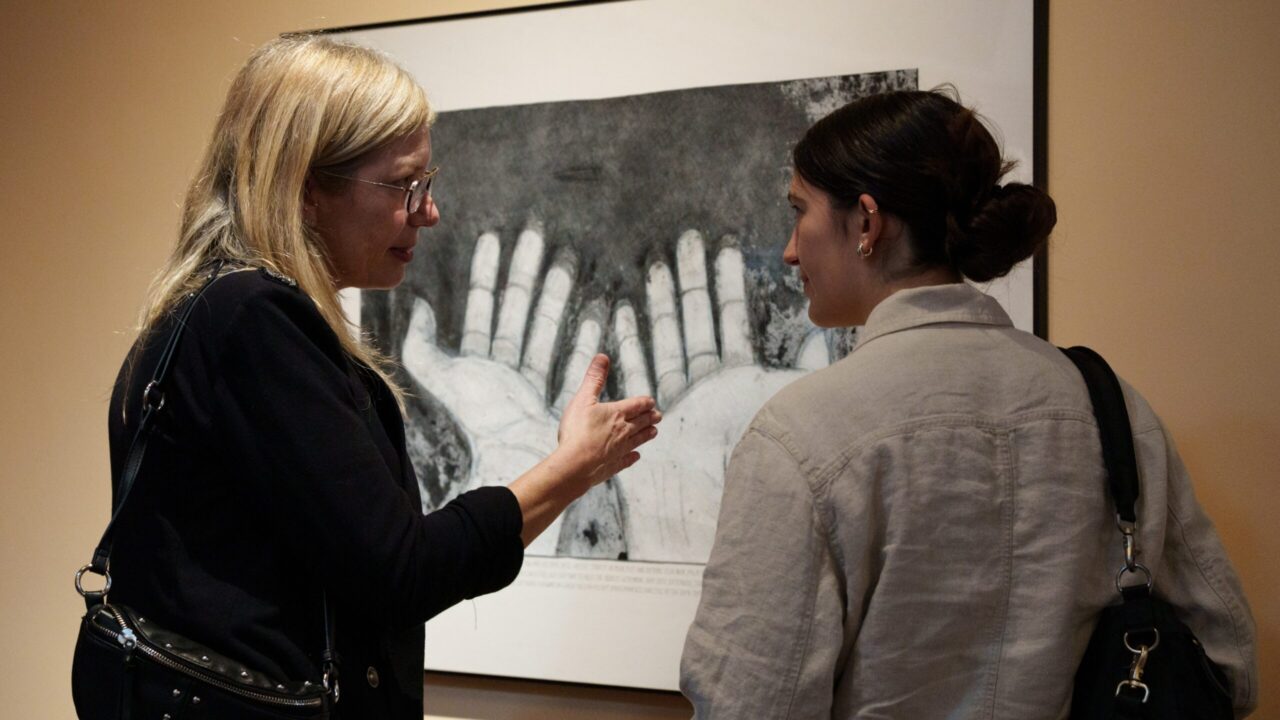
The work is part of “Burn Line,” Salomon’s ongoing series that turns objects lost or damaged in Southern California wildfires — ritual items, shoes, artwork — into art that meditates on loss, resilience and transformation. Salomon created the pieces in collaboration with survivors of 2024 and 2025 L.A.-area blazes, some of whom were on hand, and clearly emotional, as Salomon detailed the project on Sunday at the Magnes Collection of Jewish Art and Life in Berkeley.

The menorah piece was part of a showcase of work by the fellows of LABA Bay Area, the local hub of an international creative laboratory for Jewish culture. LABA uses the study of classical Jewish texts to inspire art, conversation and community (laba means “lava” in Hebrew). The 2025 Bay Area participants include visual artists, filmmakers, a dance educator, a playwright and a poet, all coalescing around this year’s LABA theme of “change.” (Previous years’ themes have included “drunk” and “taboo.”) Their responses to that theme ranged from visual art to a dance performance, a short play, films, music and interactive installations.
While classic Jewish writings fuel the creations, LABA doesn’t require the works to be identifiably Jewish or directly reference the words that inspired them.
Instead, Jewish text study “fertilizes the work you’re seeing today,” Elissa Strauss, LABA Bay Area’s artistic director, said at Sunday’s event. “It’s really about creating an umbilical cord between the ancient imagination and the imagination of the present so we can reimagine a future through art and culture and community.”
Each of the works at the Magnes was inspired by a particular text. Salomon linked “Burn Line” to a quote from the Book of Exodus: “God spoke to Moses from within the burning bush, and behold, the bush was bursting with fire, but the bush was not consumed.”

The link between objects and memory also animates Hila Amram’s installation “A Hole is to dig,” which presents a curated set of items from the Magnes collection: a rusty watch, a tarnished silver knife, a replica of porcelain kosher tableware from the Queen Mary ocean liner, which once carried Jewish immigrants from Europe to the United States. Amram assembled the objects into a temporary portable kitchen that folds into a suitcase, a symbol of surrendering the settled for the uncharted.
The installation “speaks about stepping out of one’s comfort zone, moving away from a physical place, a cultural identity and the intimate voices of family and origin toward a new land that only reveals itself along the way,” Amram told J.
The Israeli artist, who now lives in San Francisco, was inspired by a verse from Genesis: “Go forth from your land, from your birthplace and from your father’s house, to the land that I will show you.”
“It can be read both as a concrete call to Abraham and as a deep human experience of leaving the familiar for the unknown,” she said.
Near Amram’s installation visitors could enter a booth and pick up a wall-mounted phone, where they’d hear questions like, “How do we stay focused on being a holy people?” and “How do we not let our fears own us?”

Next to the booth, a series of gold Motorola Razr phones hung in a fabric cradle above a table covered with brightly colored old-style landlines. Multidisciplinary filmmaker, artist, journalist and educator Samantha Grant (also a J. board member) encouraged viewers to take any of the phones somewhere private and use them to respond aloud to the prompt they’d just heard.
The interactive conceptual work, she said, takes partial inspiration from hitbodedut, a Jewish meditative practice of speaking one’s innermost thoughts aloud to cultivate a personal, intimate relationship with God.
Called “The I and Thou Phone,” the project was inspired by 20th century theologian Martin Buber’s concept of the authentic, respectful connections that can emerge when people treat others as whole human beings rather than objects.
The artist believes such mindful dialogue has never been more necessary in the Jewish community.
“There’s been a real lack of conversation and an inability of people being willing to talk about things because everyone is terrified of saying the wrong things or hurting someone’s feelings or upsetting someone,” said Grant. “But not talking when something horrible is happening is just as bad as saying the wrong thing.”
Other LABA fellows with work on display included artist and art historian Michelle Brenner; writer and playwright Maya De La Rosa-Cohen; filmmaker and musician Chance Reiniesch; dance educator Liv Schaffer; and Ronit Shalem, a contemporary visual artist originally from Israel.
Among the bunch were also two Northern California rabbis: Genevieve Greinetz and Chel Mandell, the founder and creative director of Tzimtzum, a Santa Cruz community that centers on the intersection of Jewish experience and queer, trans and gender-expansive identities. In the atmospheric and vulnerable film “On the Water, I Disappear,” Mandell — a trans rabbi and surfer — ponders the intersection of these overlapping identities against footage of the foggy coastline and a lilting piano score. The film, while focused on Mandell’s own experience, also functions as a larger musing on change: how shifting tides, be they personal or communal, can reflect both rupture and renewal.
In January, a new cohort of 10 fellows will begin work on the 2026 LABA theme, “name.” The fellows “will be jumping headlong into the potency and mystery” of names “and humanity’s strange relationship with language overall.”
Update on Dec. 15: Ari Salomon’s last name was misspelled in a photo caption and credit due to an editing error. It has been corrected.