

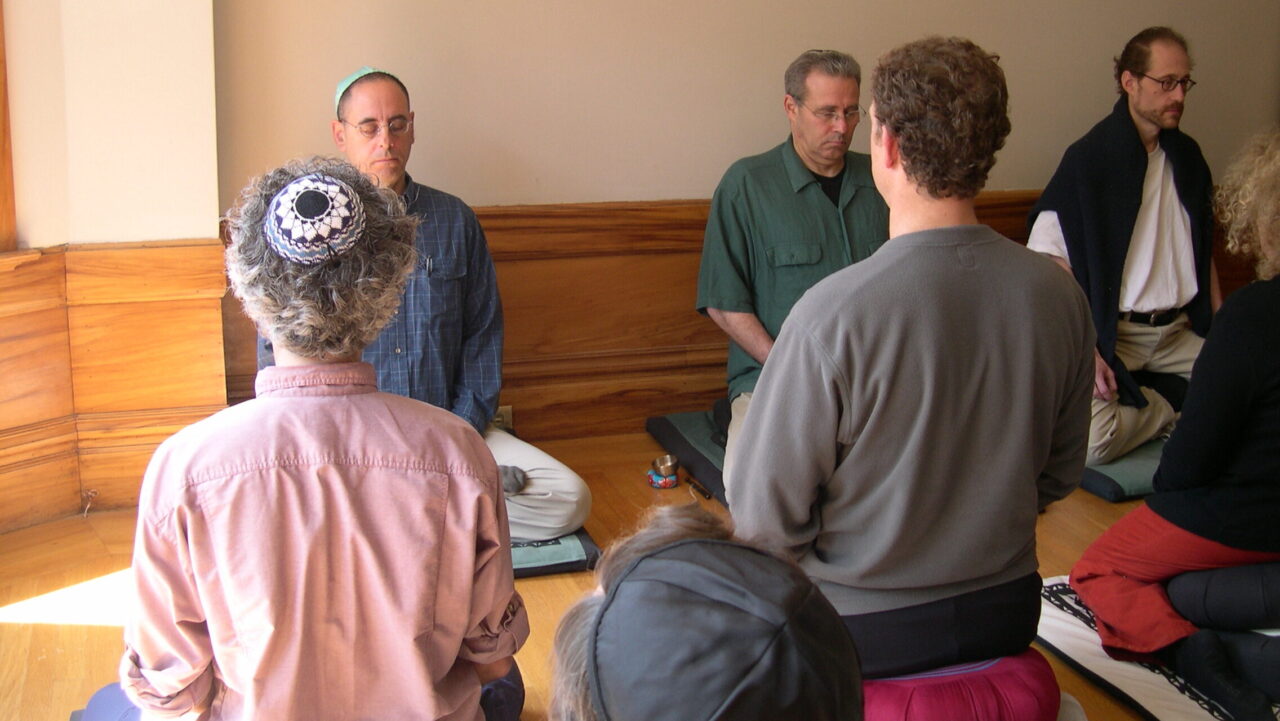
It’s no longer unusual to meet synagogue-goers who meditate regularly. Some do it in a specifically Jewish way, while others use Buddhist meditation practices to complement their Jewish spiritual lives.
Few institutions have played a greater role in spreading meditation among mainstream Jews in America than Makor Or, the meditation center housed within Congregation Beth Sholom in San Francisco. This month, the Conservative synagogue in the Richmond District is marking a milestone: 25 years of Jews sitting together in silence. (Though I’m a member of Beth Sholom, I’m a total newbie to the world of Makor Or.)
Makor Or was co-founded by poet and Zen priest Norman Fischer and the late Beth Sholom Rabbi Alan Lew, who wrote books like “One God Clapping: The Spiritual Path of a Zen Rabbi” and the High Holidays classic “This Is Real and You Are Completely Unprepared.”
When Lew died at the age of 65 in 2009, it seemed that Makor Or might die with him. Makor Or had its years in the wilderness but is back where it began, operating as a program of Beth Sholom. Today it’s led by Rabbi Dorothy Richman, Beth Sholom’s rabbi emerita and one of Lew and Fischer’s early Makor Or students.
I spoke with Richman ahead of the anniversary events to learn about Makor Or’s legacy, its future and the role of meditation in American Judaism.
This interview has been edited for length and clarity.

What was in the air 25 years ago that allowed a Conservative shul to start its own meditation center? I know Makor Or isn’t the only Jewish meditation program that was created around the turn of the millennium.
So for me it starts with the great Rabbi Rachel Cowan of blessed memory, who really created the whole field of Jewish meditation. She built the field as it is now; she seeded it. She was working at the Nathan Cummings Foundation, and they started a program while I was still in rabbinical school that brought rabbis to retreat centers for Jewish meditation retreats. I was in my last year of rabbinical school, and I asked if I, a rabbinical student, could go. And that was really my first true experience of Jewish meditation.
And Makor Or came out of that stew of people and ideas that Rabbi Cowan was bringing together?
I actually have a document with the mission statement that was written by Rabbi Lew at the founding in 1999. And in it, he talks about Rachel Cowan. He talks about the then very popular sociologist Robert Wuthnow [author of “The Restructuring of American Religion” and “What Happens When We Practice Religion?”]. Rabbi Lew talks specifically about Makor Or being a model of practice spirituality, and that the difference between Makor Or and other programs is that it is integrated with the life of the synagogue.
I’m glad you brought that up. When I moved here a decade ago, I wouldn’t have been surprised if there was a Jewish meditation center in San Francisco. What surprised me is that it exists inside of a Conservative shul, and, in fact, there is significant overlap between the meditators and the minyan regulars.
That was intentional. There were people who got into minyan through meditation. And there were minyan people who had never meditated before, who started to meditate because that was available.
The vision was, meditation would not be an a la carte extra. It was seen as a fully integrated spiritual practice that would be transformative for individuals and for synagogue life; that was the idea. And you had in Lew and Fischer, two generational talents and best friends, extraordinary spiritual leaders, who created this together.
What was Makor Or like in the early days? I’ve heard talk of the Practice Period, which sounds pretty intense.
To be a part of a Practice Period at Makor Or was a nine-month commitment, where people had to come minimally three times a week to sit [meditate] and daven [pray], on top of classes, on top of retreats, on top of chevruta [one-on-one study with a regular partner]. It was a major transformational experience for many, many people. To give that much — it was transformational. People went to rabbinical school because of it. It really changed people’s lives.
I want to read you a quote from Rabbi Lew in one of the first articles we wrote about Makor Or, back in 2001: “I’m passionately indifferent to the question of what precedent there is in Judaism for meditation. At Makor Or, we freely admit that the meditation we learn comes from Buddhist teachings. But then, Judaism has always borrowed techniques from other cultures when it served to make Judaism more vital.”
That’s part of what happened early in the Jewish meditation world: We had to decide if we are mainly influenced by practices we learned outside of Judaism, or should we be doing more Jewish contemplative practices that still exist and are still being practiced? Or, as a third option, are these distinctions, at some level, not the full story?
We lost a lot of what we had as a contemplative tradition in practices that were never really written down or discussed. We are, at some level, consciously or unconsciously, plugging back into a history that was clearly ours, even if we don’t know exactly what its mechanics were.
Is there a concrete sense of like, where and when these now lost things were being practiced? Or is it just a sense that this must have been going on at some point?
We do have some textual proof of contemplative practice, as far back as the Mishnah, which tells that the Hasidim Harishonim, the Early Pious Ones, would sit for an hour before they would pray in order to turn their hearts, incline their hearts toward the One. So what were they doing?
Well, they’re having a sit, I guess.
Makor Or 25th anniversary events
Intro to Jewish Meditation, 5-6 p.m., Fri. Dec. 5., and 10-11 a.m. Sat., Dec. 6. Free.
Celebrate and Rededicate: Makor Or at 25, 9:15-9:45 a.m., Sun., Dec. 14. Free.
Hanukkah Meditation Retreat, 10 a.m.-5 p.m., Sun., Dec. 14. $54 in person; $36 on Zoom.