

Food coverage is supported by a generous donation from Susan and Moses Libitzky.
As 2025 came to an end, predictions for the “it” veggie of 2026 started popping up across the culinary world. The response was overwhelming, and unlikely: cabbage.
For some, cabbage feels like an afterthought. But for me, an Ashkenazi Jew who grew up in a cold climate, it’s comfort food. Ever versatile, cabbage can be enjoyed raw, in soups, steamed, grilled, fermented, roasted or fried. Best of all, it’s affordable and long-lasting. It’s a trend worth savoring, a small serving of hope for 2026, and a chance for me to highlight one of my favorite underrated vegetables.
There’s no better time to celebrate vegetables than on the holiday of Tu Bishvat, which is much like Earth Day and is known as the “new year for the trees.” It marks the start of a new agricultural growth cycle and serves as an environmental awareness day across Israel and beyond. It’s often celebrated by planting trees, eating fruit, spending time outside and hosting Tu Bishvat seders.
These festive meals highlight the Seven Species, or Shivat HaMinim, crops mentioned in the Bible as being abundant in the Land of Israel: wheat, barley, grapes, figs, pomegranates, olives and dates. Each carries spiritual meaning and significance.
For the past few years, I’ve hosted and catered numerous Tu Bishvat meals. With its focus on the environment, the holiday offers a perfect opportunity to share a plant-based meal with others, something that’s good for the planet and your health. I aim to feature each of the Seven Species at least once on my menus,from cocktails to salads and desserts, finding creative ways to use dates and pomegranates, whipping up hearty barley-based salads and sticky fig-filled desserts.
This year, I’m hosting two Tu Bishvat seders. One is a Tu Bishvat-inspired meal for my women’s Shabbat Club, The Tish, which is Yiddish for table. Women from the Chicago area will gather to nosh, drink and connect while giving back to charitable causes. The second seder will be held in partnership with a local synagogue, creating a Tu Bishvat experience around a communal dinner table. If you know anyone in the Chicago area, send them my way. On the menu for both events is roasted cabbage with date and olive salsa.
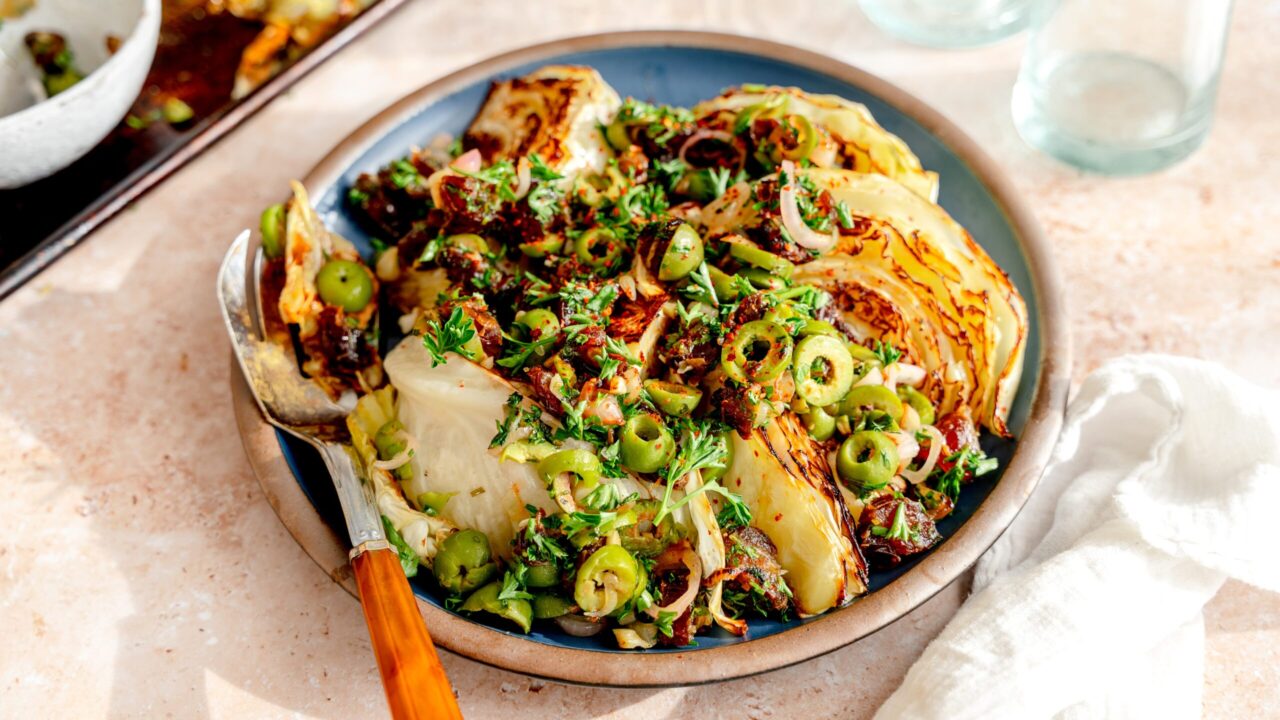
When roasted, cabbage becomes sweet and slightly nutty, with crispy caramelized edges and buttery centers. High heat brings out the natural sugars, toning down the pungency of raw cabbage. It’s paired with a sweet and salty “salsa” of Medjool dates, briny Castelvetrano olives, garlic and fresh parsley. You can substitute dried figs for dates, and add an optional tablespoon of chopped capers. For a smoother texture, pulse the mixture in a food processor until finely chopped.
This is a side dish that will steal the show and prove that cabbage deserves its moment in the spotlight.
Roasted Cabbage With Date and Olive Salsa
Serves 4 to 6
Total time: 40 minutes
For the cabbage:
- 4 Tbs. extra-virgin olive oil, divided
- 1 medium green cabbage, cut into 8 wedges
- ½ tsp. kosher salt
For the salsa:
- 2 medium shallots, thinly sliced
- 2 cloves garlic, minced
- ½ cup Castelvetrano olives, pitted and coarsely chopped
- 8 Medjool dates, pitted and chopped
- ½ cup fresh parsley, roughly chopped
- ½ tsp. lemon zest
- 1 Tbs. lemon Juice
- 1 tsp. Aleppo chile pepper
For cabbage: Preheat the oven to 450F. Place a baking sheet in the oven to preheat. Meanwhile, use a pastry brush to apply 2 Tbs. of oil to the cut sides of the cabbage wedges. Season liberally with salt.
Carefully remove the hot baking sheet from the oven. Arrange the cabbage wedges cut-side down on the baking sheet.
Return the baking sheet to the oven and roast for 30 minutes, flipping halfway through, until the cabbage is fork-tender and deeply caramelized.
For the salsa: Heat the remaining 2 Tbs. of olive oil in a skillet over medium-high heat. Add the shallots, and let cook for 2 to 3 minutes to soften.
Add the garlic, chopped olives and dates. Cook for an additional 2 minutes until the garlic is fragrant.
Add the parsley, lemon zest, lemon juice and Aleppo chile pepper. Season with salt and pepper, to taste. Remove from heat.
Transfer the roasted cabbage to a serving dish and spoon the salsa over top. Drizzle with extra olive oil, to serve.