

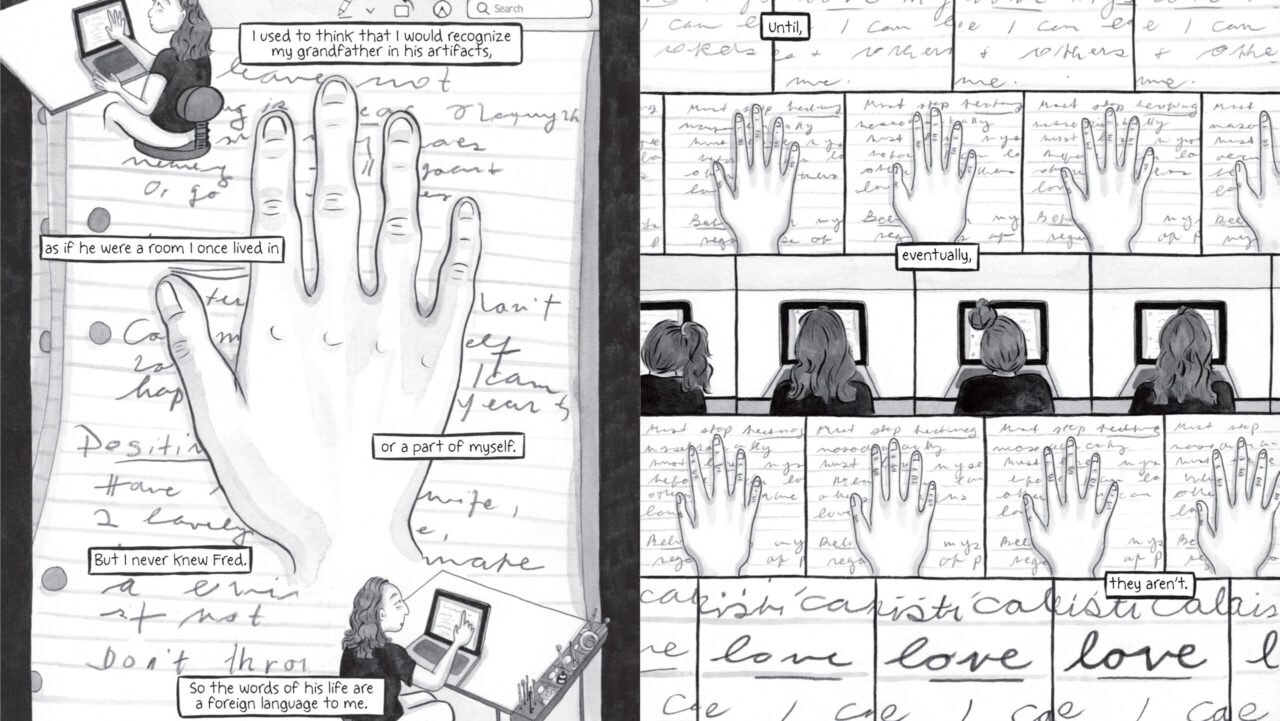
What would it mean to bring a loved one back to life, especially if you’ve never met? That’s one of the questions that Amy Kurzweil, a New Yorker cartoonist and author of two graphic memoirs, has sought to answer while sifting through history, the future and Jewish identity.
In “Artificial: A Love Story,” published in 2023, she examined the attempt by her father, noted futurist and inventor Ray Kurzweil, to create an AI chatbot based on his own pianist father’s writings. Exploring tech, love and the nature of art, “Artificial” won several awards and made it onto “best book” lists by NPR, the New Yorker, the American Library Association and others.

Her first graphic memoir, “Flying Couch,” likewise told a personal story. Published in 2016, it documented her grandmother’s escape from the Warsaw Ghetto and what it means to be part of a family.
Last month, Kutzweil joined the 2026 cohort of 10 local artists who will spend the year exploring the theme of “name” through Jewish texts with LABA Bay, the Jewish “culture lab.”
Kurzweil, 39, teaches cartooning in online classes and in-person workshops in San Francisco, where she lives. Her creative story-telling has also included a 2024 graphic op-ed for the Los Angeles Times titled “Op-comic: A Palestinian, an Israeli and a path to peace.”
This interview has been edited for length and clarity.
Tell me a bit about how your Jewishness intersects your work as a visual artist.
I grew up in Newton, Massachusetts, thinking that half the world was Jewish. It tells you something about how ensconced I was in a Jewish community.
I was always curious what it meant to me to be Jewish, and the answer I came to in my work is just that I’m Jewish because my family’s Jewish. It’s the most simple answer. It’s like, this is the tradition that comes from your mother and her mother and her mother, and that’s just what it is. I am who I am because of that. A lot of my work has been exploring those inheritances.
How did you decide to write your first memoir, “Flying Couch,” about your grandmother?
I had a creative writing teacher once who told me: You’re just going to write two books for the rest of your life. One about your mother. One about your father.
My first book, which is what really got me into comics, was about my grandmother on my mother’s side and her Holocaust story, surviving the Warsaw Ghetto, told in her own words.
I was really, really focused on working with her own words, and that became — aesthetically, historically and ethically — important to my storytelling. I became so interested and appreciative of this primary document I had, which was her oral history testimony, and realized that our relationship to the past is mediated through documentation, and documentation depends a lot on technology.
When I finished my first book, which was my way of looking at my mother and her parents, I thought, OK, it’s time to turn to the inheritance of my father’s side.
And that was a whole new project. How did that start?
The amount of documentation I had of my grandparents, especially my grandfather, whom I’d never met, was enormous and overwhelming. My grandfather died in 1970. He came from Vienna and immigrated in 1938, a month before Kristallnacht [helped by an American benefactor who admired his music]. He got out because he was this gifted artist, and then made a life in America, which was characterized by frustration, with moments of artistic success. This woman saved his life because he was such a great artistic genius, and then that just became sort of the narrative — the way you thrive is through art. And I related to that a lot.
I had this gift of this enormous storage unit full of documents that related to my grandfather, and this was really the only way that I could get to know him.
There was a lot there. There was my father’s relationship to his father, to death, to preservation. And then all of these things kind of came to a head around this project that my father embarked on, which was to build a chatbot from the documents of my grandfather.
At the time, this kind of technology — large language models — was extremely young, and nobody knew what a chatbot was. This was 2018. Now, of course, everybody has very strong feelings about chatbots, but this was a sci-fi seeming project at the time that now, interestingly, feels really quaint.
The chatbot we built was so simple, in a beautiful way, very simple compared with what large language models can do today.
The book became a reckoning with technology and archives and the past and what we can preserve and what we can’t. That book took me seven years to create.
You’re participating in the LABA cohort this year, where artists come together to study Jewish texts and produce new artistic work. This year on the theme of “name.” How’s that going?
LABA is great because they put you in community and throw you at these interesting texts with super-interesting teachers, and then you see what happens in your brain, which I’ve really, really enjoyed. I wish it could be every weekend. So fun.
I thought that an encounter with Jewish texts about language and names would be interesting in helping me reflect on this book that I’m working on, which is a craft book about graphic memoir and about the process of using words and images to document experience and to document the past.
There’s a way in which understanding [graphic memoir] as a form is new-ish. It kind of goes back to “Maus” [by Art Spiegelman], which gained popularity in the ’90s. But there have always been people who’ve used words and images to tell personal stories. That’s not that new.
It’s such an interesting and suitable way to document personal experience and memory. For me, it has to do with the immediacy and directness of the mark on the page. It’s like when you see somebody’s handwriting and the way that you really feel that person’s presence, versus a typed letter.
You’re so interested in how we keep hold of the past. Why is that?
I think there is something in Jewish culture, that because we come from this history of annihilation, there is so much interest in documentation and the past. We’re a people of letters and texts.
It’s meaningful to learn about family members who had lives that seemed dignified — or there are all these interesting pockets of Jewish history where Jewish people are succeeding — and then there are these stories where they’re cast out. We have a lot of both registers in our history, absolutely.