

A new artificial intelligence platform is transforming access to one of the largest and most important collections documenting Jewish life in Iraq.
The Voices from the Archive project at judeoiraq.org uses AI to translate, categorize and help search the vast Iraqi Jewish Archive, opening a door to tens of thousands of records that had been largely inaccessible to the public.
The platform was developed by Oakland chemical engineer David Breslauer, whose own family fled Baghdad in 1950 amid rising persecution. What began as a personal search for traces of his family history has evolved into a large-scale digital project, with Breslauer using AI to process thousands of archival documents into searchable text with English translations.
“I’ve put in thousands of hours and thousands of dollars into this because it’s just a pure passion project for me,” Breslauer told J. “This is an aging community, and that generation is not going to be around much longer, so I felt like it was sort of a personal race to get it published so that people could see it and tell their children about it.”
Historically, Iraq was home to one of the oldest Jewish communities in the world, dating back over 2,500 years. Its Jewish population largely disappeared in the late 1940s and early 1950s, when most Iraqi Jews were stripped of their citizenship and fled the country. Five years ago, the AFP reported that Iraq’s Jewish population, estimated at 150,000 in the mid-1940s, had shrunk to four.
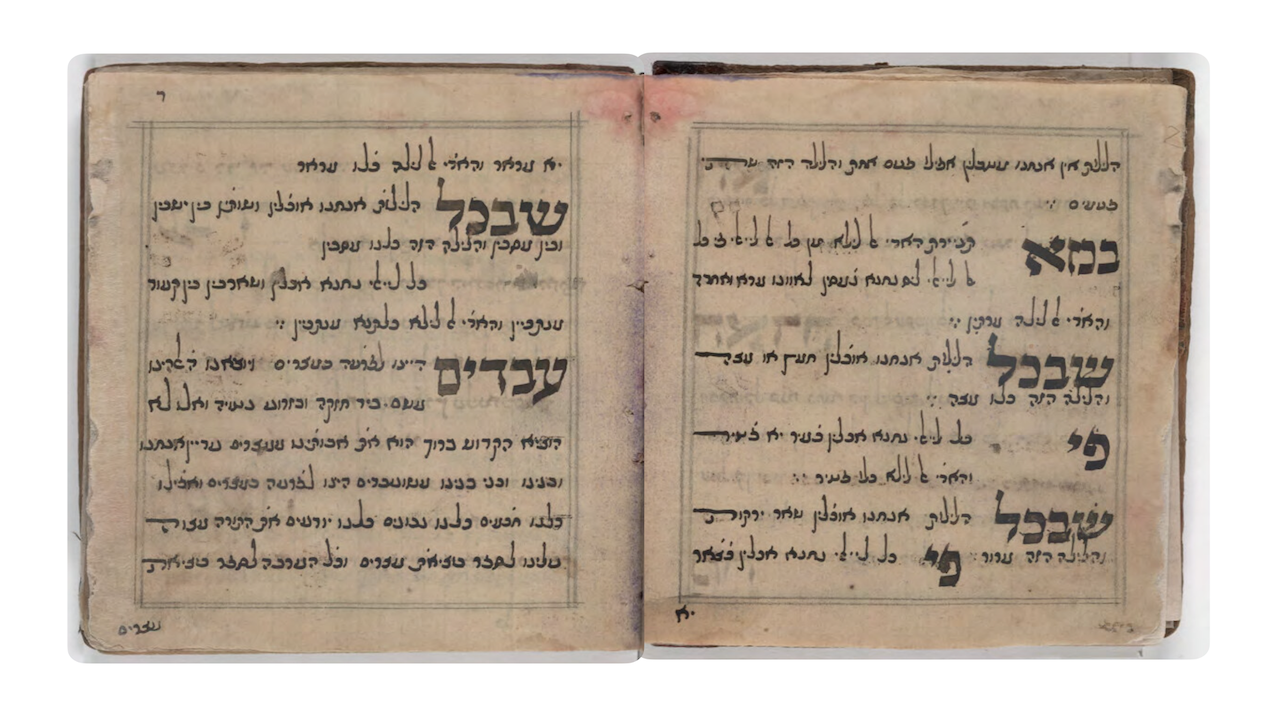
The Iraqi Jewish Archive, also known as the Iraqi Mukhabarat Archive, is a collection of more than 2,700 books and tens of thousands of historical documents that chronicle the life, culture and institutions of Iraq’s Jewish community before its mass displacement.
The archive includes school records, religious texts, legal documents, personal letters, photographs and communal records spanning hundreds of years through the 1970s. The trove was discovered in 2003 by the U.S. Army in a flooded basement of an Iraqi intelligence building in Baghdad. The documents were preserved and digitized by the U.S. National Archives.
Among the materials are items like a handwritten 1902 haggadah with paragraph-by-paragraph translation of the Hebrew text to Judeo-Arabic, a 1962 letter between local basketball clubs requesting a friendly match against each other and a 1950 offer from a travel company about arranging transportation for the airlift of Iraq’s Jews to Israel via Iran as part of Operation Ezra and Nehemiah.

For years, researchers manually sifted through thousands of pages without the ability to search by keyword or language, making meaningful access extraordinarily difficult.
“It was sort of an insurmountable challenge,” Breslauer said. “Imagine it was like a stack of 150,000 pages, kind of loosely organized into 3,000 different files, and you’re just online, scrolling through. Some are in Arabic, some are in Judeo-Arabic, a few are in English. Some are handwritten and some are typed.”
When Breslauer began the project two years ago, he ran into major challenges using AI to try to translate and organize the documents, as early models often produced inaccurate translations or “hallucinated” content that had nothing to do with the original text.
Standard Arabic, and particularly handwritten Arabic, is difficult for software to translate and transcribe, Breslauer said. Most AI models are trained in English, and Arabic is grammatically quite different and includes many regional dialects.
Judeo-Arabic, the dialect used by the Iraqi Jewish community, is even more difficult for AI to understand. Not only is it a rare and regionally specific language, but it utilizes Arabic words written in Hebrew script, requiring models to handle multiple linguistic systems at once.
As AI tools started dramatically improving over the past year or so, Breslauer was able to train his model to run these linguistic systems and build a custom pipeline designed for the Iraqi Jewish Archive to process the images, ingest them, transcribe them, translate the text and make it searchable.
In addition to basic search functionality, the platform features an AI-powered Q&A interface that lets people ask questions in English and receive relevant documents, translations and contextual insights drawn directly from the archive. Because AI search is more flexible than simply looking for search terms, you can get unexpected answers. Breslauer asked the system to find something unusual, for example, and it surfaced a tongue twister once practiced by students in a Jewish elementary school.
For Breslauer, the work is deeply personal. While manually browsing the Iraqi Jewish Archive years ago, he stumbled upon a document mentioning his great uncle, which sparked his determination to make the entire collection searchable. With his AI platform, he has since uncovered additional family records, including school test scores and official documents tied to his relatives’ lives in Iraq.
S.F-based nonprofit JIMENA: Jews Indigenous to the Middle East and North Africa serves as the project’s fiscal sponsor and sees the platform as a major breakthrough in preserving and sharing Mizrahi Jewish heritage. (So far Breslauer has paid for the project himself, but he is looking for donors to upgrade the AI functionality.)
“For nearly 20 years, the Iraqi Jewish Archive has remained in physical limbo and locked inside archival platforms that few people could access or read,” JIMENA executive director Sarah Levin said in a statement. “This project represents a breakthrough in how we preserve and share the heritage of Jews from the Middle East and North Africa.”