
Food coverage is supported by a generous donation from Susan and Moses Libitzky.
“I’m obsessed with cabbage,” Bay Area chef Aliza Grayevsky Somekh said at a recent cooking workshop. She isn’t the only one.
The New York Times pronounced the cruciferous staple the darling of restaurant menus back in 2024. The cabbage craze has continued rolling along, like kale and Brussels sprouts trends did before it.
Of course, for Ashkenazi Jews, cabbage has long been a staple. Many of us grew up on our bubbe’s decidedly not-trendy stuffed cabbage, often bathed in sweet-and-sour tomato sauce.
I remember when I visited Jules, the San Francisco pizza restaurant opened last summer by chef Max Blachman-Gentile, the charred cabbage appetizer was one of the most memorable dishes on the menu.
Somekh, an Oakland resident first covered in this column in 2019, is a Jerusalem born-and-raised chef and caterer whose Bay Area business is called BishulimSF. She professed her love of cabbage in a pre-Passover workshop put on by the JCC East Bay. This class took place at a private home in the El Cerrito hills, but when the new JCC campus opens this summer in the Rockridge District of Oakland, it will offer plenty of food and cooking programs like this one in the new on-site kitchen.
Somekh specializes in dishes from around the Jewish diaspora. The purpose of her workshop was not so much to provide inspiration for the Passover seder, but to suggest dishes that fall within the dietary restrictions of the holiday and can be eaten throughout the eight-day festival and beyond.
For Passover, “people have their own food traditions that go back generations,” she said, and she had no intention of interfering with those nostalgic holiday memories. The dishes she presented “can be an enhancement, or something extra,” she said. For Somekh, the Passover feast isn’t complete unless there’s chopped liver.

Like many chefs, Somekh is a visual eater, so she favors dishes that are “very beautiful and inviting” to the eye. For example, roasting whole heads of cauliflower, as the Israeli chef Eyal Shani does, always elicits oohs and ahs, she said.
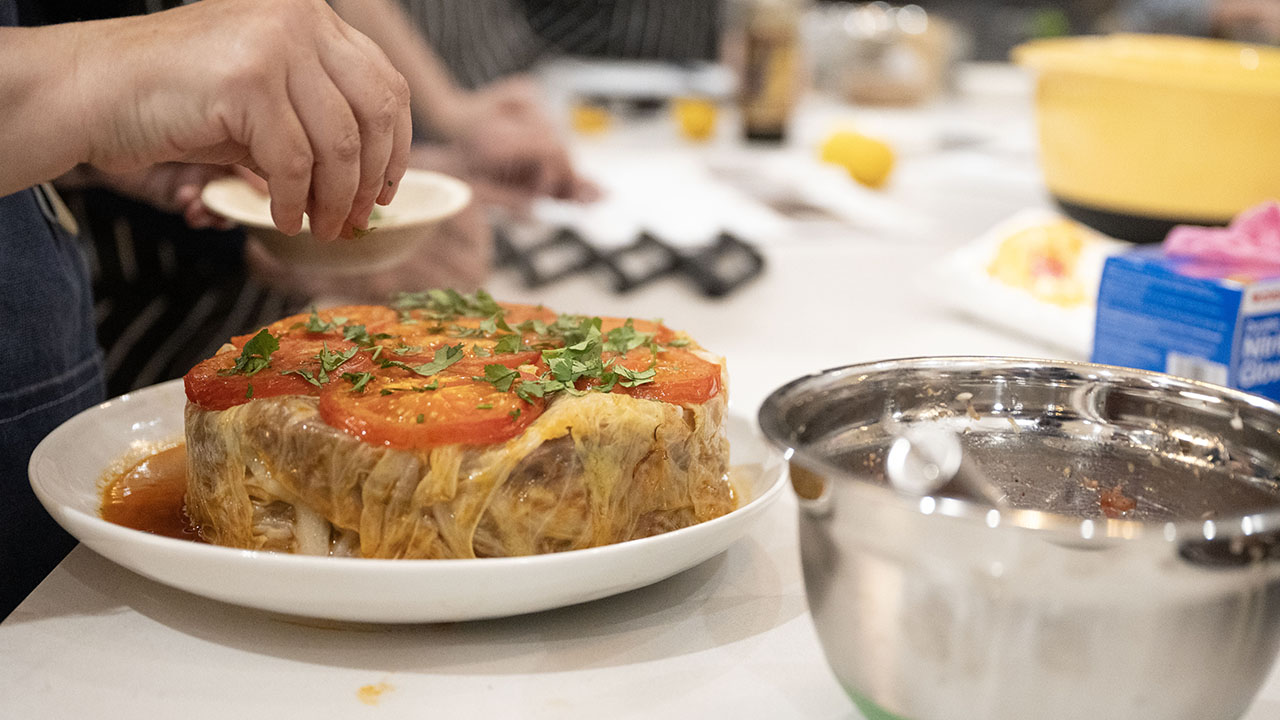
All of the dishes made that night were delicious — the group especially loved Somekh’s suggestion to put matzah balls in a creamy soup, as opposed to the more traditional chicken broth — but the cabbage cake was a standout, both in looks and taste.
“When you want to tell someone you love them, making stuffed vegetables is one way to do it, as it takes a long time,” she said, adding that she teaches a whole class entirely on stuffed vegetables. Knowing the group would be making a number of dishes in a short amount of time, she instead came up with this idea to make a “cake” with ground meat surrounded by cabbage leaves.
“I wanted to make something that takes all the flavors of stuffed cabbage without a lot of work,” she said. “This is not a traditional dish from anywhere, nor does it come from my family.” But it’s in the spirit of stuffed cabbage, and is perfect for Passover week.
When asked the next morning where Passover falls among her favorite holidays, Somekh admitted that it’s at the bottom.
“I don’t like when people tell me what I can’t eat,” she said. “I don’t like restrictions on what I can or can’t make.”

The menu she put together for the workshop suggested otherwise, in that restrictions were barely noticeable. The menu was vegetable-forward, with produce in a riot of color. Even the cabbage dish, which could have remained a pale light green, had a layer of cooked tomato slices on top, giving it a rosy hue.
Somekh’s abundant menu included three types of haroset (Ashkenazi, Iraqi and Yemenite); Jerusalem Artichoke and Leek Soup with Matzah Ball; Roasted Rainbow Carrots with Moroccan Dressing; Whole Roasted Cauliflower; Roasted Beet Salad with Oranges; Herb Salad with Apples, Dates, Nuts and Pomegranate Vinaigrette; Savory Cabbage Layer Cake with Meat; and gluten-free Tarta de Santiago (Spanish Almond Cake).
She chose to use dates and apples in several dishes because they are symbolic foods for Passover. Dates are also a key ingredient in most Sephardic haroset recipes.
Amazingly, nearly all of these dishes were made and tasted in the span of a three-hour workshop. Somekh washed most of the vegetables and did other prep before our arrival, and then each dish was put together by a team of two. Yes, we did run over the allotted time, but that was because we were chatting so much.
Participants came away with inspiration. Jen Friedman of Piedmont said the Middle Eastern spice blend baharat, made up of warm spices like cardamom, clove and cinnamon, was new to her, and she was going to seek it out.
Also, maybe just as important, she said, “I was reminded of how much fun it was to cook with friends.”

Savory Cabbage Layer “Cake” with Meat
Serves 8
For the cabbage:
- 1 large cabbage
- Water and salt (for boiling)
For the meat filling:
- 1 lb. ground beef or beef/lamb mix
- 1 large onion, finely chopped
- 2 garlic cloves, crushed
- 2 Tbs. olive oil
- 1 tsp. paprika
- ½ tsp. ground cumin
- ½ tsp. cinnamon (optional)
- 2 Tbs. tomato paste
- ½ cup water or stock
- Salt and black pepper, to taste
- Handful of chopped parsely
For the base:
- 2-3 ripe tomatoes, sliced (for the bottom layer)
Soften the cabbage
Bring a large pot of salted water to a boil. Core the cabbage and place it whole in the water. Cook for about 10 minutes, until the leaves soften and can be separated easily. Remove, cool slightly, and gently peel off whole leaves.
Prepare the meat filling
Heat olive oil in a pan over medium heat. Add the onion and cook until soft and lightly golden. Add garlic, then the ground meat, breaking it up as it cooks. Cook until meat is fully browned. Stir in paprika, cumin, cinnamon if using, tomato paste and water/stock. Simmer for 5-10 minutes until the mixture is moist but not liquidy. Finish with parsley and adjust seasoning.
Assemble the cabbage cake
Preheat the oven to 400 degrees. Lightly oil a medium baking dish or pan. Arrange a layer of sliced tomatoes on the bottom. Cover with a layer of cabbage leaves, also lining the sides. Add a layer of meat filling. Continue layering: cabbage, meat, cabbage, meat. Finish with a top layer of cabbage, folding any overhanging leaves inward to seal. Brush with olive oil.
Cover with parchment and foil, and bake for 45 minutes. Uncover and bake an additional 15-20 minutes, until lightly browned. Let rest for 10-15 minutes before slicing. Serve in wedges or squares, like a savory cake or lasagna.
Notes and variations:
- Add 1 cup of rice to the meat for a more traditional stuffed-cabbage feel.
- Include pine nuts or almonds for texture.
- This dish improves after resting and is excellent made a day ahead.
- For a more refined presentation, invert onto a serving platter before slicing, so tomato slices are on top.