

Cal needs broad cultural change
One hopes that UC Berkeley will adhere to its recent legal commitments regarding nondiscrimination against Jewish and Israeli students, faculty and staff (“Cal settles antisemitism lawsuit for $1 million, pledges policy changes,” March 19). The damage that this discrimination has done to trust, safety, sense of belonging, inclusion, equality and equity on campus for over two years now is profound. It has left a legacy of hurt and harm that can be addressed not only by stopping discrimination but also by addressing its harms in a reparative and substantive way.
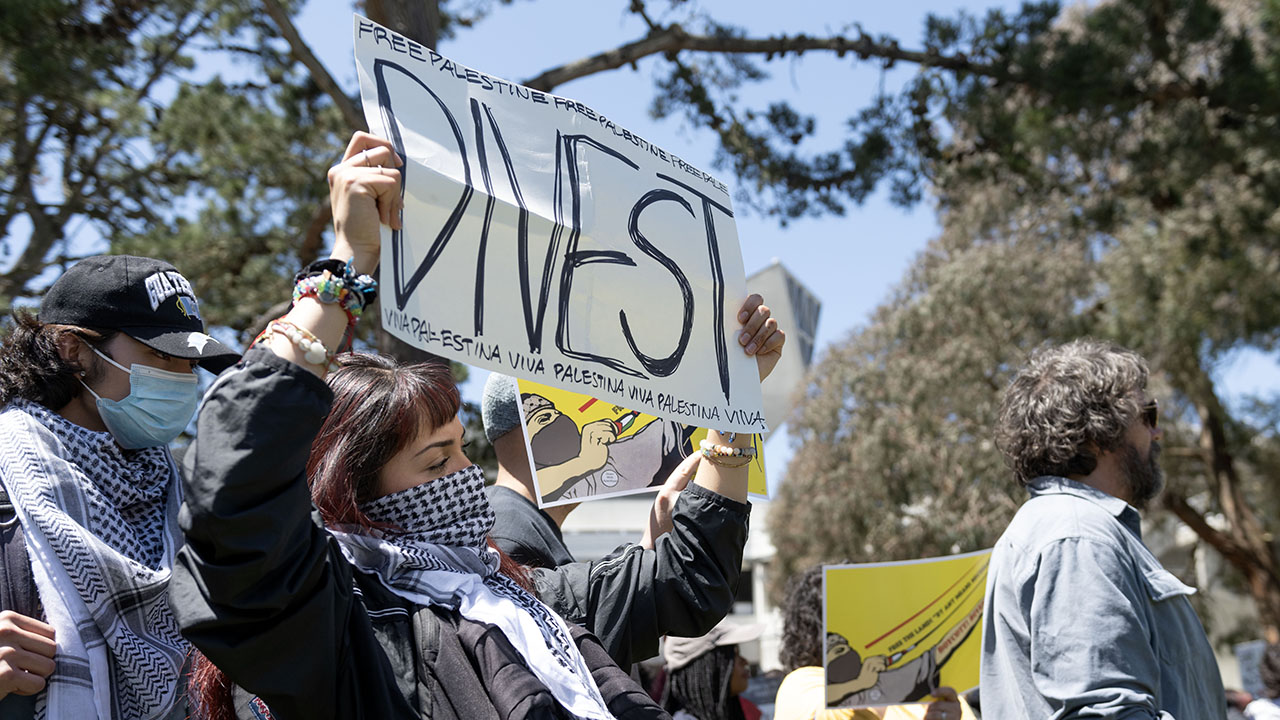
Since November, the university has been aware of hateful, coded, racist signage calling to remove “Zionists” from campus. It has been posted in violation of university regulations, yet the university has taken no action to address this very type of discrimination and bigotry.
A legal agreement to address discrimination is a good if belated start to address civil rights violations on campus. But UC Berkeley also needs something broader and deeper, a change in institutional culture, the development of an ethic of compassion and care, respect and equality that is inclusive of Jews and Israelis, and the assurance that the university will act in a more timely, respectful and responsible way when any group on campus — including Jews and Israelis — experiences threats, violence, abuse, harassment or exclusion.
Everything is not OK at Cal for Jews and Israelis. While things may be getting better, it is shameful and illustrative of what is wrong that a lawsuit was required to force the university to respect the civil rights laws and fundamental freedoms and human rights it is obligated to respect for its students, staff and faculty.
Noam Schimmel
Lecturer, UC Berkeley
SFSU’s antisemitic legacy
The opinion piece by SF Hillel executive director Roger Feigelson (“What ADL’s ‘Antisemitism Report Card’ gets wrong about San Francisco State,” March 27) makes a good case for San Francisco State’s current relationship to its Jewish faculty and students. Our faculty heroes, like Jewish studies professor Marc Dollinger, have fought for fairness at S.F. State, and President Lynn Mahoney is a great administrative leader who has shown wisdom and courage in following the rules and protecting Jewish students.
However, the decades preceding this new administration were marred by regular anti-Israel and antisemitic activities that made the campus antagonistic to Israel, such as the annual “Israel Apartheid Week.” In April 2016, when Nir Barkat, former mayor of Jerusalem, was shouted down while S.F. State security looked on, the university was taken to court, and then-President Les Wong was encouraged to resign.
The lesson is that indifference or antagonism to Israel and Jewish students on campuses will only be reversed when administrators and faculty face consequences, and new leadership enforces the rules that make a campus safe and secure for everyone.
Jeff Saperstein | Mill Valley
Archives column got it wrong
David A.M. Wilensky’s March 9 article “Was America’s first Black millionaire also San Francisco’s first Jew?” raises an interesting question but frames it in ways that blur important distinctions. The article also contains incorrect details.
William Alexander Leidesdorff’s paternal surname plainly points to Jewish origin. The more important issue is the article’s suggestion that patrilineal ancestry alone could define Jewish identity despite Leidesdorff’s documented Lutheran baptism and later Catholic affiliation. That formulation is inconsistent with halachah, which recognizes Jewish status through the maternal line or formal conversion.
Rabbi Jacob Voorsanger’s observation that Leidesdorff “did not affiliate with the nascent Jewish community of San Francisco” overlooks the fact that Leidesdorff died in 1848, before an organized Jewish community had meaningfully formed in the city. Leidesdorff did serve on Yerba Buena’s early municipal council and was appointed treasurer, but describing him as having “established” the city’s first town council oversimplifies the political transition.
More broadly, later retellings often cast Leidesdorff in the 19th-century trope of the “tragic mulatto,” a narrative that simplified the racial complexity of early California while foregrounding white achievement.
My forthcoming book, “The Ledger and the Mirror: William Leidesdorff and the Making of San Francisco,” examines the archival record and the long history of reimagining that has grown up around it. My colleagues and I also lead a San Francisco City Guides walking tour dedicated to Leidesdorff’s story.
Eric Friedman | San Francisco