

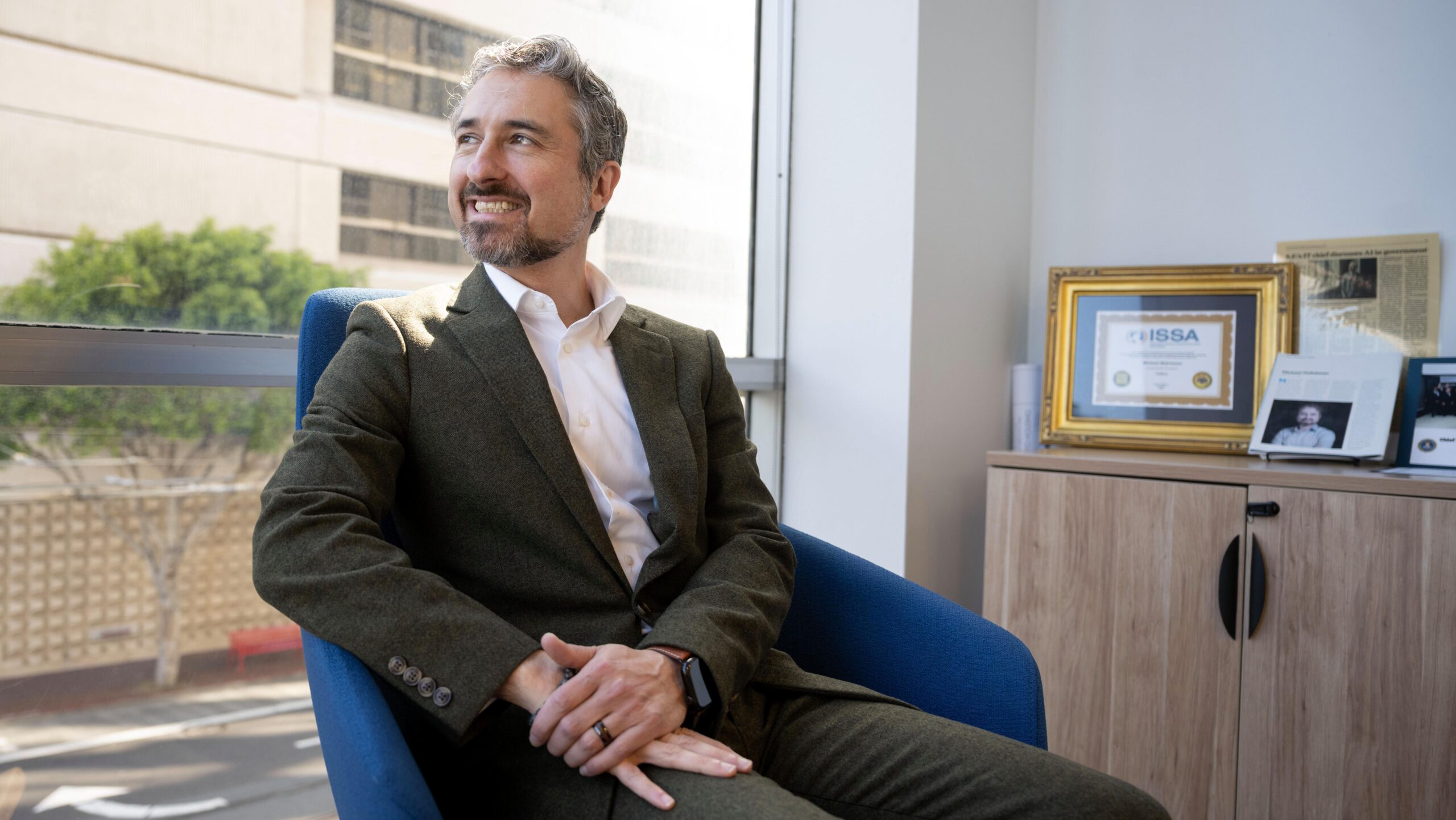
Michael Makstman was a day shy of his 15th birthday when he left his home country of Ukraine for the United States. The year was 1994. The Soviet Union had collapsed in 1991, and the situation was unstable. Ukraine voted in a pro-Russian president and, at the same time, nationalism was on the rise. The Makstman family decided to go.
They traveled with only two duffle bags each, and Makstman had to leave behind his beloved toy soldiers, a souvenir of childhood.
“Flea markets were popular, and I had my little collection of tin soldiers,” he said. “Somebody bought them for…I don’t even remember, but it was really sad for me, because I spent a lot of time playing with them.”
They moved to Chicago for a better life. There, they were taken in by the local Jewish community and supported through learning English and integrating into the American system.
For Makstman, 47, it paid off. With degrees in finance, IT and computer science, he’s worked in technology and risk management, and for six years was the cybersecurity chief for the city of San Francisco. Now he is the head of its entire IT operation as chief information officer, overseeing the information technology infrastructure that keeps the city running. He lives in the city with his wife, Gabriella Makstman, who is on the board of their synagogue, Sherith Israel, and their children.
This interview has been edited for length and clarity.
Tell me about your childhood as a Jewish boy in Kyiv.
I grew up in Ukraine. My family had deep roots in Ukraine. I had, I think overall, a very happy childhood. But a few themes were part of the family narrative. One was World War II; my grandfathers fought in the war. One of my grandfathers was captured and was in a concentration camp, but he was able to survive. It’s a fascinating, dramatic story.
My grandparents were filled with pride of survival and working really hard. They absolutely bought into this whole early ethos of the Soviet Union, of no nationalities, no religion, everybody’s equal. I remember walking with my mom’s dad during the Victory Day parade, his whole chest decorated with the medals of all the battles and all the victories.
But there was no doubt that they were Jewish. In fact, even through the late ’80s when I was in school, next to everybody’s name was their nationality, and it would say Jewish right next to mine. My school had a number of Jewish kids, but there was always this kind of systemic cultural antisemitism — just kind of the water you swim in.
As a young teen, there were clear boundaries, where my parents would say: “This profession, you would not be able to go to university for, because they have quotas.” Doctor or lawyer, I don’t know, a diplomat, sciences and maybe engineering.
My parents lived in this place of antisemitism when they were growing up. Like, don’t say who you are. Don’t raise your hand too high. I experienced a little bit of that.
But then in 1994 your family picked up and left. Why?
The day before I was 15, we came to the United States. The Soviet Union fell apart, and my parents saw Ukraine’s economic situation getting worse. Also, the Soviet Union suppressed obvious national impulses, and as Ukraine was becoming independent, it was very much accompanied by very strong antisemitism. They were telling me, we just don’t see a future here.
They brought me here with a little hope and a prayer that things would turn out different for me, and maybe for them, too.
That must have been hard for you and for them alike.
Just a few years ago, I was the same age as my dad when he came to the United States. I thought to myself, could I just pack my life into two duffle bags and move to a country where I didn’t speak the language with the hope that it would work out?
I think the Jewish community in Chicago maybe gave them a little bit of a sense that somebody here wants them. I think they felt amazed at people who were openly Jewish, how welcoming they were. There was the sense of plugging into this larger community.
You did end up successful in the U.S. Tell me about your job for the city of San Francisco.
I am the city’s chief information officer and also executive director for the Department of Technology. I’m responsible for 300-plus people who every day serve the residents of San Francisco, and also I lead the vision and the strategy and the execution of all of the IT-related work in the city.
What does that mean?
People are working every day on the streets of San Francisco, putting fiber cable underground that is the physical highway for data to get from the 911 center to the fire stations. We actually operate an Emmy-winning TV station, SFGovTV. My team supports the mayor’s phone and the laptop that he took to China and making sure that it’s secure against any cyberattacks.
Does San Francisco feel like home now?
I love to walk the streets, and think I’ve made a difference here. It’s very rooting for me, and that is really meaningful, because I was kind of uprooted.
I have a little bowl on my desk. It’s made out of carob wood, and it says “l’dor v’dor.” I think a lot of people know the story of Honi the circle maker [a Jewish sage]. He sees a man planting a carob tree and says, “You probably are not going to see the fruits of the labor. Why are you doing that?” When I look at this bowl, I think of the carob tree, I think of the chain. It’s the idea that we are doing it from generation to generation.
My youngest is going to have her bat mitzvah soon, and I just think of this chain of generations and how everybody tried to do their best to survive. It’s my turn to plant the trees for [the next generation] to nurture. The community here who built our temple, Sherith Israel, 175 years ago made a place for us to come on a Friday. They nurtured that tree, and I’m continuing it for them.
How did you come to join a synagogue?
Sherith Israel is a great place to worship and explore and learn. I do a lot of learning, because I didn’t grow up with a lot of knowledge about the spiritual side, the religious side of being Jewish. We’re not just part of a community, but also contributing to the Jewish community here, and also to the larger community. I think that’s really meaningful.