

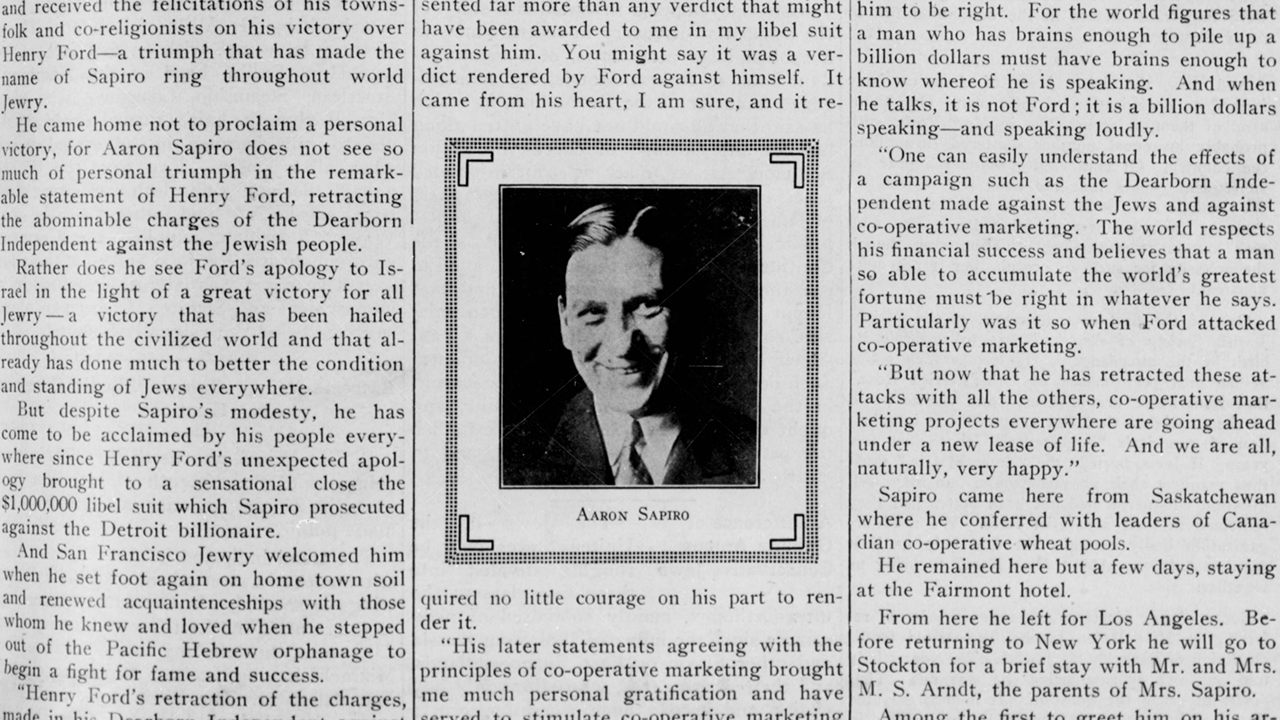
“The boy who learned his A.B.C.’s in a San Francisco orphan asylum returned to [his] home town this week, acclaimed by all the Jewish world,” we wrote in 1927.
That boy was Aaron Sapiro, a noted lawyer who was raised in the Pacific Hebrew Orphan Asylum. Despite his humble beginnings, he ended up a favorite son of San Francisco Jews after successfully suing Henry Ford for libel.
Described by historian James Loeffler as “the first modern hate speech trial in America,” the case challenged Ford’s practice of publishing antisemitic screeds in a periodical he owned.
The lawsuit began in 1924, which is when we published the headline, “Aaron Sapiro Will Bring Suit Against Henry Ford.” By that time, Sapiro would’ve already been well known to many of our readers because, though he was then living in Detroit, he had already appeared in our pages a number of times.
In fact, his first appearance in our paper came when he was a young man. In 1911, he wrote a letter to our editor, who had recently proposed that the boys of the orphanage be instructed in military drills and Boy Scout activities.
“We have already considered this very proposition and three months ago, organized a company of American Boy Scouts,” Sapiro wrote in his letter.
He sued after Ford repeatedly denigrated Sapiro by name for his support of “co-operative marketing” for American farmers, a system by which many farmers would band together to market and distribute their goods. Ford, already a nationally famed antisemite by that time, wrote in his propaganda rag, the Dearborn Independent, that cooperative marketing was a “conspiracy of the International Jewish bankers to control agriculture in the United States.”
So, Sapiro announced at a gathering of a Detroit synagogue men’s club, he was suing. “We will show that Henry Ford’s attacks on the part that I have taken in promoting co-operating marketing among the farmers of this country mean but one thing — that Ford and his hirelings are bent upon eliminating the Jew from agriculture,” he said.
Sapiro sued for $1 million in damages for making him out to be the ringleader of a sinister international cabal. The trial was repeatedly delayed but finally ended in 1927. Sapiro won the suit, including the damages he sought. Ford was forced to retract several articles and was limited in his ability to continue publishing antisemitic screeds.
Sapiro returned to the Bay Area victorious that year. “Aaron Sapiro slipped into San Francisco and received the felicitations of his townsfolk and co-religionists on his victory over Henry Ford — a triumph that has made the name of Sapiro ring throughout world Jewry,” we wrote.

However, we noted, Sapiro did not see this as a personal victory. “Rather does he see Ford’s apology to Israel” — meaning the Jewish people — “in the light of a great victory for all Jewry, a victory that has been hailed throughout the civilized world and that already has done much to better the condition and standing of Jews everywhere,” we wrote.
The lawsuit “not only has absolved our people from the stigma of the accusations which were hurled in the Ford publication but it has lifted industrial and commercial pogroms against the Jews,” he said during his 1927 visit. “The effect has been as marked in Europe as in the United States, for in Europe our people were being crushed by industrial pogroms just as they were being murdered in the most benighted countries.”
Sapiro eventually came to believe that Ford had genuinely changed his mind about the Jews. In 1933, Sapiro even sought Ford’s help in improving the situation of Jews in Europe.
“Will you take this opportunity to communicate with the leaders of Germany and tell them that you once suffered from these ideas and that you saw that they were untrue and that you did the noble thing of admitting your error and of giving the Jews their fair standing before the people of the world?” Sapiro asked him.
Ford did not fulfill the request.
While Sapiro lived in Detroit, New York and Chicago, he frequently visited San Francisco and often made time to stop by the orphanage, which had relocated and was renamed Homewood Terrace.
In 1928, he offered sage wisdom on a visit to Homewood Terrace. “The youngsters were attentive auditors and his candid advice of the importance of reading and studying Jewish history and literature made its impression upon the young folks,” we wrote.
Our obituary for Sapiro in 1959 was brief. “He pioneered the organization of California farm cooperatives and drafted laws for such operations in many states,” we wrote. “He also was active in labor causes.” We described him as a “nationally known lawyer” and said that “he was widely known for his fight against Henry Ford.”
It was also remarkably incomplete. By the time of Sapiro’s death, he had also faced criminal racketeering charges. He was allegedly involved in a Chicago money laundering scheme linked to Al Capone. Sapiro was indicted in 1933, but the charges were dropped after a mistrial.
This publication was, at the time, a booster for the local Jewish community rather than a proper news organization obligated to report on such unpleasantness. So Sapiro’s trouble with the law never made it into our record — until now.