

This story was originally published in the Forward. Click here to get the Forward’s free email newsletters delivered to your inbox.
The wandering Jew. The rootless cosmopolitan. Being homeless and belonging nowhere has long been a negative Jewish stereotype.
But what if this trait was, instead, something beautiful?
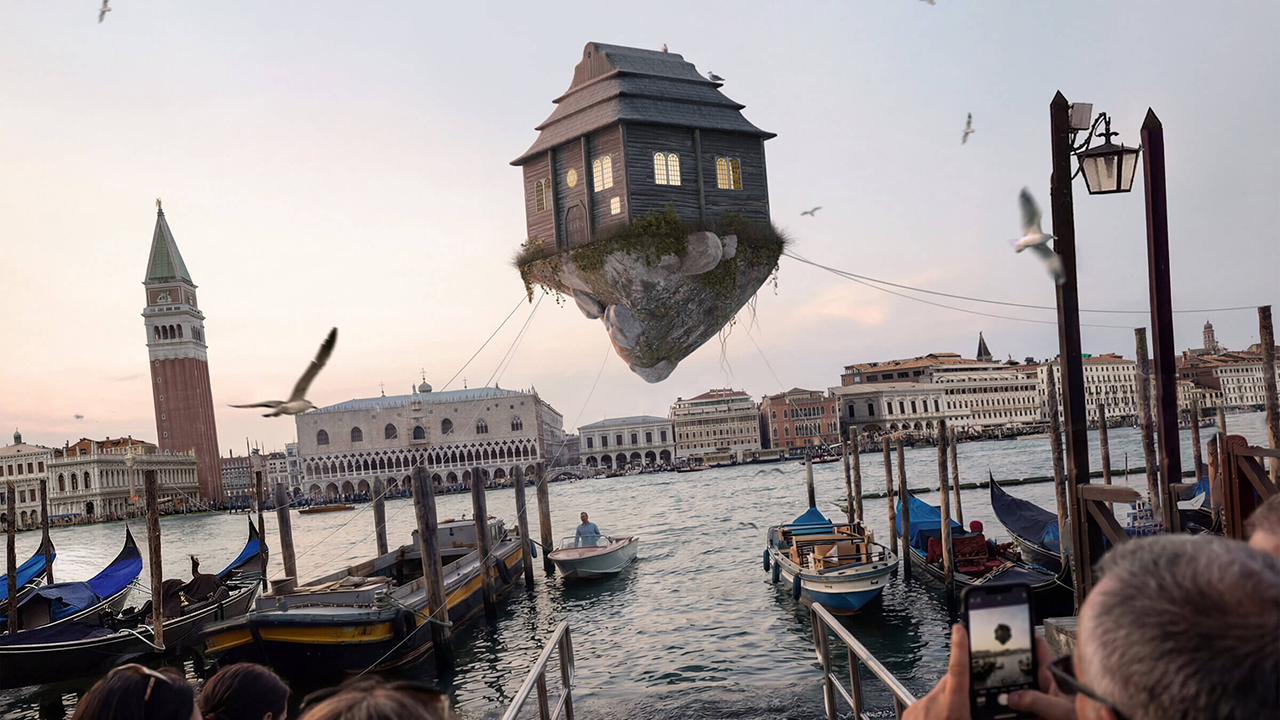
That’s the idea posed by “Nabatele,” an art installation from Ukrainian-Jewish artist Anna Kamyshan. A synagogue, an amalgam of different wooden shtetl synagogues across Europe, perches on a heap of earth. But it’s not on the ground — the synagogue is soaring in the sky.
It sounds impossible, but Kamyshan is installing “Nabatele” as an official project of the Venice Biennale, where it will float over the city’s lagoon, starting July 16. She worked with engineers in the U.K., a production company in Spain, and she imported some supplies from Denmark to make it all come together.
“We are trying to engineer some magic,” Kamyshan said, describing the process over a video call.
The Venice Biennale, which has been around since 1895, is the oldest art festival of its kind. It is organized by country; each has its own pavilion in Venice where artists representing their nation install their pieces. But that utopian vision of inclusion isn’t always simple. This year, in protest of both Israel’s and Russia’s participation, the entire jury — the group in charge of meting out the festival’s prestigious awards — resigned from the festival after putting out a statement that they would not award artists from countries “whose leaders are currently charged with crimes against humanity by the International Criminal Court.” (Both Benjamin Netanyahu and Vladimir Putin fall into this group.) Protests, led by the activist group Art Not Genocide Alliance, have marched through the streets of Venice.
But “Nabatele” is affiliated with the Yiddishland Pavilion, a project that sidesteps the entire controversy of choosing which nations can participate. It isn’t tied to Israel, or, for that matter, any other country. In fact, arguably it isn’t tied to the Biennale. It’s not even a physical pavilion. It debuted — unofficially — at the Biennale in 2022, when artist Yevgeniy Fiks and curator Maria Veits had the idea of a “conceptual, independent, non-national” pavilion. But it’s something of a guerilla project. Since Yiddishland doesn’t have a physical pavilion, its exhibits are scattered around the city, often including performance art popping up in public spaces.
In an interview with the Forward in 2025, Fiks said the idea of Yiddishland originally emerged in the early 20th century when a group of Yiddish-speaking Jews toyed with rejecting nation-based identity in favor of “the idea that Yiddish language and culture create their own homeland — an imaginary place where Yiddish-speakers always belong.” It’s fitting, then, that its pavilion is similarly ephemeral.
“Nabatele,” however, is a very physical piece. Yiddishland might not have a physical state or pavilion, but despite this lack of space on land, the installation is monumental. It floats, filled with helium, over Venice’s waters. And it was too big to install without the Biennale’s official buy-in. So Kamyshan, with support from the Montreal Jewish Museum, submitted the project to become an official part of the festival, as a “Collateral Event.” It was a longshot, the artist said, and none of them expected it to be accepted.
But it was. Which meant Kamyshan had to figure out how to actually make the project.
“If there would be this stateless state of Yiddishland, what would be the representation of it at the Venice Biennale? For me it’s clear — there is no space, it has to fly,” Kamyshan said. “It’s also a very Jewish thing, not to be rooted.”
The “Nabatele” synagogue rests on what appears to be a massive pile of rocks and soil — an earthly groundedness it carries into the sky. (How does all of this wood and dirt float? Well, Kamyshan told me it was made of “the most cosmic magical materials,” and also a lot of helium. Beyond that, she said that she didn’t want to spoil the illusion.)
The name comes from a compound of the Slavic word nabat, which means a beacon or alarm in Russian and Ukrainian, along with the Yiddish diminutive elle, softening the meaning. (Nabat in biblical Hebrew has a related definition, meaning “to look.”) Light shines out of its windows, a nod to every synagogue’s ner tamid, or eternal light, serving as a sort of flare or lodestar, beckoning to passersby.
“I think it’s difficult times for Jews to identify yourself as Jews,” Kamyshan said. “It’s just heavy, you know?” So she made something light — an alarm to remind people not of the danger of being Jewish, but of its beauty.
If all goes well with installation, the highest point of the floating synagogue will be 45 meters above the water — nearly 150 feet.
Kamyshan said she hopes the message of lightness, and of carrying a home within yourself, will be universal for members of an increasingly globalized world. As a Ukrainian-Jewish woman, born to a Russian-speaking family — and simply as an artist who has moved regularly and lived in cities across the world — Kamyshan said she related to the idea of rootlessness beyond its Jewish history. In the past, she struggled with the feeling that she was never quite enough of any one of her identities to belong. Today, however, she sees her lack of home as a kind of superpower that prevents her from being “trapped by some land.”
“I have to be rooted within myself, and it gives me a lot of freedom. And I enjoy this freedom,” she said. “And when you look at this art object you think: Was it ever part of the land and was uprooted? Or did it always enjoy this freedom? And I like this ambiguity.”
“Nabatele” will be on view in Venice from July 16 through Sept. 16, 2026, weather depending.