

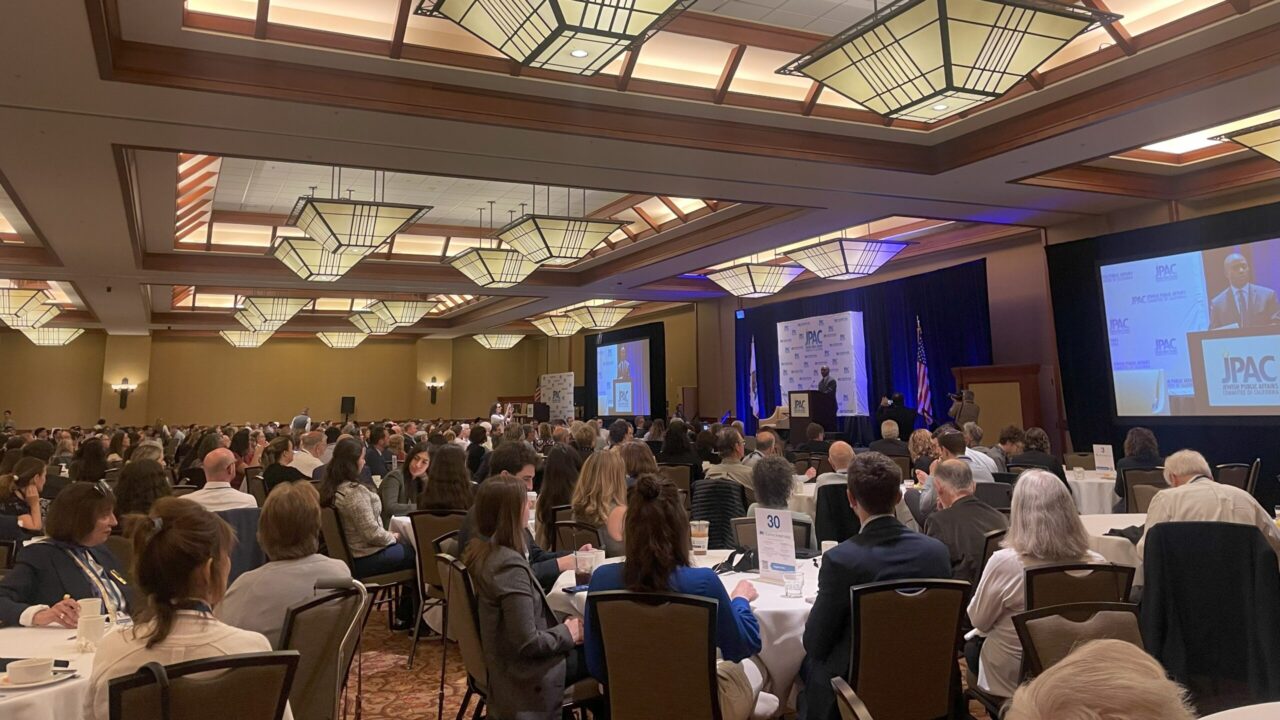
The annual summit of California’s Jewish leaders last week drew a record-breaking 500 people seeking to answer the question: How do we respond locally to the global spike in antisemitism since Oct. 7?
“We never paid attention, really. Members of the Jewish community did not pay attention to what was happening in their local communities. They did not pay attention to school boards, did not pay attention to what was happening in Sacramento. People who are activists in the Jewish community focused primarily on Washington, D.C.,” Anita Friedman, the longtime executive director of S.F.-based Jewish Family and Children’s Services, told the Jewish Public Affairs Committee of California’s Capitol Summit 2024 in Sacramento.
“This was a wake-up call that we have to reorganize ourselves,” Friedman added. “This is part of a reorganization of the Jewish community.”
The conference, which packed Sheraton Grand’s conference hall on May 14 and 15 with lawmakers, Jewish community leaders, advocates and allies, featured speakers and breakout sessions focused on a very different world than the same event last spring.
The Oct. 7 Hamas massacre in Israel and the subsequent war in Gaza have led to waves of antisemitism, pro-Palestinian protests and tent encampments on college campuses and an intense discourse about the state of Jewish life at home and abroad. The combination of these factors pushed many summit attendees to refocus their efforts on building community and planning direct collective action to ensure that California is a safe place for Jews.
The event featured keynote speakers Gov. Gavin Newsom via video stream, Lt. Gov. Eleni Kounalakis, Superintendent of Public Instruction Tony Thurmond, Attorney General Rob Bonta and Jewish Council for Public Affairs CEO Amy Spitalnick.
This is a wake-up call to reorganize.
Breakout sessions covered free speech on college campuses, raising children amid the digital age and “reflections from the Gaza border” with panels that included state legislators, educators and experts in health, wellness and technology.
Students were on top of the agenda for many speakers and attendees. Discussions covered strategies to address the pervasive threat of misinformation on the internet and in educational institutions.
“As Jews, we should be wary of conspiracy theories. Though there are certainly outside actors … these [tent] encampments would be going on with or without them,” Gregg Drinkwater, program director of UC Berkeley’s Antisemitism Education Initiative, said on a panel titled “Balancing Free Speech and Hate Speech on Campus.” “Punishment won’t stop it. Focusing on some outside cabal won’t stop it. Only education will stop it.”
Summit participants also spent an afternoon in the Capitol to lobby members of the state Senate and Assembly about bills addressing antisemitism and hate, supporting refugees and asylum seekers and promoting online safety for kids.
“We are here because of advocacy work, but our primary job is relationship building. What better way to spend two days than with so many people who are doing the work on the ground floor?” Joy Sisisky, CEO of the S.F.-based Jewish Community Federation and Endowment Fund, told J. “It couldn’t have come at a better time. … The issues JPAC has decided to focus on are spot-on.”
David Sapp, legal affairs secretary in the governor’s office, offered an analysis of the “Golden State Plan to Counter Antisemitism,” which Newsom unveiled in April.
The plan, crafted with help of the California Legislative Jewish Caucus and JPAC, focuses on the state’s priorities, including security grants for religious institutions, aid for victims of hate crimes, penalties for proliferating hate symbols, reinforcement of Holocaust education and support for the University of California’s recently established Systemwide Office of Civil Rights.
“The plan was about putting together what is already underway, identifying further actions needed since Oct. 7 and committing to further actions to continue to support the priorities the governor has in addressing these issues,” Sapp said during a Q&A with David Bocarsly, JPAC’s executive director.
Sapp said California’s plan should serve as a model for other states looking to address antisemitism.
Friedman underscored the significance of it as well.
“It’s very important to remember that the difference between the destruction and survival of the Jewish people is the government,” Friedman told J. “The ‘Golden State Plan’ is a signal that the government is with us and we have a future here. … [Newsom] understands the role of government in protecting minorities, including Jews. It’s a very good, comprehensive plan and it’s a base from which to work.”