

Books coverage is supported by a generous grant from The Milton and Sophie Meyer Fund.
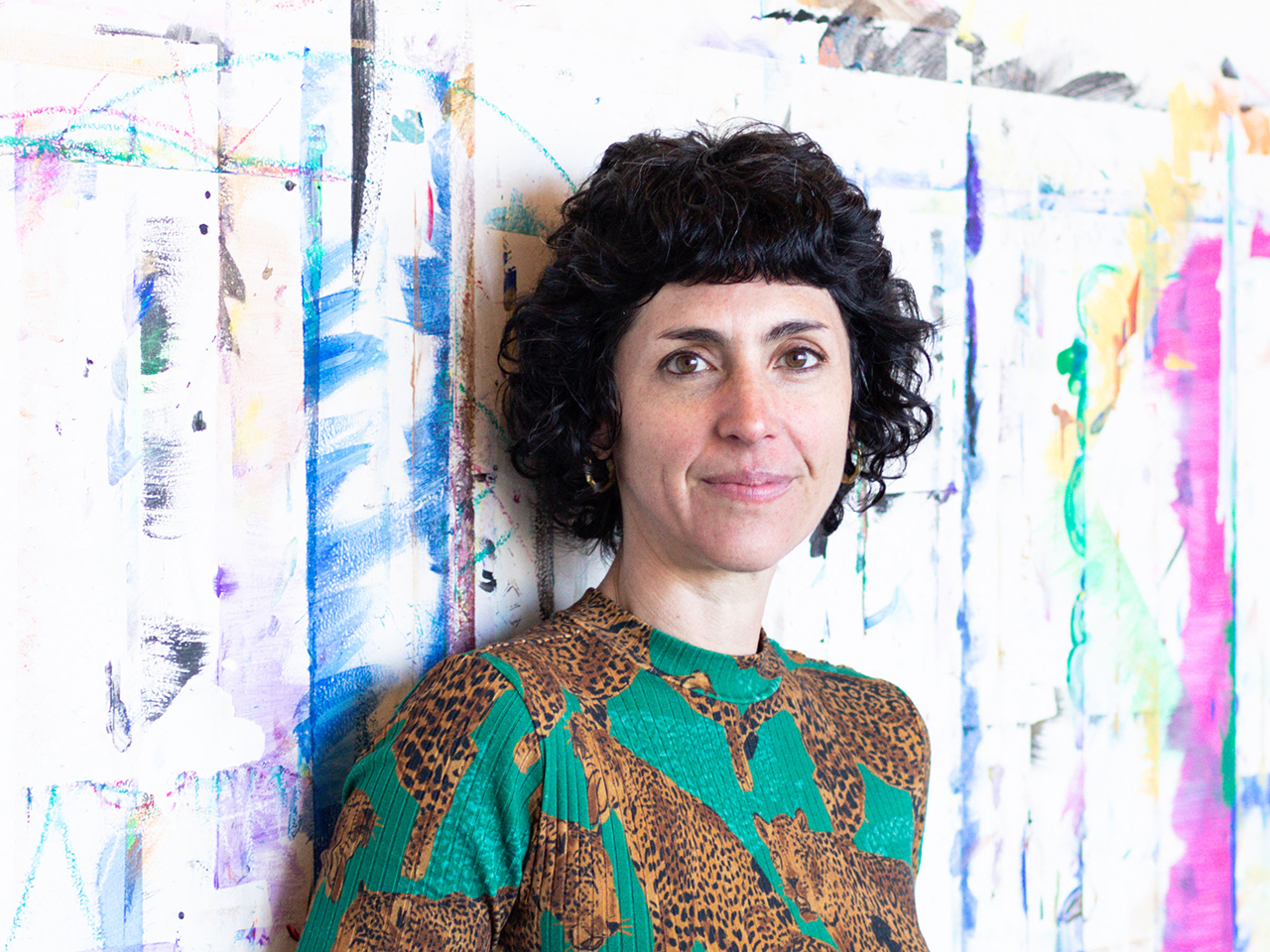
Rabbi Adina Allen’s first “place of all possibility” was her mother’s art studio in her childhood home in Chicago. That’s where, Allen said, she was encouraged to “get messy” and confront difficulties in her life by “making art about it.”
In 2015, Allen and her husband, Jeff Kasowitz, established their own “place of all possibility” in Berkeley by co-founding the Jewish Studio Project. JSP takes a concept created by Allen’s mother called the Open Studio Process, which uses art to help people access their inner creativity and wisdom, and gives it a Jewish context.

With what the couple calls the Jewish Studio Process, participants use prompts from Jewish text, usually Torah passages, and through making art, engage with the feelings the text stirs within them — bringing the heart and body into a process that traditionally engages just the intellect.
In “The Place of All Possibility: Cultivating Creativity Through Ancient Jewish Wisdom,” her first book, Allen invites readers to undertake this process on their own or with friends. Half the book, set for release on July 30, is an explanation of the process itself and why Allen believes it is deeply connected to Jewish tradition. The other half includes sample exercises: text prompts and creative projects that might emanate from them.
J. recently sat down with Allen in Berkeley at JSP, an airy room with participants’ artwork hanging on the walls. This interview has been edited for length and clarity.
J.: You write that this book is not about belief, but about experience. What does this mean?
Rabbi Adina Allen: I feel that this is a time in which the deep gems of wisdom within Jewish tradition need to be opened up to more people. I want them to be able to benefit from how much beauty this tradition has to offer. So I wrote this book for those of all beliefs and none. One of my JSP colleagues said it’s actually not about belief, it’s about an embodied experience of feeling something. Belief keeps you in the realm of the intellect, whereas this is about moving into something that’s actually felt, a felt experience.
You give lots of credit to your mother, Pat Allen, who co-founded the Open Studio Project in 1995 and authored two seminal books, “Art Is a Way of Knowing” and “Art Is a Spiritual Path.” How did you combine that technique with Jewish tradition?
I really love the open studio process methodology, which is pretty basic. It begins with intention-setting in a sentence or two — what you want to get out of the process of art making — then moving into exploratory art making with any material, and then witness writing, which is writing in response to the piece. And then there’s a ritually held space where people can read a piece of what they’ve written, if they want. And no one comments on it.
What Jewish Studio Project adds is the text learning, refracting our personal exploration through the test. It’s like learning in beit midrash. There’s something really dynamic and exciting to me about that.
And what I found in this process, in taking the same text and then engaging it through the art making, it allows one to drop down into other places in the self, to move from the head down into the hands and into the heart, not to create something that is representative of the text, but lets someone see, here’s how I see the text.
It’s a moving meditation, to feel into what is actually landing within me, what’s opening up within me, and to give space for that emergence. I think that often those two modes of engagement, the intellectual and the more intuitive, explorative, happen in two bifurcated, separate spaces. I wanted to bring those two together.
Some people say “I’m not creative” or “I’m not good at art.” What do you say to them?
The Torah begins: Beresheit bara Elohim, [“In the beginning, God created”]. That first verb of Torah is bara, to create. Then a few verses later, we’re told that human beings are made b’tzelem Elohim, in the image of the Divine. To me, how can that mean anything other than we are created creative, endowed with that capacity. And when we are in touch with that place of creativity within ourselves, that is at least one of the ways where we are in touch with God, the Divine, our deepest self, the soul of the world. Looking at God’s creative process can help us understand or connect more deeply to our own creative process.
In the second half of the book, you suggest six texts as prompts and give sample exercises. One text from Genesis includes the phrase tohu v’vohu, often translated as the primordial chaos out of which God created the world. The exercise you suggest is going through your junk drawer, taking out the objects in it and using them to construct an art piece. What do you hope comes out of such an exercise?
I think that art making can be used as cross-training to help us build skills to be better parents, coworkers, community members, etc. Working with the stuff in your junk drawer, you’re probably not going to save that piece forever, and that’s not the point. It’s about, how do I encounter what I perceive as mess? How do I find beauty and meaning in it? How do I let myself be moved to work with it in a certain way?
I think when it’s stuff in your junk drawer, there isn’t that pressure to [make beautiful art]. You get to hone these creative muscles of play, exploration, emergence, working with mess.
This book is designed to let people access the Jewish Studio Project process on their own. But you do feel there’s something special about doing it in a group: choosing the text, making art and sharing it with group members, who offer no comment on your creation. What does one get out of the group process, which you describe as akin to a beit midrash? And what makes it so Jewish?
There’s a sense of shared resonance that’s created that feels like a nonpersonal love. Probably the closest thing is if you were at a really beautiful prayer service, and you feel this sense of goodwill and connection because you just engaged in this meaningful thing together.
The surgeon general talks about the loneliness epidemic today, and how that’s a huge contribution to mental health challenges, especially for young people. My hunch is that it isn’t only about friends or relationships with family, but also a broader sense of feeling disconnected and cut off from something bigger.
Part of what this process as a spiritual practice provides is that it helps people feel: I’m held by something bigger. I’m part of something bigger.
And bringing Torah into it: If you are Jewish and you are engaging with it, it’s something my ancestors have done. And so not only am I connected to something amorphic, to God, to energy, but I’m also connected to generations past and to generations future. I’m tapping into that well of energy.