

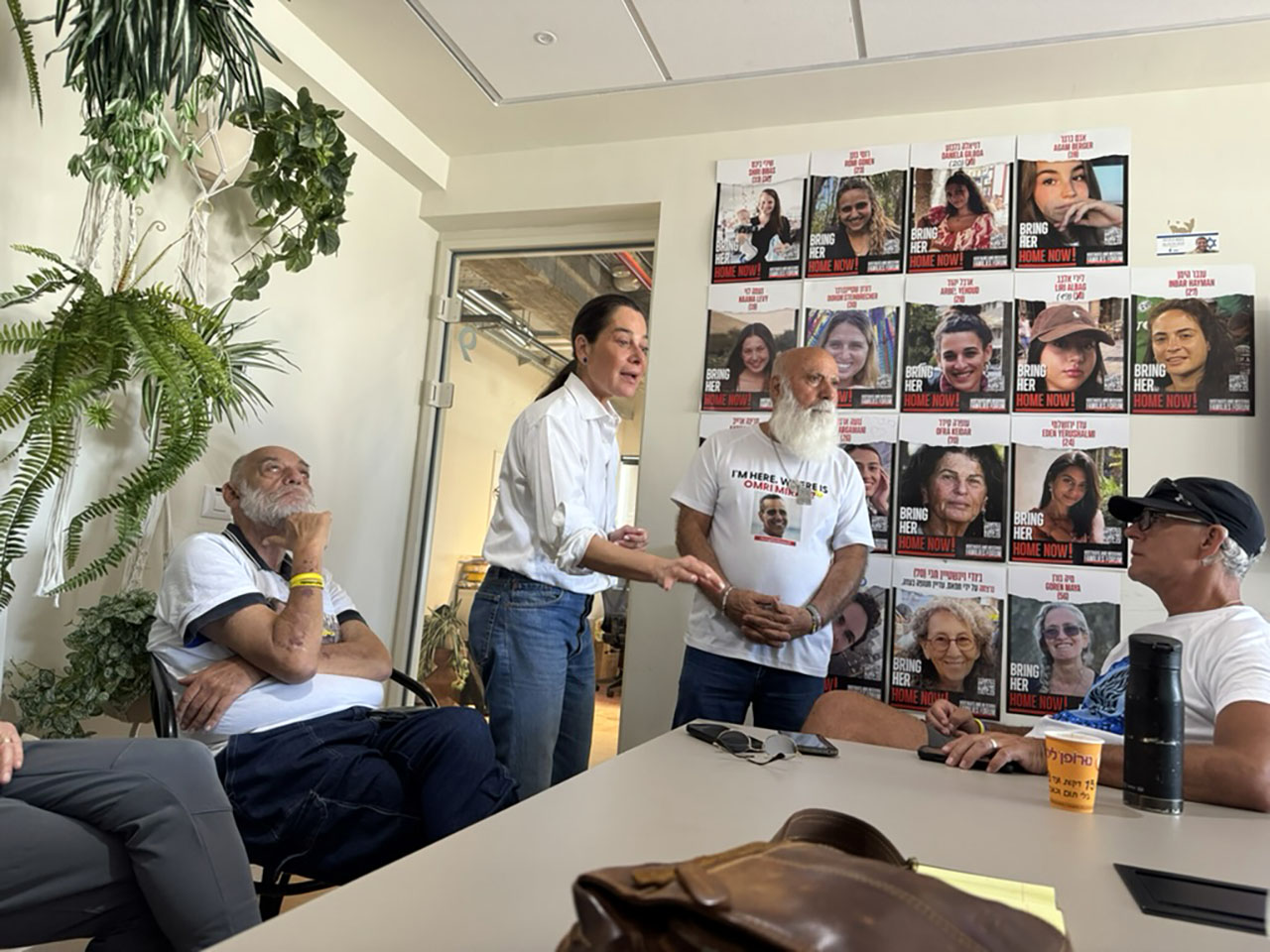
“You flew thousands of miles just to give us a hug. That’s what gives us strength. The Jewish people are family — that is our superpower.”
These were the words spoken by Dani Miran, the father of Israeli hostage Omri Miran, when we asked where he finds the strength to remain hopeful.
Not every moment on our Ramah Solidarity and Service trip to Israel in July was filled with such optimism, though. The trip was as heart-breaking as it was soul-filling.
We cried at the Nova music festival site when we went to bear witness to the hundreds of memorials created by the families of the victims. We were overwhelmed when we visited the bomb shelter from where Berkeley-born Hersh Goldberg-Polin was kidnapped after 28 people were murdered there. Our hearts broke at the “car cemetery” not far from the Gaza border where we saw over 1,500 burned-out cars, stacked up in piles like the shoes in Auschwitz, each with its own story.
We felt the pain of every family member when we made the pilgrimage to Har Herzl, Israel’s equivalent of Arlington National Cemetery, which is once again an active burial ground with new graves dug almost every day for Israel’s greatest generation.
We rolled up our sleeves, as we made meals for soldiers at a cooking studio in Tel Aviv that was repurposed after Oct. 7. We were humbled as we helped serve a barbecue dinner for soldiers on an army base alongside a group of Israeli volunteers who do this multiple times a week at a different base each time. We felt useful when we picked 1.5 tons of grapes at a farm because all the field workers are serving in the military. We were grateful to be of service when we packed food in Netivot, a small city in the western Negev (which is often referred to as the Gaza Envelope), for families in the surrounding area.
We gave hugs, as we came to show solidarity with families of hostages, as well as families of soldiers and civilians who were killed, and listened to their unbearable stories. We were emotional when we took pictures at Tel Aviv’s Hostage Square, where art installations stand alongside meeting tents for hostage families who continue to demand that we “bring them home now.” We felt good spending money at Cafe Otef, a pop-up coffee/chocolate shop run by the members of Kibbutz Re’im to sell products from the kibbutzim that were devastated on Oct. 7.

There is no way to thoroughly encapsulate these experiences, but there is one story I want to share.
After learning that his son had been kidnapped, Dani came to Tel Aviv from where he lives three hours north. He didn’t know what to do — he just knew he had to be around other families who understood the hell he was living in, so he just showed up at Hostage Square.
He felt like he was sleepwalking, unable to wake from his nightmare. A stranger approached him on the square and asked where he was staying for the night. Dani said he didn’t have a place to stay, so the stranger invited him to stay at his place. Dani politely declined but the stranger insisted, so Dani reluctantly accepted.
Three hours later, the stranger returned because he knew that Dani wouldn’t really take him up on his offer. Dani said he would, but he still didn’t go. Later that night, the stranger came back again and finally took Dani in his car to his apartment. He brought him up to his flat and handed Dani the key, telling him that he would stay with his sister so Dani could have his own space.
Dani looked around at the beautiful home, saw the expensive art on the walls and the nice items on the shelves, and joked, “As soon as you leave, I’m taking all this nice stuff, putting it in a car, and driving away with it.”
The stranger smiled and said, “You have the key. Do with it as you please. My home is your home.”
After a few days, the stranger learned that Dani couldn’t sleep because he liked to fall asleep with the TV on and there was no TV in the bedroom. So the owner bought a TV and installed it in the bedroom. Dani stayed in the flat for three months, and now these former strangers refer to each other as brothers.
It didn’t matter whether these two men shared the same politics. Neither asked if they had the same religious beliefs. It was simple: “My home is your home.”
That’s Israel — unbelievable generosity mixed with dark humor, shared trauma creating unbreakable connections. That’s what gives strength to those on the frontlines. That’s at the heart of the resilience of Israel. That’s the superpower of the Jewish people.
There is no way to fully do justice to these encounters. It’s impossible to convey the depth of connection you feel with people. My hope is that you can make the trip to Israel and experience it yourself.