

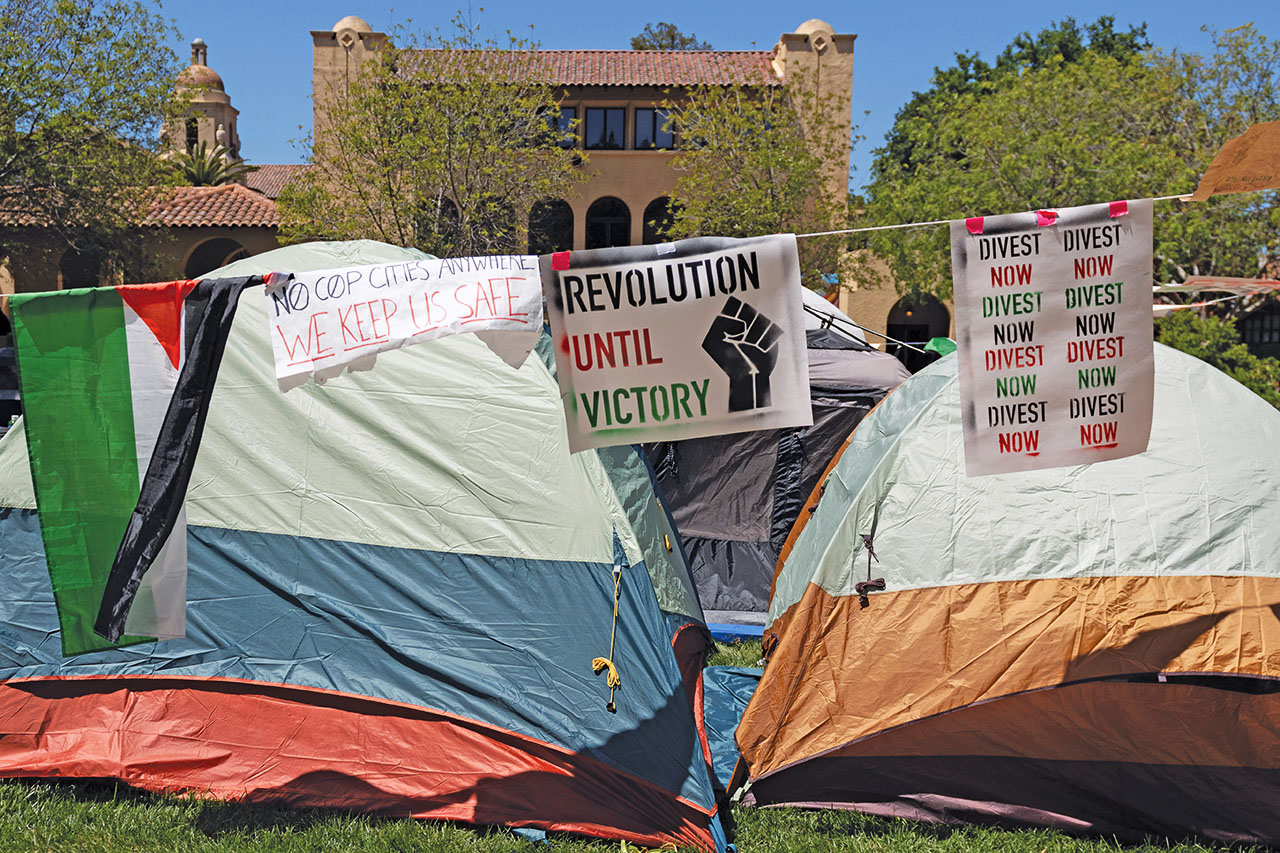
In a blow to pro-Palestinian student activists, Stanford University has announced it will not be accommodating to their proposal to “divest from companies supporting the Israel Defense Forces.”
The university announced the decision, handed down by the Board of Trustees Special Committee on Investment Responsibility, alongside an open letter issued Oct. 15 and addressed to Stanford Students for Justice in Palestine (SJP).
The letter, signed by the committee, explained the reasoning behind its decision to “take no action.”
“Our decision neither minimizes the importance of the issues raised by the conflict, nor condones the actions of any of the parties involved in the conflict,” the letter reads. “Rather, it recognizes the role of the university as a place focused on the creation and transmission of knowledge and where, regarding issues in the world, we seek to hear all viewpoints rather than to impose a university viewpoint.”
The letter described a petition received last spring asking Stanford to “divest from certain companies,” but did not say which companies. A short preamble to the letter said students had asked the university to “divest from companies supporting the Israel Defense Forces.”

Rabbi Jessica Kirschner, executive director of Hillel at Stanford, said she was pleased with the committee’s decision.
“They rightly identified how divisive the issue is on campus and within our alumni community, and chose not to take a symbolic action that would inflame things further,” she told J. in an email. “I imagine this is disappointing to advocates, who now may look for different targets for their activism, but it is very much in line with the university’s commitment to institutional neutrality.”
The trustees investment committee quoted the school’s policy on “investment responsibility” in its response.

“Just as the University does not take positions on partisan or political issues, the Trustees maintain a strong presumption against using the endowment as an instrument to advance any particular social or political agenda,” the policy states.
Protests against Israel were robust during the last school year at Stanford. Students erected a tent encampment on White Plaza, raising concerns from the campus Hillel and from some Jewish students.
The encampment was removed by the university after 13 pro-Palestinian protesters occupied the offices of the school president and provost. The protesters were arrested for vandalism inside and outside the building described as “extensive.”
Stanford is not the only school that agreed to consider divestment as part of a complex set of negotiations with student pro-Palestinian protesters. Brown University said last spring it would consider a divestment plan in exchange for the peaceful end to student protests and tent encampments. The school’s board of governors voted Oct. 8, rejecting the student proposal to divest from companies with business in Israel.
Other schools have also signaled an openness to talks on divestment; Harvard, the New School, Northwestern, Rutgers and Johns Hopkins University each agreed in some way to let students make their case. And the University of Minnesota allowed students to make a formal presentation on divestment.
In San Francisco, S.F. State University President Lynn Mahoney told protesters in May: “I welcome the opportunity to look at our investment policy to better align with our role as an agent of social justice.”

In August, SFSU announced it would divest from Lockheed Martin, Italian defense company Leonardo, equipment company Caterpillar and data and security firm Palantir Technologies — all companies identified by pro-Palestinian student protesters as targets.
The Stanford trustees investment committee has taken action before on issues of global affairs.
In 2005, students presented a plan to divest from four companies associated with atrocities in an ongoing conflict in Sudan. The university said it would unwind holdings in four energy companies with ties to the nation.
According to the board of trustees guidelines, “very rare occasions may arise when companies’ actions or inactions are so abhorrent and ethically unjustifiable as to warrant the University’s dissociation from those investments. Such activities include apartheid, genocide, human trafficking, slavery, and violations of child labor laws. These instances may be reviewed on a case-by-case basis and must meet the very high bar articulated above.”

Marc Levine, director of the Anti-Defamation League’s Central Pacific Region, said ADL welcomed Stanford’s decision.
“The request would have politicized Stanford’s investments to further SJP’s longtime goal of delegitimizing the State of Israel’s existence,” he told J. in an email. “Even worse, SJP is an organization that spent the past year glorifying and justifying the violence committed by Hamas in support of the destruction of Israel. A year after Hamas’ Oct. 7 massacre, it is heartening to learn that Stanford is reconfirming its long-held rejection of this aim.”
Besides divestment, the students also requested “full transparency into Stanford’s assets, including investments, donations, grants and contracts.” According to the committee’s letter, that request was declined because of the endowment’s need to remain competitive, among other factors.
The value of Stanford’s endowment as of Aug. 31 was $37.6 billion, according to the university.
Stanford Students for Justice in Palestine condemned the decision in an Instagram post.
“This rejection from the cowardly and complicit Trustees and administration will not stop us and our work in solidarity with Palestine until its total liberation,” the post said. “The student intifada does not end with a singular administrative rejection.”