

Updated on Nov. 7.
Robin Herzog’s father, Steffen, was 8 when he and his brother boarded a train in Frankfurt headed to safety in England.
Jacqueline Shelton’s mother, Ilse, was 17 when her train left Berlin for the U.K.
Ralph Samuel was 7 when he took a flight on his own to England from Dresden.
They were among the 10,000 children, almost all of them Jewish, saved from Nazi-occupied Europe by the Kindertransport, a massive rescue operation that brought these children to the United Kingdom during the nine months before World War II broke out in September 1939.
The children said goodbye to their parents and other relatives at train stations and airfields in Germany, Austria, Czechoslovakia, Poland and the Free City of Danzig, expecting to see them again as soon as it was safe. Most never again saw their families, who became caught up in the maelstrom of the Holocaust.
Herzog, Shelton and Samuel were among the lucky ones whose families survived.

On Sunday, they were joined by Melissa Hacker, whose Vienna-born mother was also saved by the Kindertransport, at the Jewish Community Library in San Francisco where they told their stories to a rapt, standing-room-only audience. The 85th anniversary event was co-presented by the Jewish Family and Children’s Services Holocaust Center and the Kindertransport Association (KTA), a New York-based nonprofit that connects Kindertransport participants, as well as their descendants.
“None of us would be here if Britain hadn’t accepted those 10,000 children,” said Herzog, who lives in Oakland and is co-chair of the Northern California chapter of KTA. “My grandmother didn’t hesitate to send her two boys to England on their own. I don’t know if I’d have had the strength.”
Hacker, executive director of the national KTA, described how a group of Jews, Quakers and other British citizens approached Parliament following the November 1938 antisemitic violence of Kristallnacht in Germany, convincing the British government to take in children most at risk from the Nazi Reich. They would largely be hosted by British families, with their trip to the island nation and their upkeep paid for by a host of refugee and sectarian organizations, notably the Refugee Children’s Movement and the Central British Fund for German Jewry .
“The idea was that the children would return home after the war,” Hacker said. “This was not a path to citizenship.”
Samuel, who is 93 and has lived in Oakland for 60 years, said that at age 7 he was too young to be afraid when his parents put him on that plane to London. He remembers walking down the 12 steps from the plane with a cardboard sign around his neck stating his name and the name of the family that had agreed to house him, “more like a package than a person.”

That was January 1939. When the war began in September, he was evacuated again, this time to the countryside along with 1.5 million British children, as London prepared for German attacks.
“By the age of 8, I’d been evacuated twice,” he said.
Both Samuel and Herzog benefited from Britain’s shortage of domestic servants, which led to a program that allowed 20,000 young women from Europe to enter Britain on work visas. Samuel’s mother arrived in March 1939 and was hired as a maid by the family that took him in.
“I remember very clearly eating in the dining room, and my mother eating in the kitchen,” he said.
Herzog’s grandmother — Steffen’s mother — was also able to come to England as a domestic servant, but she only saw her boys during school holidays.
“I can only imagine what it meant for him and his mother to enjoy such joy then,” compared with what was going on in Europe, Herzog said.
Before the war, Shelton’s grandparents owned a small department store in Berlin, which was “Aryanized,” or given to non-Jewish owners, after the Nazis came to power in 1933. Her mother was training to become a nurse at the Jewish Hospital Berlin during Kristallnacht “as people came in bloody and beaten,” Shelton said. The family was refused visas to the United States, which had a very strict quota on Jewish immigration, but she and her younger sister secured seats on a Kindertransport train.
At 17½, she just squeezed under the age requirement. Like most older teenagers, she entered a training program in England and was not hosted by a family. Eventually the family reunited in England, and they all managed to obtain U.S. visas thanks to a cousin in Chicago.
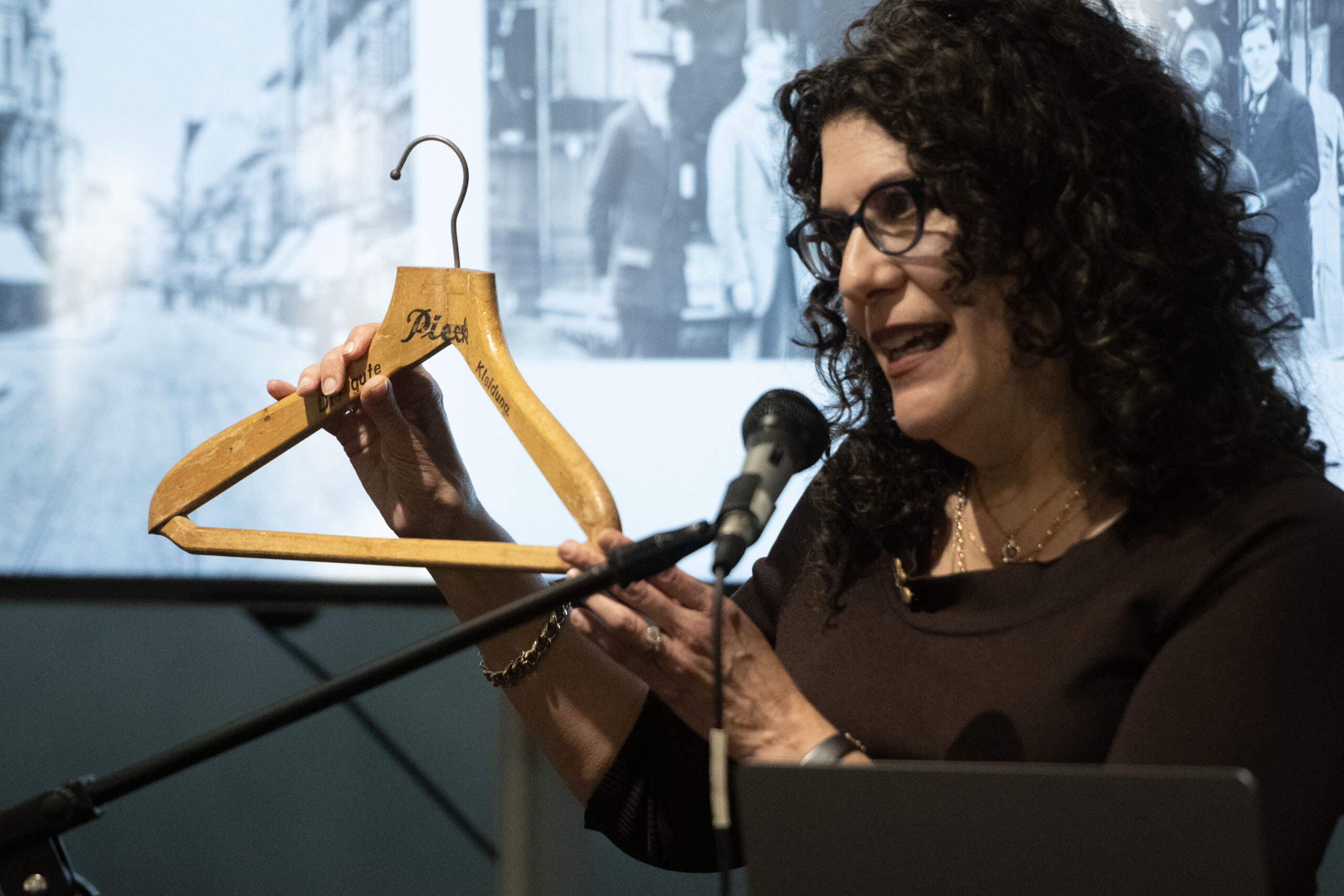
During her talk, Shelton held up a wooden clothes hanger with the name of her family’s department store embossed on it, one of seven the family took with them from Germany.
“When you don’t have much, even something as utilitarian as a wooden hanger becomes a precious family heirloom,” she said.

As the years passed, the Kindertransport children became “hidden” survivors of the war, Hacker said. They knew they hadn’t suffered like the concentration camp survivors, or those who spent the war years in actual hiding in continental Europe. For decades, they didn’t talk about their experiences.
“I always knew there was something different about my parents,” said Shelton, who lives in San Francisco and is a KTA national board member. “They had accents, they spoke German to each other, and we had a small family. Just the three of us.”
She recalls that her father would watch black-and-white Holocaust documentaries at night. “He wouldn’t let me watch with him,” she said. “He’d say, kind (child), go to bed.”
The silence among Kindertransport participants only began to change in 1989, when their first reunion took place in London. It drew more than 1,200 former Kindertransport children, some of whom had never met another participant before. A year later the KTA was formed, and the now-grown survivors were able to connect with one another and share their stories.
Today, Samuel is part of the speakers bureau of the JFCS Holocaust Center and shares his story with local students. He relearned German and has made three trips back to Germany to tell his story, two of them to students at the Dresden gymnasium, or high school, he would have attended if not for the war.
As survivors pass on, their children understand that it has become their responsibility to preserve these personal histories.
Herzog is working on a book about her father and grandmother. Meanwhile, Shelton, who has completed the KTA’s speaker training program, relates her mother’s Kinderstransport story to middle-school students in the Bay Area.
“I’m the storyteller now,” she said.