

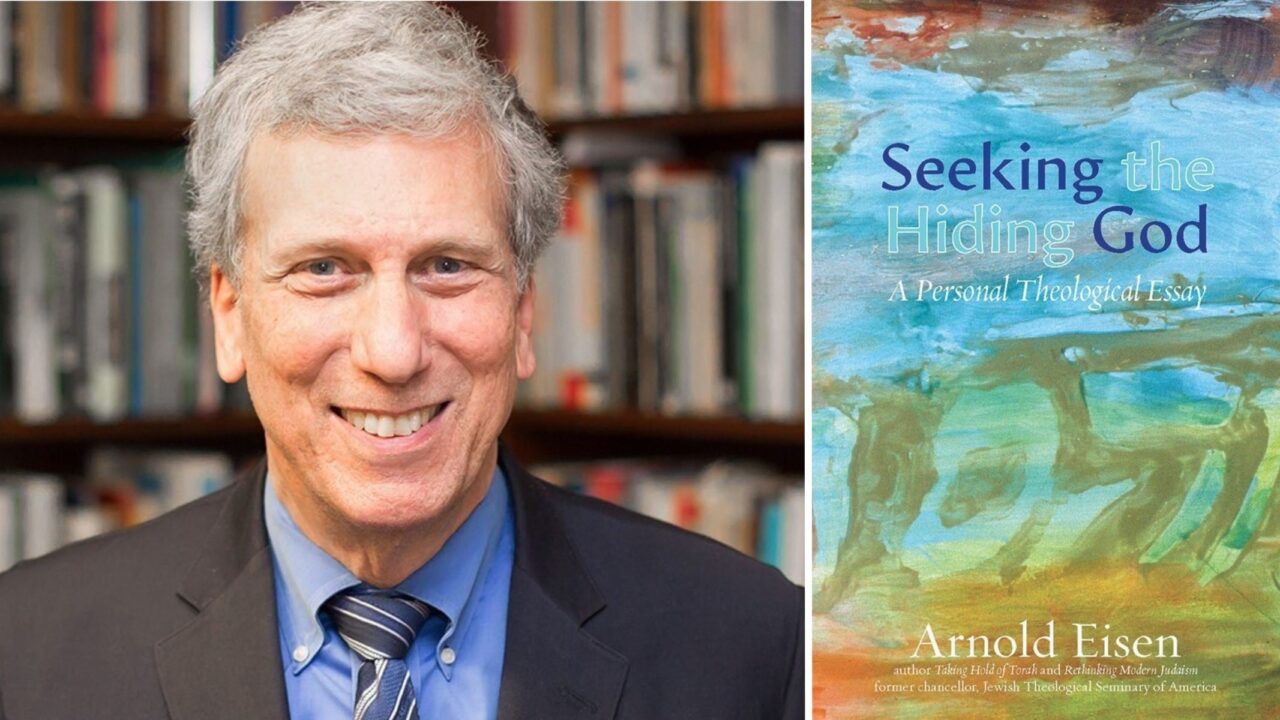
After stepping down as chancellor of the Jewish Theological Seminary in spring 2020, Arnold Eisen found himself with the time to think about a big question he’d long put off as the leader of the Conservative movement’s flagship university and, before that, as a Stanford professor of Jewish culture and religion.
“When my friends asked, ‘Arnie, why is it that you have faith and we don’t?’ — I tried to figure out what experiences in my life made me open to the possibility of faith,” he said in a recent interview with JTA.
He answers their question in a book released this fall, “Seeking the Hiding God: A Personal Theological Essay,” in which Eisen describes what he believes about a God whom he acknowledges to be elusive, if not unknowable.
The book is a professional departure for Eisen, whose previous books examined the interior lives of American Jews and the classics of modern Jewish thought. It is also a personal departure for an observant Jew who nonetheless shared the American Jewish allergy to what he calls “fervent God-talk.”
“I was writing scholarship about other people’s Jewish thought for something like 40 years, but I always somehow avoided facing the questions of what I actually believe,” said Eisen.
Begun during the Covid-19 lockdown and finished after the 2023 Hamas attack on Israel, the book synthesizes the thoughts of some of Eisen’s intellectual heroes, including the Conservative movement theologian Rabbi Abraham Joshua Heschel and the German-Israeli philosopher Martin Buber.
From Heschel he learns that Judaism is a call to action; from Buber, that miracles aren’t evidence of the supernatural, but an invitation to “abide in the astonishment” of creation. In this interview, Eisen, now 73, said his aim is not to prove to the reader that God exists, or is good but to offer one Jewish believer’s account of how Judaism makes sense of the world.
This conversation has been edited for length and clarity.
JTA: Why did you feel the need to write a book of theology?
Arnold Eisen: I wanted to try to do an account of what I myself believed about God. I had a sabbatical year off, and it turned out to be the Covid year, and it was also the year I was about to turn 70. So there was this confluence of circumstances that led me to sit down and think hard and reflect.
I am thinking of an old radio program, “This I Believe,” where guests had to lay out their philosophies in five minutes. Do you have the elevator pitch version of your theology?
I don’t have that pitch, but let me start with the title: ”Seeking the Hiding God.” The dominant theological issue in Jewish life for the last couple generations has been the Holocaust, and one of the major theological responses to the Holocaust is what we call [in Hebrew] “hester panim,” the hiding of God’s countenance, a phrase from the book of Deuteronomy. Some Jewish thinkers apply this not only to reactions to tragedy, but to the condition of modern life.
I had the sense for a long time that if I was a better person or more devoted to my Judaism, that I would be granted a more robust set of religious experiences, and be more certain about this God that our tradition teaches us can be encountered. And what I came to recognize is that my sporadic, momentary, ephemeral encounters with God were far more typical than not, and that many Jewish thinkers testify that this is precisely the kind of experiences that they’ve had as well.
A word that keeps coming up in your book is “action,” and how human action is key to bringing out redemption, or righting injustice. That seems key to your theology.
Absolutely central. I’m a child of the ’60s, and I saw that political action and social activism made a difference for good in the world. In Heschel, I had this personal example. … I got to meet him, and he left me convinced that that piety does not stop in the synagogue. In his book “God in Search of Man,” he writes that Judaism doesn’t take a leap of faith. It takes a leap of action. And that paragraph means everything to me.
You write that when you teach American college students about Buber and Heschel, they ask “why these thinkers needed to talk about God so much when what they really cared about was ethics.” It’s the classic question: Can’t you be good without God, and what does belief in a supreme being add to the equation?
Yes, one could have a good life without God. And one does not have to be a Jew to have a good life or whatever afterlife is promised to us. But if this is an eternal human search, and if you can have the grace of encounter with God — why would you possibly want to live without that?
You write in your book, “Jews engage in sustained or fervent God-talk much less than Americans of other faiths.” As someone who was in the business of training rabbis for 10 years, do you see that as a failure of the synagogue or other institutions?
I’m acutely aware of how difficult faith is in the modern world, especially for Jews in America, where we are such a distinct minority. I had the experience [of recently] speaking at a synagogue in San Diego, and having to tell committed Jews that the theology which says God is responsible for everything that happens in the world is by far not the only Jewish theology there is. One does not have to believe that the Holocaust happened with God’s acquiescence, let alone with God’s active participation. And [the audience] was simply not aware of all these options. They’ve never been exposed to them, not as adults and not back in Hebrew school. That, to me, that’s tragic.
I want to ask how your ideas about God and practice and action might address the questions you just posed.
We’re in a difficult time. Because of AI, people are going to lose their jobs, and people who have jobs are going to be [doing something] completely different than they were before. And it’s scary because of climate change: The catastrophe is imminent, and at some level, we all know this. The Hamas attack on Oct. 7 made tragedy and fear visceral for many Jews, and some of them flocked back to Jewish communities. They want contact with their tradition. They’re looking for meaning. It’s a moment of crisis, but it’s a moment of great opportunity. We just need to be creative.
How does Israel fit into your theology?
Israel is crucial to my Judaism, but not because God is doing this. I don’t know what God is doing there. I pray that it will turn out to be the beginning of the flowering of our redemption. But who knows?
My teacher David Hartman [the late Israeli American philosopher] taught me … that the theological model for Israel is not Exodus, but Sinai, where what is important is that Jews try to live up to the responsibilities of the covenant, and that they translate the ethical principles pronounced in the 10 Commandments. Israel opens up new possibilities for covenant. What can we do now that we’re a majority responsible for non-Jews as well as for Jews, Jewish health care policy, Jewish foreign policy, Jewish educational policy, etc.? It’s a great opportunity to see what mitzvah can mean in the modern world.