

Jews across the U.S., including in the Bay Area, have donated generously to campaigns to support Israel and to fight antisemitism since the Oct. 7, 2023, Hamas attack.
But there’s a flip side.
In the past year, many have given less money to local Jewish organizations whose missions — whether related to education, social services or culture — don’t revolve around today’s politically charged issues, Bay Area nonprofit leaders tell J.
Coming as nonprofits continue to recover from the impact of the Covid-19 pandemic, the funding shift has hit hard and, in some cases, could have long-term consequences.

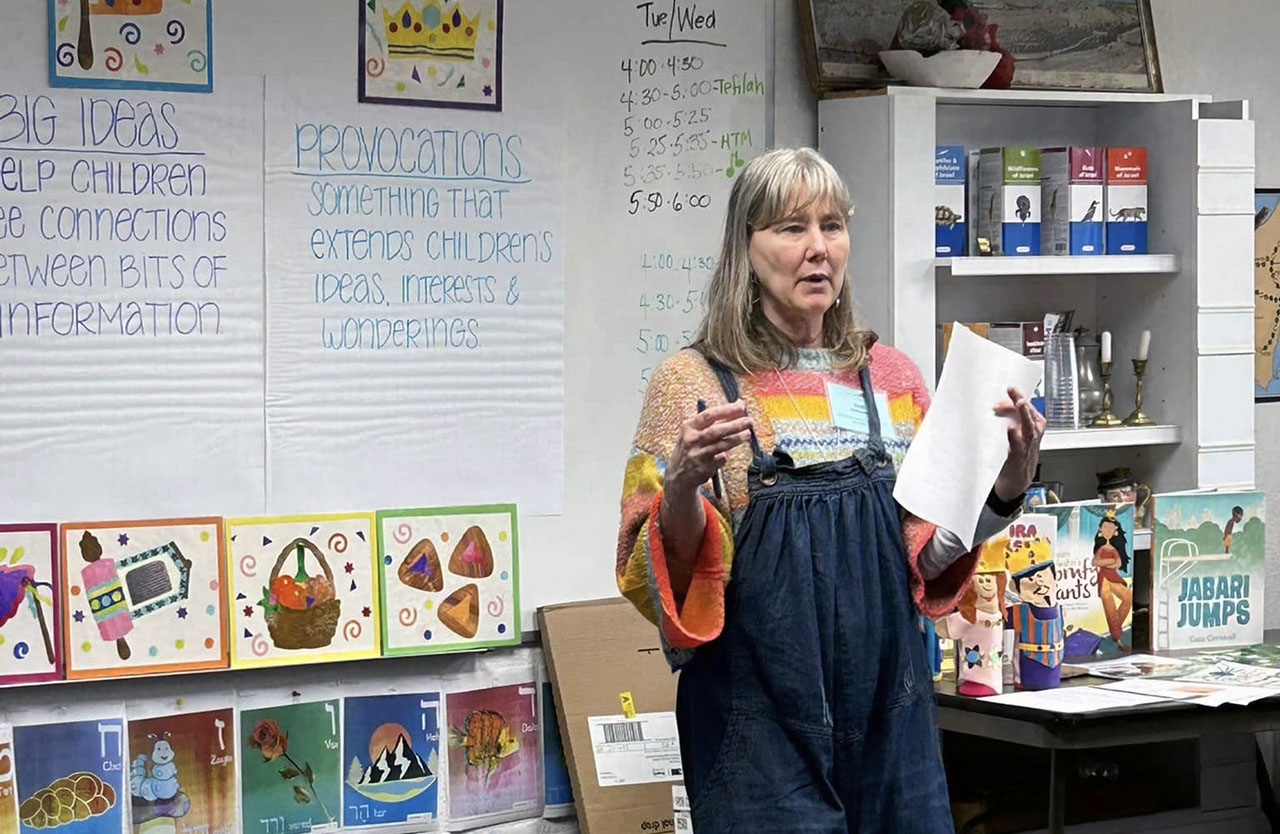
“We’ve literally seen both the number of individual gifts we receive and the amount of individual funding we receive just kind of slide down,” said Dana Sheanin, CEO of Jewish LearningWorks. Long known as the Bureau of Jewish Education, the 126-year-old nonprofit trains and mentors Jewish educators across the Bay Area.
Climate changes
Jewish LearningWorks isn’t alone.
Shalom Bayit, the Bay Area’s Jewish domestic-violence prevention organization founded in 1992, has seen a 25% drop in donations from individuals since the Oct. 7 attack, executive director Naomi Tucker told J.
“The place where we began to see it pretty immediately was with individual donors,” some of whom “directly told us that they were pivoting and redirecting all their philanthropy to Israel,” Tucker said. “That was a message that we got loud and clear from many different people. And then there’s sort of the quiet exodus of donors who just didn’t renew their support.”

Urban Adamah, a 13-year-old Jewish urban farm on 2 acres in Berkeley, has also seen a dip in donations since the Israel-Hamas war began, said executive director Adam Weisberg.

“In the months following Oct. 7, we did hear from, not a huge number but certainly a number of donors, who said that they were considering or were giving more to organizations directly offering assistance in Israel or working to address antisemitism in North America, and therefore they might not be giving as generously to Urban Adamah as they had in past years,” he said.
Robin Mencher, CEO of Jewish Family & Community Services East Bay, said the story has become a familiar one.
“Almost everyone else I’ve spoken to in the Jewish nonprofit space experienced a reduction of donations at year’s end in 2023,” said Mencher, whose 147-year-old organization provides social services to Jews and non-Jews, including refugees from Afghanistan and Ukraine.
Some donors told her: “‘We’re not saying goodbye to you, but we’re really feeling called in other directions,’” Mencher said. “I very much respect that and understand it.”
Coming together for Israel
In August, the Jewish Telegraphic Agency reported that Jewish federations across North America raised more than $850 million in aid for Israel after Oct. 7. As part of that effort, the San Francisco-based Jewish Community Federation and Endowment Fund set up its own Israel Emergency Fund and disbursed $22 million by June 2024 to Israel-related causes.
The Anti-Defamation League likewise experienced a post-Oct. 7 bump in donations for its work in combating antisemitism. According to national communications director Todd Gutnick, donations for the six months following the Oct. 7 attacks were up around 40% from a similar period a year earlier.
“Philanthropy often flows where there is need in times of crisis, and that’s certainly something we’ve experienced at ADL,” regional director Marc Levine told J.

Levine said the money has enabled the ADL to fight antisemitism in “K-12 schools and universities, the workplace, health care settings and online.” However, he added, “it is important to remember that long-standing challenges addressed by nonprofits haven’t gone away during this crisis.”
(J., which is a nonprofit, saw a small bump in donations directly after Oct. 7 in response to its reporting on the local spike in antisemitism.)
The nonprofit executives who spoke with J. said that people should of course donate to the causes they consider most urgent, but those same leaders also want the community to remember the needs that local groups have been filling for years and decades.
“What I’ll say to both individual donors and foundation partners is that we totally recognize the importance of those other areas that they’re funding, and we honor that they need to focus in the areas that they think are most pressing, critical,” Weisberg said. “And we hope that they will consider some degree of continued funding for our work, given the investment they’ve made over the years.”
An already-tricky situation
In addition to a drop in donations from individuals, institutional giving has, in some cases, waned.
The San Francisco-based Walter & Elise Haas Fund, which gave out about $13 million in grants in 2023, announced in November last year that it had “paused the Jewish life grantmaking program” and would take no applications in 2024. The foundation is part of the philanthropic network of the Haas family, inheritors of the Levi Strauss fortune, which has a long history of donating to Jewish and other causes.
Shalom Bayit’s Tucker said she knows of some smaller foundations that are “winding down” their operations. “That seems to be a current trend,” she said. “It’s happening among several family foundations that I know of.”

Jewish LearningWorks has been “holding steady” in terms of foundation money this year, Sheanin said, but the situation isn’t encouraging.
“In the long term, what I would say is the foundation landscape in the Bay Area — and I’m sure you’ll hear this from my colleagues — is really shifting in a way that feels not great,” she said.
Meanwhile, the S.F-based Federation, which for generations had acted as the central clearinghouse to funnel donations to local Jewish organizations, decided in 2023 to make a significant shift in its focus to that of a philanthropic adviser, with donor-advised funds and giving circles — both of which put more control into the hands of donors. The Federation does still award grants, including 26 grants this fall totaling $670,000 to fight antisemitism in the Bay Area.
“The bulk of their resources are donor-directed, and they’re not in a position to solve this problem for us,” Sheanin said.
According to Rebecca Randall, the Federation’s chief philanthropy officer, although some Bay Area Jewish groups saw a dip in donations, “even some of the region’s smallest Jewish charities received more grants from Federation’s donor-advised funds in 2024 than they did in 2023.”
What’s more, Randall said, since July 1 of this year the Federation, through its annual campaign, restricted fundraising and endowment funds, awarded over $8 million to Bay Area Jewish institutions and $2.5 million to global and Israeli organizations.
“This underscores that, while giving to Israel and global organizations remains strong, the overwhelming majority of Federation grants over the past six months have gone to local institutions,” Randall said.
Weisberg said Urban Adamah has seen institutional support weaken.
“In the past months, [we] learned that two foundations that have provided major support over a decade-plus will not be continuing that support because they’ve shifted their priorities and their focus to other areas,” he said. Fortunately, he added, individual donors have stepped up to fill that gap.
Shalom Bayit had previously raised money from non-Jewish foundations that focus on domestic violence prevention, but such sources have dried up post-Oct. 7 because, according to Tucker, supporting a Jewish organization, regardless of its mission, is seen by some as “giving to the oppressor.”
“It’s almost impossible to get non-Jewish funding now, so we rely on funding within the Jewish community. And funding within the Jewish community, in the world of Jewish philanthropy, has really been shifting,” she said, in part because of Oct. 7.
Organizations on shaky legs
The real-world consequences of current fundraising trends include layoffs, hiring freezes, scaled-down operations and actual closures.
For Sheanin, this is not a future problem but a present one. Jewish LearningWorks has seen a nearly 50% drop in annual gifts since the Oct. 7 Hamas attack.
“We are down two staff positions since last December,” she said, bringing the number of employees to seven.

Mencher of JFCS said that a drop in donations has delayed implementing parts of its strategic plan.
“The collective impact, I think, is that underinvestment in the vibrancy of our Jewish community here in the Bay Area really does have long-term repercussions,” she said.
Two local organizations shut down this year and another is on shaky legs, although it can’t be said with any certainty whether the post-Oct. 7 funding shift was the final straw.
Social justice group Jewish Youth Community Action announced this fall that it would close, citing “chronic” staff turnover, financial woes and other struggles. It was one year shy of its 30th anniversary.

The Jewish Coalition for Literacy — a program of the Jewish Community Relations Council Bay Area — closed down this summer after 25 years of helping grade-school students learn to read. “After Oct. 7 and the crisis that ensued, JCRC had to direct all available resources to really address the needs of the community facing the alarming rate of antisemitism and anti-Israel vitriol,” Jan Reicher, JCRC’s board president, told J. at the time.
Then in November, the Contemporary Jewish Museum announced that it would close for at least a year to regroup and reassess its finances. Dec. 15 is the last day CJM will be open to the public. Executive director Kerry King told J. that “no one factor” created the institution’s yearslong financial problems but that donors pivoting to Oct. 7-related giving “has been a factor.”
An uncertain future
The situation for Jewish nonprofits going forward feels fraught, Sheanin said.
“I actually think it’s going to get worse for a lot of our organizations,” she said. “And I’m fearful.”
This instability makes it harder to plan.
“Every year, some people step up, some people step back, so you maintain some kind of equilibrium,” she said. “You never can be sure of exactly where we’re going to come out, but you feel like you have a relatively good chance of making your number.”
Tucker feels frustrated because she considers Shalom Bayit’s work as important as ever. Many domestic abuse survivors continue to struggle over the global denial of sexual violence perpetrated by Hamas on Oct. 7, and over the re-election of President Donald Trump, who was found liable for sexual abuse. Shalom Bayit has also faced antisemitism from former allies in the domestic violence prevention arena and even from former funders, Tucker said.
“It’s not as if there’s a decrease in the need,” she said. “There’s more difficulty, and yet we have a lot less funding. So that’s been really hard.”
Mencher expects the community’s need for JFCS services to grow during the coming Trump administration, which plans to target immigration, both illegal and legal. The nonprofit has assisted more than 2,150 people from Afghanistan and the Ukraine since 2021 through its refugee services program.
“There’s no shortage of work to be done,” she said.
Barry Finestone, CEO of the S.F.-based Jim Joseph Foundation, which has been a strong funder of Jewish education, warned in a November 2023 eJewishPhilanthropy op-ed that donors shouldn’t forget American Jewish organizations as they pour donations into helping Israel.
“Right now, the Jewish philanthropic community must have a ‘yes, and’ approach toward funding,” he wrote. “Yes, we absolutely need to support Israel and Israelis. … Meanwhile, the American Jewish community needs to stay intact. Unless philanthropy steps up in the U.S. as well, there is a genuine chance much of the organizational structure we have spent generations building will be stretched to the limits.”
If that happens, more nonprofits — especially those without a significant endowment — may go under.
“In the case of the really impressive tapestry of Jewish organizations in the Bay Area,” Sheanin said, “we will never build back up all that we have if we lose it.”