

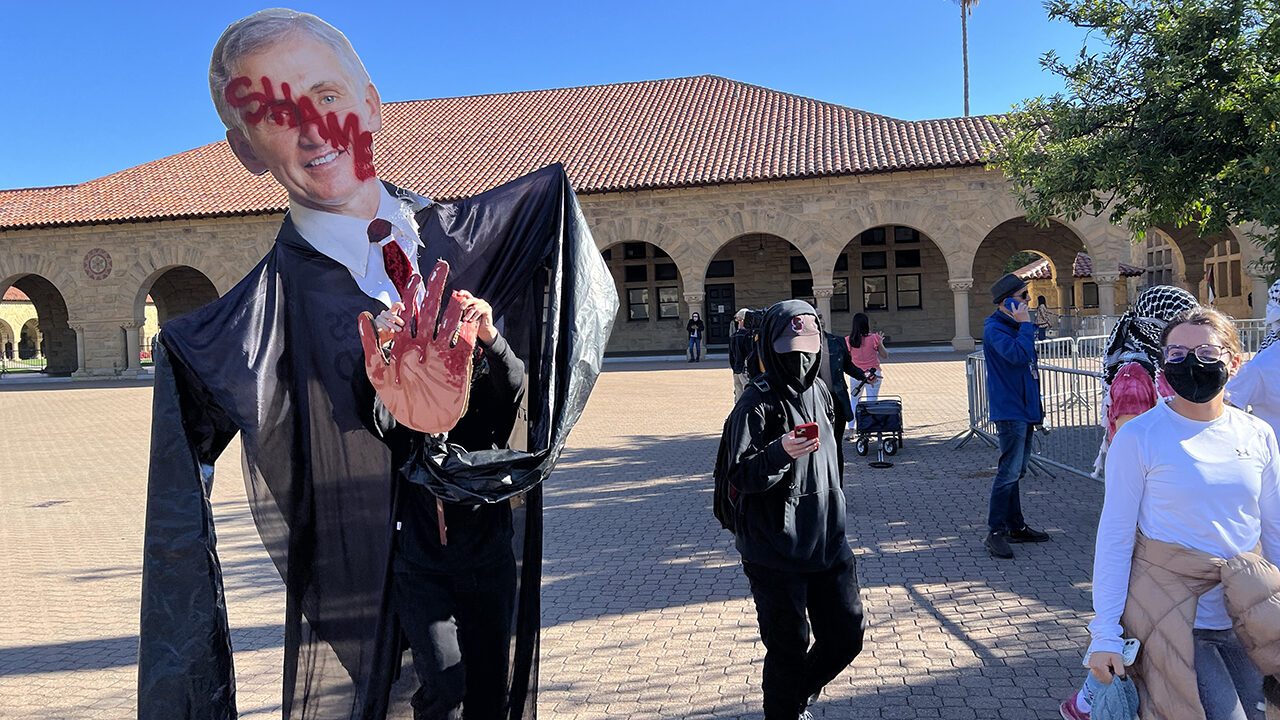
All 12 pro-Palestinian protesters arrested during a dramatic takeover of the Stanford University president’s office last June have been charged with felonies by the Santa Clara County District Attorney’s Office.
“Dissent is American. Vandalism is criminal,” District Attorney Jeff Rosen said Thursday during a press conference in San Jose.
The decision to charge them with felony vandalism and felony conspiracy to trespass represents a muscular salvo against the protesters, who were demonstrating against Stanford’s investments in Israel-linked companies. Nine were undergraduate students at the time of the incident, according to police. The defendants could face more than three years in prison, but during the press conference and in a phone call with J. recently, Rosen indicated that prosecutors won’t likely seek such a harsh penalty for defendants who plead guilty.
Police initially arrested 13 people, but prosecutors later dropped their case against Dilan Gohill, a student journalist who was covering the demonstration for the Stanford Daily.
Around 5:30 a.m. June 5, on the last day of classes of the spring quarter, “dozens” of protesters, police said, amassed near Building 10, which houses the office of the president. At the time, Richard Saller was interim president.
Masked demonstrators, carrying tools such as crow bars, hammers and an angle grinder, broke into the building, according to a police summary of events, which included photos of the tools. The demonstrators covered surveillance cameras and barricaded the doors using ladders, furniture and other equipment, the summary said. Police began to enter the building around 7 a.m. and found 13 people there.
Prosecutors said the effort was carefully planned using the encrypted messaging app Signal and a digital pamphlet called “The Do-It-Yourself Occupation Guide.” The guide, which is available online, is a handbook for radical demonstrations that includes tips and suggestions. “Use an angle grinder to cut through locks, bolts and chains,” it states. On the question of vandalism, it reads, “Occupying a space removes the space from the capitalist landscape. A group may decide it is better to destroy or vandalize a space than to return it to its usual role in good condition.”
Vandalize the space they did, according to photos, social media posts and a written account by police.
Photos in a police document show damaged door frames, a ransacked office and papers stained with a red substance. One photo shows an Israeli flag soaked in the red substance, which police described as fake blood.
Graffiti left on the outside of buildings included “De@th 2 Isr@hell,” “Kill Cops,” “Pigs Taste Best Dead” and “School $$$ Is Blood $$$,” though it’s unclear whether the defendants were responsible for that graffiti. Those messages weren’t included in the police document.

“Stanford University has documented over $250,000 in damages as a result of the occupation and vandalism to the building,” the police document states.
The California threshold for felony vandalism is $400.
The felonies represent a rare, but not unheard of, charging decision from a local prosecutor in the case of pro-Palestinian student activism. At the University of Michigan, seven protesters were charged with felonies for resisting arrest or obstructing police when authorities tried to remove them from a tent encampment last May. Eight protesters arrested at the City College of New York last April were charged with felony burglary after an attempted sit-in.
In a phone call with J. on Friday, Rosen said the demonstrators’ political positions were not a factor in his charging decision, referring to the defendants as “conspirators,” not protesters. Universities are not “accountability free zones,” Rosen said during remarks Thursday.
“Say they’re acting this way because they want us to help Ukraine, or they want us to help Russia, or they want us to treat animals more fairly, or they want us to all drive electric vehicles,” he told J. “Their cause is their cause. Their speech is protected under the First Amendment. Vandalizing property is not.”
Charges of felony vandalism and felony conspiracy to trespass carry up to three years and eight months in prison, though Rosen envisions alternatives to incarceration.
“I don’t think this is a prison case. I’m not going to ask for prison. I don’t even think it’s a jail case,” he said, adding that he hopes defendants will plead guilty, “make restitution to Stanford University” and then perform some type of court-ordered cleanup work. To “help clean up trash on the side of the road or clean up public buildings,” he said. Rosen, who is Jewish, referenced “teshuvah,” a Hebrew word meaning “repentance” that is often used during Yom Kippur.
All of the 12 defendants are American citizens. Rosen said half had already turned themselves in to authorities.
Stanford issued a statement on the charging decision, saying that it had already disciplined the students with suspensions, probation, “delayed degree conferrals” and community service.
“We believe the decision on how to proceed with these cases rests with the Santa Clara County District Attorney’s Office based on the evidence gathered,” according to the statement emailed to J. from Stanford spokesperson Dee Mostofi. “We respect their decision in this matter.”
The Council on American-Islamic Relations San Francisco Bay Area strongly condemned the charging decision, describing it as the “criminalization of student free speech” and of pro-Palestinian protesters.
“This is a shameful attempt to punish students for speaking out against genocide,” chapter executive director Zahra Billoo said in a statement, calling the students’ actions a “form of political expression.”