

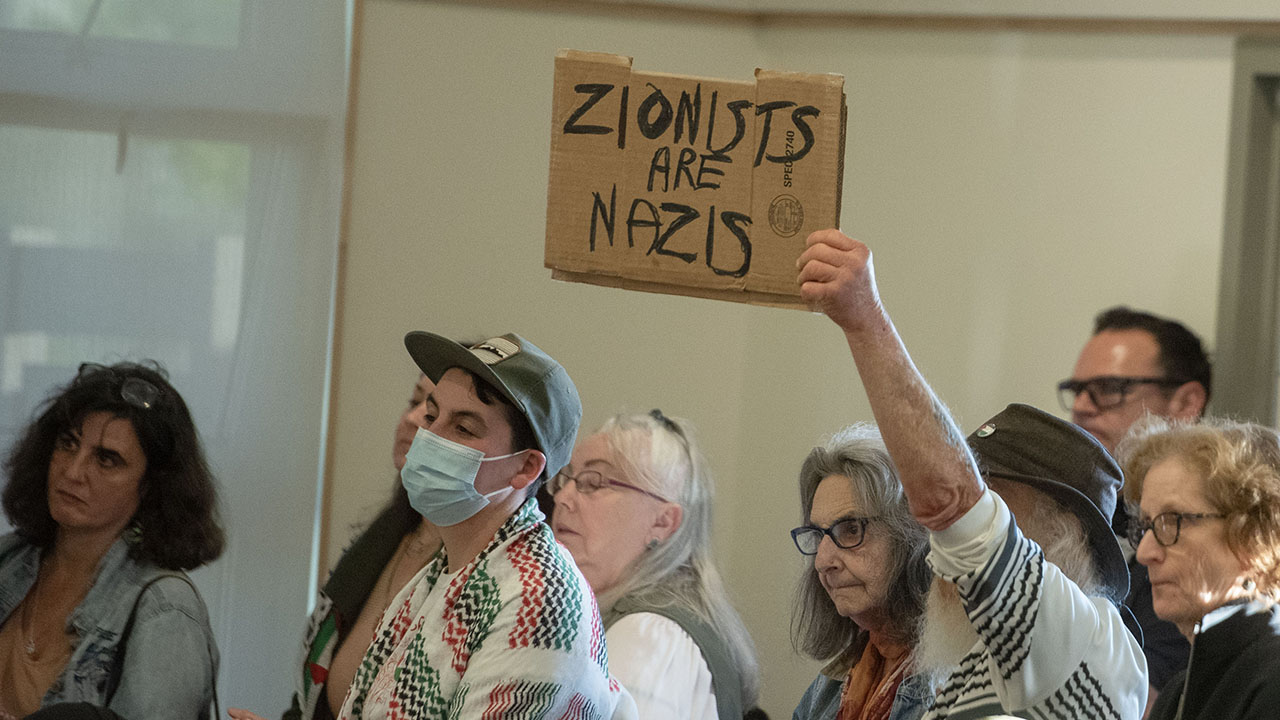
After a seven-hour, single-topic meeting on Monday, with nearly 130 public comments, the Berkeley City Council passed a resolution on Israel’s war in Gaza — but it was neither the resolution pro-Palestinian activists have loudly pressed for, nor what the pro-Israel community wanted.
Ever since the Hamas attack on Israel on Oct. 7, 2023, and Israel’s military response in Gaza, pro-Palestinian activists in Berkeley have pressured the city to take a formal stand against the war and to call for an end to U.S. military aid to Israel. A former councilmember told J. that members’ inboxes were flooded with emails, sometimes “thousands a day.”
The pro-Israel community, by contrast, has repeatedly asked the council not to pass any resolution on the conflict. The Jewish Community Relations Council Bay Area, for example, has said it would only further divide the Berkeley community.
In an online alert prior to Monday’s meeting, titled “Don’t bring the Israel-Hamas war home,” the JCRC called a proposed resolution “divisive” and urged Berkeley residents to join them “to reject any resolutions that will inflame community tensions and create a forum for hate.”
Neither side got its way, after a bruising meeting filled with intense public comments.

As at many comparable meetings in Oakland, San Francisco and Berkeley since the Israel-Hamas war began, some speakers veered into extreme anti-Israel animosity and antisemitism. Speakers pounded the podium and shouted insults at the council, calling them “Nazis” and “cowards.” Former councilmember Cheryl Davila accused current councilmembers of “being bought and paid for by AIPAC,” a reference to the pro-Israel lobbying group American Israel Public Affairs Committee.
Mentions of Oct. 7 atrocities — when Hamas massacred 1,200 people and took 251 hostages — were greeted with shouts of “lies!” References to relatives killed in the Holocaust drew exaggerated, audible yawns.
Outside the venue, as more people jostled to get into the room after the fire marshal declared it was full, at least one altercation erupted between two women and two men, resulting in a Jewish man being put in a headlock as his clothing was torn. Berkeley police arrived, but no arrests were made.
In the end, the council decided to tack toward the center, with a resolution that did not condemn Israel or Hamas and that opposed both antisemitism and Islamophobia.
With six councilmembers present and three participating by Zoom, the council declined to consider the resolution put forward by its own Peace and Justice Commission (PJC). Prepared last September but not put on the council’s agenda until this week, the resolution called for an “immediate and permanent” cease-fire in Gaza, a halt to U.S. military aid to Israel and self-determination for the Palestinian people.
Instead, the council voted 7-1, with one abstention, to accept an alternate resolution prepared by councilmember Terry Taplin.
Stating that the city of Berkeley “has no jurisdiction over international affairs,” Taplin’s resolution crossed out most of the language of the PJC resolution, leaving only its references to the war’s impact on individuals within the Berkeley community, an affirmation of the “city’s aspirations for a lasting peace” and the safety and security of all Berkeley residents, and its condemnation of anti-Jewish and anti-Muslim sentiment at home and abroad.

Since the start of the Israel-Hamas war, more than two dozen cities and public bodies in Northern California have passed resolutions calling for a cease-fire.
Berkeley, however, had resisted continual pressure from pro-Palestinian activists to entertain such a resolution.
At a Berkeley City Council meeting in November 2023, soon after Oakland and Richmond passed strongly worded cease-fire resolutions, then-Berkeley Mayor Jesse Arreguin declined to bring forward any such proposal. In a statement released hours before the 2023 meeting, he said, “These resolutions will not end the violence abroad, but they do fan the flames of hatred here at home.”
When Taplin presented his resolution early in Monday’s meeting, it was greeted by loud boos and jeers from the pro-Palestinian contingent, which constituted the majority of the nearly 200 people packed into the small room. He was called a “coward” and a “traitor,” among other names.
About a dozen pro-Israel members of the public sat together near the front of the room, some of their chairs bearing photos of the 59 hostages still held in Gaza.
During the five-hour public comment period, 98 speakers supported the PJC resolution, and 31 opposed it. The former speakers were cheered, and the latter were booed.
Mayor Adena Ishii tried over and over to maintain order, pleading with the activists to stop interrupting speakers and calling people names. Emotions were high, and at one point Ishii broke down in tears while describing the suffering of the Gazan people. That did not, however, put a stop to the mayhem.
Public comments ranged from tearful to resolute to angry.
“I urge you to support the PJC resolution in its entirety, and not the watered-down version put forward by councilmember Taplin,” one member of the public told the council during his allotted one minute to speak.
Other comments showed the deep pain that pro-Palestinian Berkeley residents are feeling.
“My tax dollars were used to kill my family in Gaza,” said one woman, who described herself as Palestinian American, before referencing “the pure evil that is Israel.”
“There are people dying,” another speaker said. “To turn a blind eye to that is a crime that will be remembered.”
Most of the pro-Israel speakers said they supported Taplin’s resolution, with one woman on Zoom saying, “Taplin’s resolution focuses on the pain felt on all sides. It tries to bring people together.”
Speaking to J., Alameda resident Mike Devine said he “certainly wants the war to end,” but criticized the PJC resolution as being one-sided.
“It doesn’t respect the existence of Israel as a Jewish state,” he said. “It uses the word ‘ethnonationalism,’ which is code for an anti-Zionist position. It talks about self-determination for the Palestinians, but no equivalent for Jews. It’s a BDS resolution in disguise.” BDS is an acronym for the boycott, divestment and sanctions movement against Israel.
As the meeting’s midnight deadline approached, and it became clear the council was not going to entertain the PJC resolution, the room erupted in anger. Dozens of activists ran up to the front, clapping and chanting “Free, Free Palestine!” and “From the river to the sea, Palestine will be free!” — a reference that many Jewish groups see as a call for the destruction of Israel.
The protesters did not allow the meeting to continue, and after several minutes, councilmembers walked out.
Unbeknownst to those in the room, however, the council had quietly voted before leaving. The sole “nay” vote belonged to councilmember Cecilia Lunaparra, who was elected to the council in April 2024 just before she graduated from UC Berkeley. Wearing a kaffiyeh around her neck and long, dangling earrings in the colors of the Palestinian flag, she spoke passionately in support of the PJC resolution and was cheered by the activists.
Speaking to J. after the meeting, former councilmember Sophie Hahn, who is Jewish, said she was disappointed that councilmembers passed any resolution about the war. They did so, she said, simply because the constant pressure from activists wore them down.
“Since Oct. 7, the council was lobbied heavily through letters and protests,” said Hahn, who served eight years on the council before she lost her bid for mayor in November. “The pressure, the disruption of council meetings and the thousands of emails — sometimes thousands a day — were nonstop.”
Hahn said she received threatening phone calls, including from one man who said he was going to come to her house so she might as well push through a cease-fire resolution “and get it over with,” she recalled.
“I’m actually sorry the council chose to take action,” she said, noting that she spoke to some councilmembers recently who said they hoped passing such a resolution would end the disruption of meetings.
“Certainly the actions of the activists to shut down [the] meeting shows that won’t happen,” she said. “Being forced to take any action at all is a shame. I don’t think it’s a win for democracy.”