

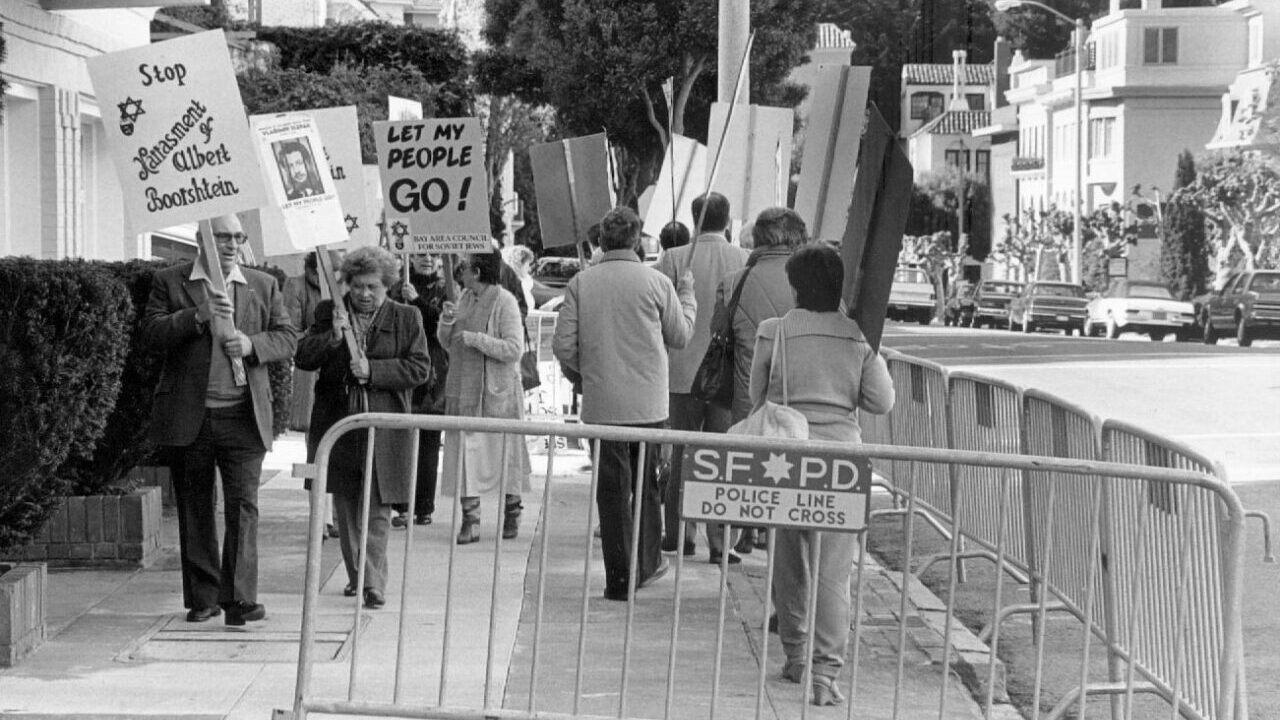
Archiving efforts to free Soviet Jews
We appreciated your cover story on Jewish organizations archiving their historical materials. (“Saving the past for the future: How local Jewish orgs are preserving their history,” May 19)
The Bay Area Council for Soviet Jews (BACSJ) was the most active organization of its kind in the United States. After Natan (Anatoly) Sharansky’s release from prison in 1986, he asked his wife, Avital, which organization was most effective in its efforts on his behalf. She replied, “The Bay Area Council.”
BACSJ began in 1967-68, had thousands of members and closed 30 years later. Mission completed.
Led by courageous activists in the USSR and here, we helped free over 1,600,000 Jews. Our legacy is more than history. It’s a lasting blueprint for Jewish courage, activism and unity.

Now we are working together to educate and inspire future generations about the miracle of “The Second Exodus.” We’ve created the Soviet Jewry Movement Archives Project.
To learn more, visit sovietjewryarchives.org or contact us at [email protected].
John Rothmann and Morey Schapira
BACSJ past presidents
Kosher wine vs. ‘Jewish’ wine
I read with interest the May 15 sponsored content in J. headlined “Jewish Food & Wine Retreat returns to Camp Newman in September.”
Then I read farther down in the section about wine that most of the wines being poured will not be kosher. However, they will be made by local Jewish winemakers.
Welcome to Wine Cluelessness 101. I certainly don’t begrudge any Jewish winemaker from celebrating their Jewishness with the wines they make. However, to call their wines “Jewish” simply because they, themselves, are Jewish is what we call a “shanda.”
Jewish food, kosher or not, attempts to adhere to some kind of cultural and/or religious tradition. That’s easy. But to make a Jewish wine, what tradition do we follow? It’s simple. We make it kosher.

I might make an exception for non-kosher wines produced in Israel, which by their very existence, acknowledge Jewish history and heritage.
But I’m sorry, California Jewish winemakers who make not-so-Jewish wine — even if it tastes great — should acknowledge their own BS. As a winemaker who actually makes the effort to keep his wines kosher, I’m insulted by this secular Jewish embrace of cultural expediency. It’s not legitimate. It’s not OK. And it’s definitely not Jewish.
Jeff Morgan
Covenant Wines co-owner
Berkeley
Clear message from Oakland schools
Even though the Oakland Unified School District determined that an unauthorized teach-in included “highly charged terminology” that would have made Israeli or Jewish students feel “unsafe,” the district decided not to discipline anyone involved. (“Oakland schools decline to discipline staff over 2023 pro-Palestinian teach-in,” May 20)
The message from the district to pro-Palestinian activists in the district’s teachers union is clear. They expect parents and school officials in Oakland to passively acquiesce when their schools are usurped to advance a political agenda. They do not expect any consequences as long as the students potentially affected by “highly charged terminology” are Jewish instead of, say, Muslim.
Julia Lutch
Davis
‘Food as a political tool’
Thank you for the article on the rally protesting the war in Gaza. (“Oakland rally mourns loss of life on both sides as Israel-Hamas war drags on,” May 5) It is important to publicize that many in the U.S. Jewish community are speaking out against the Israeli government.
As a Jew and a supporter of Israel, I am increasingly torn by what is going on. Most recently the State of Israel has resumed military operations with little evidence that it will accomplish more than it has already. Moreover, it has begun using food as a political tool, starving the Palestinian people and turning others around the world against Israel. Israel’s actions against the Palestinians have now become the cause of the increase in antisemitism.

The prevention of adequate food and medical supplies for entering Gaza is especially appalling. First Israel prevented any supplies from entering the area for some 2½ months. Then, in response to world opinion, it said it would allow food but severely limit the places where food would be distributed and screen who would get it and who wouldn’t. Realizing that it did not have infrastructure in place to manage the distribution, it then said the U.N. could resume its role temporarily but restricted the amount of food to a tiny percentage of what is needed to keep people from starving. Who knows what will happen next?
Are Netanyahu, National Security Minister Itamar Ben-Gvir and Finance Minister Bezalel Smotrich and their followers thinking that starving 2 million Palestinians isn’t so bad compared with the 6 million Jews killed by the Nazis? This situation must be brought to a close.
Jon Kaufman
Oakland
Imagine a cease-fire during WWII
The people at the Oakland rally for peace by SFBay4Peace, J Street and others don’t realize that wishing for and wanting peace is not the path to peace. Heed the lessons of World War II. A phony cease-fire in the middle of the war would have left Hitler governing, so he could refurbish and probably break the cease-fire.
Israel is continuing the war until it meets the goal of Hamas releasing all the hostages and ending its governing of Gaza. Anything less than that is a short-term peace, not a long-lasting peace, which can best come when the warring parties themselves want it. Then they can stop the hate, the fear and the blame and build a true peace. Israel has suffered greatly, just as much as the Palestinians. The demonstrators don’t have a real path to peace, and they have empathy only for the Palestinians and not Israel, which is shameful.
Norman G. Licht
Palo Alto
JCRC’s nuanced positions
Reading David Spero’s letter to the editor “Petition against JCRC” (May 16) accusing Israel of “sliding into fascism,” I am mystified. Have he and any of the 900 signatories challenging the Jewish Community Relations Council Bay Area’s positions actually read any of the thoughtful and nuanced statements that the JCRC has put out in the recent past?
For example, JCRC has affirmed the need to address antisemitism on campuses while at the same time affirming the need to respect due process. And while it has opposed local divestment and cease-fire resolutions, it has at the same time mourned the suffering and devastation in Gaza.

Spero and his allies seem to take an all-or-nothing stance that makes no room for complexity. Furthermore, they seem unwilling to acknowledge the antisemitism of the left and of more radical Muslim organizations or to try to understand the actions of Israel in context.
Here’s my message to those challenging the JCRC’s positions: Listen with an open mind. You may change your tune.
Malka Weitman
JCRC council member-at-large
Berkeley
A ‘wicked son’
In regard to David Spero’s May 16 letter to the editor, no Jew should take him or his group of friends seriously. One does not build community by demanding answers to fake questions. One does so by asking open-ended questions that lead to discussion — as Jews do, for example, on Passover. It’s clear, however, that he relishes his role as the wicked son.
Jeffrey C. Goldman
Belmont
Pajaro Valley’s wake-up call
What is happening at the Pajaro Valley Unified School District should be a wake-up call for everyone in this state. (“Central Coast school board rejects Holocaust education proposal,” May 9) It is a direct outgrowth of Liberated Ethnic Studies as three of the trustees of that district ran on a slate of renewing a contract with a Liberated Ethnic Studies Model Curriculum ideology.
This district is not unique. I personally have watched how discussions regarding ethnic studies have become an opportunity for antisemites to come out and spew their bigotry. Sadly, sometimes it is coming from school board members. Keep following this story because it is not over by a long shot.
Gil Stein
Aptos