

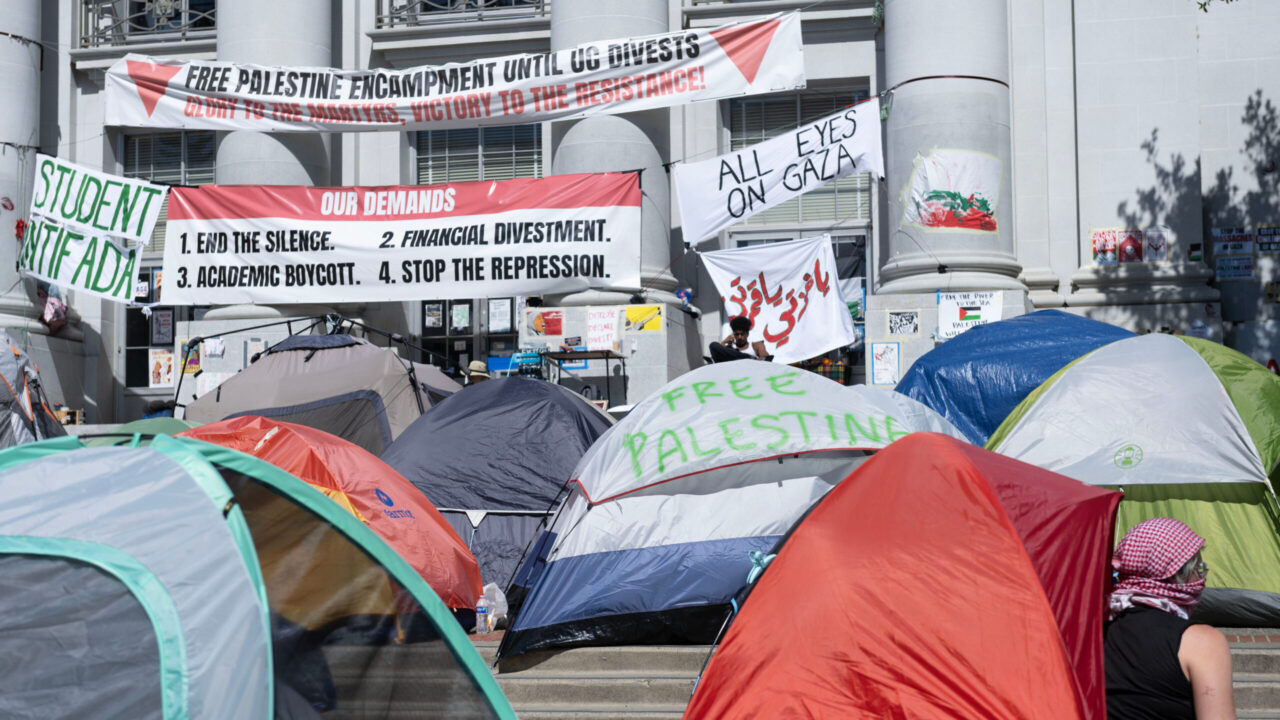
Updated on July 8
With hundreds of millions of dollars in federal research grants at stake, the University of California system has issued a letter affirming its opposition to student government boycotts of Israel.
UC President Michael Drake’s one-page letter was sent July 2 to UC chancellors after the Trump administration threatened to cut federal grants that did not comply with new requirements. The letter outlines an effort to balance free-speech rights with existing policies for student governments that prohibit financial boycotts of any single country.
“University policy provides that ‘any financial and business activity under the control of student governments is operated in accordance with sound business practices,’” Drake wrote. “Actions by University entities to implement boycotts of companies based on their association with a particular country would not align with these sound business practices.”
Drake’s letter does not explicitly mention Israel but cites an April 2024 statement from the UC Office of the President rejecting divestment from Israel and a December 2018 letter signed by all UC chancellors opposing academic boycotts against Israel.
The UC system includes 10 universities, six medical schools and three national laboratories.
The National Science Foundation, which awarded $524.8 million in research grants to UC schools in 2024, revised its granting conditions on May 19. The new policy requires grant recipients to certify that they do not take part in financial or academic boycotts of Israeli companies and academic institutions.
The U.S. Department of Health and Human Services implemented a similar change in April. Last year, the department awarded $122 million in research grants to UC schools, more than any other single institution, according to a recent UC report on federal grants.
Some UC schools have already taken action against student associations for supporting the boycott, divestment and sanctions movement against Israel. In March, the UC Davis School of Law suspended its student government for passing a resolution to withhold funding from events featuring speakers from Israeli academic institutions, or purchases of products from companies that do business with Israel.
UC Berkeley’s undergraduate student association passed a similar resolution in May 2024. It’s unclear whether the UC Berkeley administration intends to intervene. However, the financial operations of the student government — known as the Associated Students of the University of California — depend on funding from the university, which must comply with university-wide policies, according to spokesperson Dan Mogulof.
Other than potentially withholding federal research grants, the Trump administration has been scrutinizing certain schools in the UC system over their responses to antisemitic incidents on campus.
In February, the Department of Justice Federal Taskforce to Combat Antisemitism announced its investigation of 10 schools nationwide, including UC Berkeley and UCLA, that have experienced intense antisemitic incidents since October 2023, in the wake of the Hamas massacre in Israel.
A year prior to that announcement, a violent anti-Israel protest took place at UC Berkeley’s Zellerbach Playhouse, where Israeli speaker Ran Bar-Yoshafat was scheduled to appear. Protesters damaged the building and injured multiple students.
In March, the DOJ also announced plans to investigate the entire UC system to determine whether it discriminated against Jewish faculty and staff by enabling an “antisemitic hostile work environment” on its campuses. Investigators from both the DOJ and Equal Employment Opportunity Commission have already interviewed some UC Berkeley faculty, J. reported in April.
UC Berkeley Chancellor Rich Lyons was set to testify before the U.S. House Committee on Education and Workforce on July 9 as part of a hearing on antisemitism and higher education. However, that hearing was postponed this week with no new date set.