

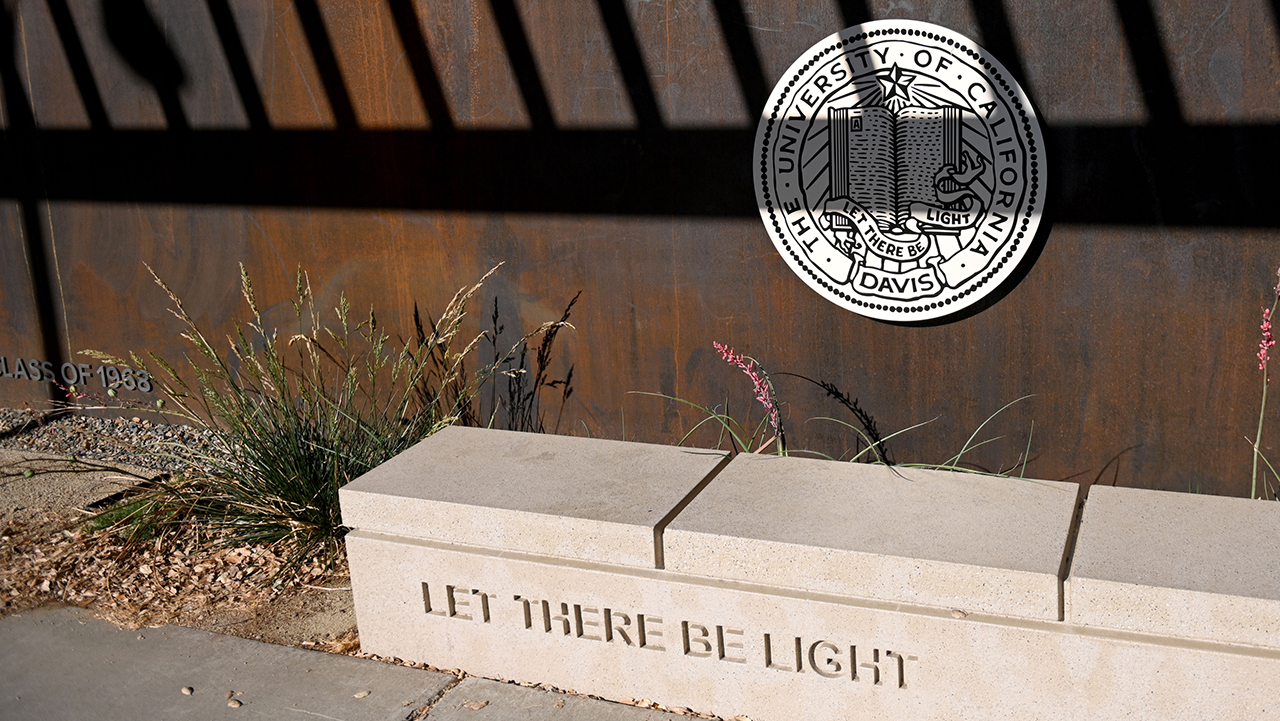
The UC Davis School of Law has suspended its student government for passing a resolution to boycott companies that do business with Israel and to stop Israeli academics from speaking on campus.
University leaders, who announced the move Monday, also directed law school administrators to take control of the Law Students Association (LSA) budget of around $40,000, according to university spokesperson Bill Kisliuk.
The LSA voted Feb. 28 to approve the resolution, titled “UC Davis Law Student Association Boycott of Businesses Connected to Israel and Complicit in Ongoing Genocide and Occupation in Palestine.”
Kisliuk said in a statement that the association “knowingly violated University of California policy by seeking to implement a discriminatory resolution intended to boycott people or entities with ties to Israel.”
In preparing the resolution, the authors referenced a guide produced by national organizers of the boycott, divestment and sanctions (BDS) movement against Israel. The resolution states that the LSA will not use its funds to support businesses targeted by BDS, specifying Burger King, Domino’s, McDonald’s, Peet’s Coffee, Starbucks and Taco Bell, among others.
The resolution also outlines a “general boycott list” of companies it claims are “linked to Israeli support through parent, subsidiary, and partner companies,” including Dasani, General Mills, Heinz, Kellogg’s, Kraft, Keurig, Nestle and Sadaf.
University of California policy states that student governments and associations must provide financial support for activities on a “viewpoint-neutral basis.”
The Sacramento Bee reported that the LSA’s board sent an email to the law school’s students stating that it decided to move forward with implementing the resolution despite its violation of UC policy and despite pressure to reverse course.
“Members of the campus community may peacefully exercise their constitutional right of free expression,” Kisliuk said in the statement. “Yet the university cannot allow disregard or violation of state or federal law and university policy.”
California is one of 38 states that have adopted laws to discourage boycotts against Israel, according to a database published by the Jewish Virtual Library.
In 2016, California passed an anti-BDS law, preventing taxpayer funds from supporting entities that discriminate “against individuals of the Jewish faith under the pretext of a constitutionally protected boycott or protest of the State of Israel.”
In addition to backing a boycott, the LSA resolution blocks the law school’s student government from funding speakers from Israel’s government or four major universities, as well as speakers from law firms that rescinded job offers to pro-Palestinian law-school graduates.
A similar controversy at UC Berkeley’s law school drew public criticism in 2022 when several student groups adopted a bylaw banning speakers who support Zionism. In November 2023, the pro-Israel law firm Brandeis Center for Human Rights Under Law filed a lawsuit against UC Berkeley, claiming that the ban amounted to discrimination against the university’s Jewish community.
Pro-Israel groups have been pushing UC Davis administrators to take action against the LSA resolution. The pro-Israel advocacy group Israel War Room started an email campaign in mid-March, urging the law school’s leadership to dissolve the student association, take over its budget and investigate the LSA “to ensure this discriminatory, antisemitic policy cannot be implemented.”
StandWithUs, a pro-Israel advocacy group, applauded the UC Davis administration’s decision to take “strong action to support the Jewish and pro-Israel students on campus,” Oleg Ivanov, executive director of StandWithUs Northern California, said in a statement to J. “We hope this leads to further actions that help ensure the safety and fair treatment of Jewish and pro-Israel students.”
Although Kisliuk, the UC Davis spokesperson, said the LSA’s suspension is not a permanent ban, he declined to specify what kind of action the LSA would have to take for the suspension to be lifted.
This is not the first time that students at UC Davis have passed BDS resolutions, although the university’s response appears unprecedented.
In February 2024, the Associated Students of UC Davis approved an “association-wide” boycott of Israel and companies with links to the country. The resolution restricted the use of ASUCD’s $22 million annual budget from buying goods from companies identified by BDS.
In contrast with the LSA’s actions, Kisliuk said that “there has been no effort by the [ASUCD] to implement” the 2024 resolution.
Back in May 2021 after a short military conflict between Israel and Hamas, the ASUCD urged the UC Board of Regents to divest its UC Retirement Plan and General Endowment Pool from companies doing business in Israel.
The LSA resolution that passed last month includes a similar clause calling on both the UC Davis administration and the regents to divest from Israeli-associated assets. It also calls upon the law school’s administration to protect students who express solidarity with Palestinians from retaliation.
Kenneth Marcus, chairman of the Brandeis Center and the head of the legal team in its lawsuit against UC Berkeley, drew a distinction between previous BDS measures at Davis and the latest one.
“There is a world of difference between advocating for a boycott, which is often free speech, versus instituting a boycott, which is a form of conduct,” he said. “Student governments often adopt BDS boycotts, which are largely advisory.”
Added Marcus, “It is entirely appropriate for university administrators to respond.”
Marcus, who served in the Department of Education during the first Trump administration, said the recent surge of universities taking disciplinary action against students who violate university rules or local and state laws while protesting Israel is likely a direct reaction to President Donald Trump’s decision to pull or threaten to pull federal funding from universities that don’t address antisemitism on campus.
“We’re seeing university administrators react in a way that reflects the forceful rhetoric as well as the strong actions coming out of the Trump administration. That’s been the case from coast to coast,” Marcus said.