
Food coverage is supported by a generous donation from Susan and Moses Libitzky.
Shortly after Big Finish Wine Tavern opened earlier this year, Adam Manson put matzah ball soup on the menu for about six weeks. I asked the wine bar owner what he would pair with matzah ball soup. His answer: dry Riesling.
Big Finish is an approachable neighborhood tavern in San Francisco’s Mission District, born in part out of the frustration Manson felt when dining out with his wife at a restaurant where glasses of wine hovered in the $22 range. He wanted to do better.
So he went ahead and created a place that didn’t take itself too seriously — as evidenced by a TV over the bar playing episodes from different “Star Trek” series (on mute) and the “Star Trek”-themed bathroom — where he can geek out over wine with guests if they ask questions, or just stay quiet and pour if that’s more their vibe. At Big Finish, most glasses average around $15.
“I don’t have to go on a diatribe about a particular winemaker if you don’t care,” Manson said. “The wine list is international, eclectic and ever-changing. I think it’s just yummy wine, as far as the style goes, and then there are some I don’t particularly like, but I know someone will.”
He also developed a full food menu, with reasonably priced entrées, like cacio e pepe ($20), a burger ($21) and fried chicken ($23). Food prices top out at $32 for local halibut or a pork chop.
Everything on the menu is something Manson likes to eat and make at home. A smoked trout dip with house-made potato chips seasoned with Old Bay is reminiscent both of his Jewish roots and the decade he spent working in bars in Washington, D.C. And the pimento cheese dip? It’s there because it was always in his refrigerator growing up.
Manson, 47, was raised in a Reform home in Dallas. While his single mom was more focused on getting food on the table than cooking, he began experimenting in the kitchen as a boy. He remembers making his mom breakfast for Mother’s Day and birthdays.
Now, looking back, he says he had no idea what he was doing; not knowing how to season food with salt while cooking was just one memory, he said, so nearly everything he made had little taste.

Even so, “I liked being able to make something for people and have them enjoy it, even if it came out terrible because I didn’t know what I was doing.”
Though Manson first came to the food and beverage industry as so many do, working in restaurants in high school, his roots in the industry go back generations.
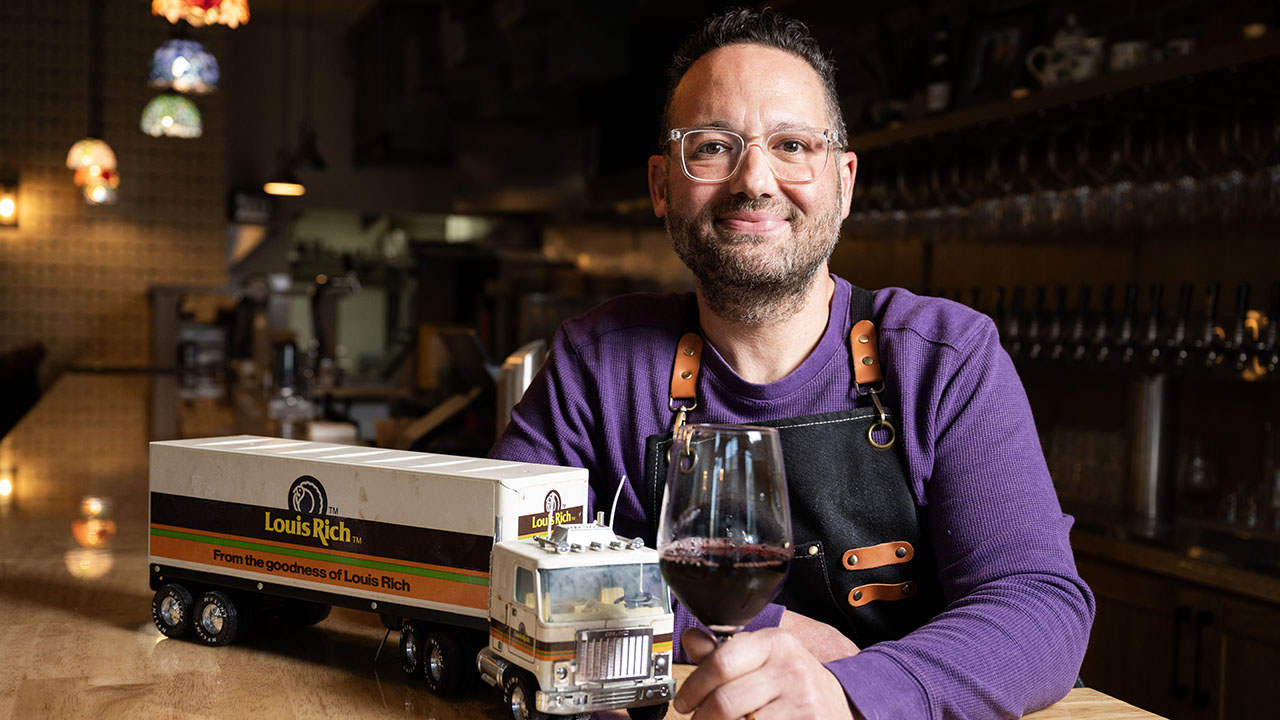
His paternal great-grandfather, Louis Rich, arrived in America from Russia in 1906. At first, he worked as a kosher butcher in Illinois. After bringing his family over, he was able to save up and buy a produce company.
According to an unofficial online bio, Rich bought a former tomato-processing factory in West Liberty, Iowa, in 1943 and turned it into a slaughterhouse for chickens. His sons later changed the focus of the company to turkey products. In 1960, the company was renamed Louis Rich Foods, and in 1979, they sold it to Oscar Mayer. Today, various lunch meats and turkey bacon are still sold under the Louis Rich name.
Manson worked toward becoming an accountant while in college at Texas A&M, but in his senior year, he realized that he couldn’t continue on that path.
“I can’t sit in a cubicle,” he thought. “I’ve got to be moving around, and work with my hands.”
He applied and was accepted into the Culinary Institute of America in Hyde Park, New York, calling it “one of the best decisions I’ve ever made.” And yet, he realized he wasn’t quite cut out to be a chef.
“Everyone else was faster than me,” he said. “I’m so slow and knew you had to be really fast to be successful.”
In the required classes on wine, he observed that while some of his classmates struggled, learning about the regions and varietals came naturally to him, even though he entered knowing nothing about it. (His father used to drink Riesling over ice — with a lemon wedge.) He also did well in the accounting and management courses.
Manson met his wife in one of those D.C. bars. They moved to San Francisco in 2014.
While he is still getting used to the rhythms of running a new business, he said he hopes to be able to offer Shabbat dinners served family-style some day, with favorites like brisket and tsimmes. How soon that happens, he isn’t sure, but he does know the matzah ball soup will return come Passover. (He said his wife, who isn’t Jewish, taught him how to make excellent matzah balls.)
“I still have some people coming in and asking for it,” he said. “It will come back.”