

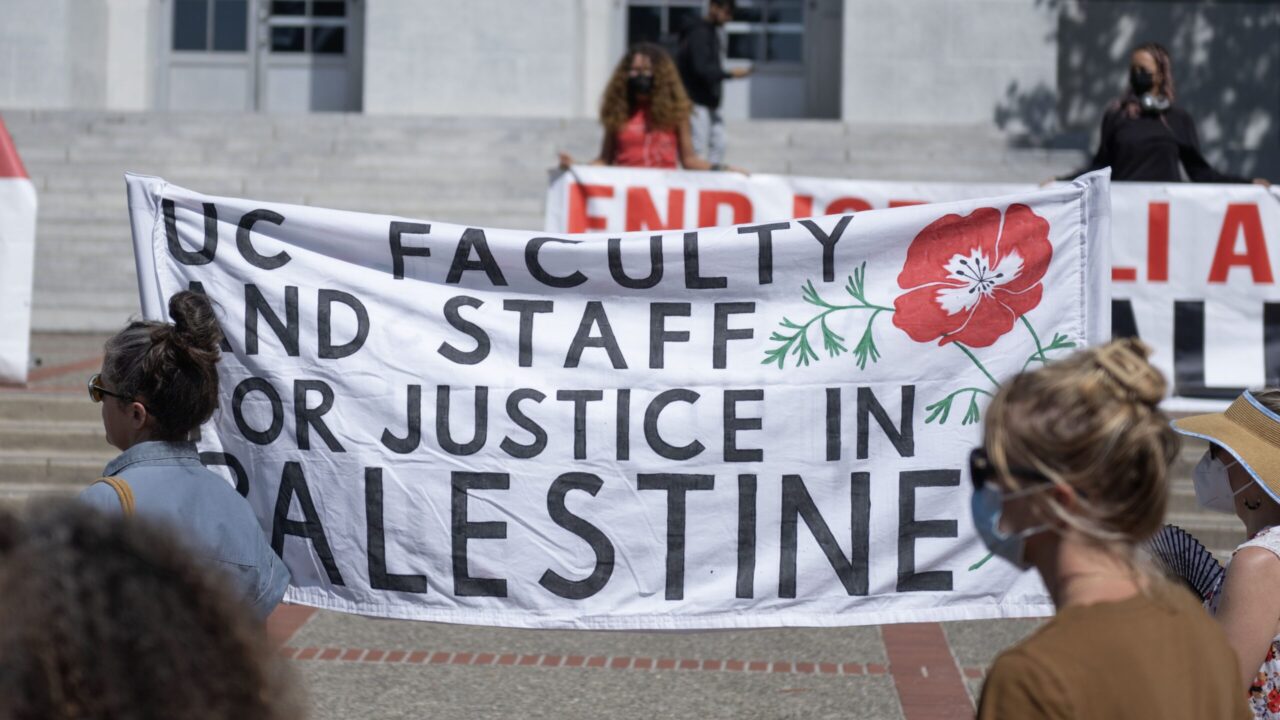
UC Berkeley’s Faculty and Staff for Justice in Palestine (FSJP) used its Instagram account in October to “like” a National Students for Justice in Palestine statement that ended with: “Death to the occupation. Death to Zionism. Death to all collaborators.” That same month, FSJP’s account also amplified graphics praising a “martyr” and urging followers to “hold fast to resistance.”
FSJP is the faculty network driving the academic boycott of Israel at Cal. When its social media account endorses explicitly threatening exhortations, the message is unmistakable: Those who identify as Zionists are being cast as enemies and targeted for harm.
In an effort to combat the surge of antisemitism on its campuses, the University of California has moved to prohibit the divestment-from-Israel boycotts demanded by student protesters, issuing a system-wide directive this summer that bars “university entities” from engaging in “boycotts of companies based on their association with a particular country.”
But that policy doesn’t touch the faculty-run academic boycott advanced by FSJP, which has done far more to fuel campus antisemitism than any divestment push.
Academic boycotts are the primary on-campus tool of the boycott, divestment and sanctions (BDS) movement, coordinated globally by the Palestinian Campaign for the Academic and Cultural Boycott of Israel and in the United States by affiliate USACBI. These campaigns extend far beyond opposition to Israeli policy. Their central doctrine is anti-normalization — denying Zionism any legitimate place in academic life and, by extension, excluding Zionist Jews from the university community.
Unlike economic divestment aimed at companies or governments, academic boycotts target the academic enterprise itself. They pressure faculty and departments to cut ties with Israeli institutions, cancel collaborations, disinvite scholars and block study-abroad programs. The reach of academic boycotts goes even further: They seek to denormalize Jewish- and Israel-affiliated institutions, such as Hillel, and Jewish or Israel studies programs, while using classrooms and conference halls to portray Zionism as illegitimate and to advocate the dismantling of the Jewish state. The result is a campus climate where open inquiry narrows, curricula are distorted, and Jewish and pro-Israel students are marginalized.
UC Berkeley illustrates the problem vividly: More than 170 faculty members, many of them department leaders, have endorsed an academic boycott of Israel. FSJP has translated that boycott agenda into daily classroom practice. Its “Pledge to Speak About Palestine” toolkit urges instructors to insert anti-Zionist narratives into syllabi, treat teaching as political “resistance” and work around rules limiting political advocacy in the classroom.
FSJP’s push to inject anti-Zionism into courses has been echoed at the institutional level with the 2024 establishment of a Palestinian and Arab Studies program, chaired by a founder of the campus FSJP chapter and a vocal supporter of the academic boycott. An announcement for the program’s fall series — six talks — lists speakers who have publicly supported the academic boycott and who advance an anti-Zionist narrative, presenting Israel solely as a colonial, apartheid and genocidal state.
Significantly amplifying the problem are more than 30 Berkeley departments that, over the last two years, sponsored dozens of one-sided events featuring boycott-supporting speakers. These events portrayed Israel as uniquely evil, with no balancing perspectives.
The results for Jewish students have been dire. Since October 2023, incidents of physical and verbal harassment at UC Berkeley have increased dramatically, while rhetoric condoning violence against Jews or Israelis or calling for Israel’s elimination has skyrocketed. Chants of “intifada” and “from the river to the sea,” as well as militant imagery, have become routine.
That is why focusing only on economic boycotts will not solve the problem of campus antisemitism. Across the country, faculty-backed academic boycotts have normalized anti-Zionist exclusion, making educational environments unsafe for Jewish students and eroding the university’s core mission.
UC should take the lead in reversing this trend. It has already banned economic boycotts; it should take the next step and prohibit academic boycotts, barring departments, programs and faculty from advancing campaigns that target a central dimension of Jewish identity and violate institutional neutrality.
If UC sets the standard, others will follow. If it does not, the academic boycott will continue to entrench a climate of censorship, exclusion and bigotry.