
Update on Jan. 25
Food coverage is supported by a generous donation from Susan and Moses Libitzky.
The supper club isn’t a new concept, of course, but occasionally one emerges that sparks more than the usual amount of buzz. Right now, that’s the Berkeley Supper Club. While it’s open to all, it has a decidedly Jewish flair.
The latest dinner happened during Hanukkah at Urban Adamah. Our amuse bouche, or welcome bite, was freshly spun cotton candy on a stick, tasting faintly of celery, and garnished with crispy fried potato strands, reminiscent of a latke, and a sprig of dill.

Organizer Alon Yoeli, 29, started by hosting dinner parties at his house as a way to make friends when he was new to the East Bay in 2023. Though not a professional chef, he spent time training in restaurant kitchens. He took on unpaid internships at Berkeley’s Cultured Pickle Shop and then Chez Panisse while juggling day jobs, including coaching water polo at Berkeley High School. He would shop, prep, cook and serve the food himself, accepting donations to cover the cost. Over time, the events outgrew his place.
“[It] turned into a ‘we,’ something bigger than myself and into a collective and the expression of each of these individuals’ passions,” Yoeli said.
For the supper club held in December, 16 volunteers, including Yoeli, collaborated on a 12-course dinner for more than 50 guests. This was the first time Urban Adamah, the organic Jewish farm and education center, hosted the club. Yoeli’s earlier events received financial support from Moishe House Without Walls.
The supper club’s character has developed organically, he said. At first, he didn’t put much thought or planning into it. While volunteers come from a range of backgrounds, the management team happens to be Jewish, including Yoeli; Asher Thibeault, a fine-dining chef; Benjamin Sockolov, general manager of A Fork Full of Earth Organic Catering; and Tal Sadeh, a chef who also designs menus and T-shirt merch.

“The supper club is a product of who I am and who the major contributors are,” Yoeli said. He welcomes the guests and introduces each course, though other chefs come out to serve, too. Yoeli isn’t in the kitchen during the dinner, but he does much of the prep work in the days beforehand.
“When four Jews sit down to do menu design, it ends up being a little bit Jewish,” he said.“It’s definitely inspired by where we come from. It’s hard to separate the Jew from the Jewish food.”
Last year the group put on 13 dinners, including seven in cooperation with Moishe House Without Walls. Many were held to coincide with Jewish holidays including Passover, Sukkot and Lag BaOmer. At the Hanukkah event, Yoeli lit the menorah and expressed gratitude for being able to produce and enjoy such a dinner.
After seeing how hard his mother worked running an Israeli restaurant called Paprika on the island of Oahu, where he lived as a child, he frequently reflects on the privilege he has to do that same kind of work for fun. He spent his high school years in Carmel.
While the menus change for each of the dinners, some elements remain constant. Yoeli always makes bourekas — pastries made from flaky dough with savory fillings — as a nod to his Israeli mother. At the Hanukkah dinner, the boureka filling was pureéd sweet potato, cheese and herbs. There’s also a crudo, or raw fish, reminiscent of his Hawaiian childhood.
Cotton candy begins each meal, with an extra “wow factor” if Whitney Vangrin, a supper club volunteer and performance artist who owns the cotton candy machine, is available. While several desserts show up on the menu, a frequent one is a stunning, handcrafted chocolate bonbon donated by Karen Urbanek, owner of the Berkeley-based, high-end chocolatier Flying Noir. She recently provided chocolates filled with a plant-based ganache, flavored with cloves, black lemon and Aleppo chile.
Most courses are vegetarian, with one or two fish dishes. They’re also kosher-style, though wild duck contributed by a volunteer who is a hunter is sometimes served.
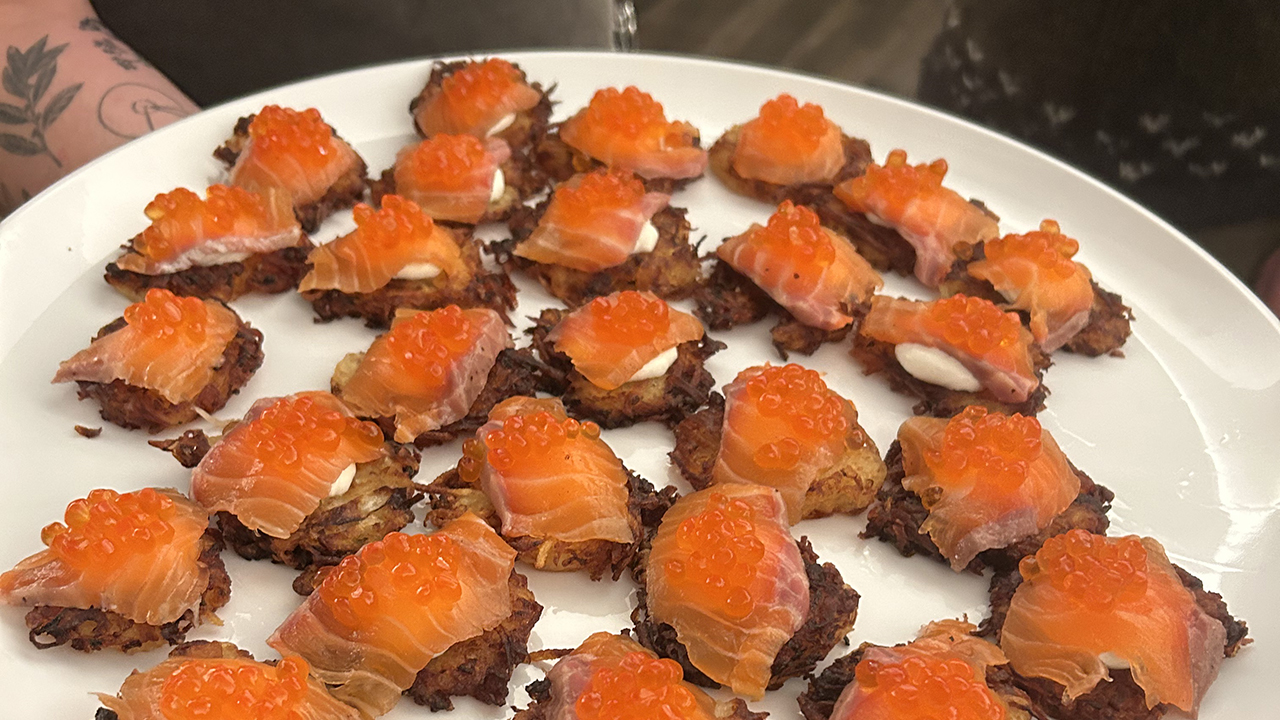
Many dishes feature emulsions or mousses, hallmarks of a fine-dining chef. It was impossible to say which course was our favorite. Highlights included a latke topped with house-cured gravlax and salmon roe; collard green rolls stuffed with majadera on a bed of labne and dukkah; and trout with perfectly crispy skin on a bed of kohlrabi pureé with a blood orange and saffron beurre blanc sauce and Tokyo turnips.
While I was expecting to be among the older guests — the suppers are limited to about 60 people — I was pleasantly surprised to see that the club attracts diners of all ages and backgrounds. My husband and I chatted with a Danish expat couple now living in the Bay Area. They said they were drawn to the dinner not only because of the food, but because they wanted to learn more about Judaism and the celebration of Hanukkah. To enjoy the supper club, one need only love food, have a willingness to chat with strangers for about three hours over a shared meal, and put aside expectations of it being like a traditional restaurant.
Later, I learned that a group from the co-housing development Berkeley Moshav had attended together. Moshav member Dan Alpert described the overall experience as “magical.”
“The space at Urban Adamah is glorious and beautiful, and Alon is such a welcoming presence,” Alpert said.
He had a hard time understanding why so many people would work so hard doing something for no pay. It’s a question Yoeli has trouble answering himself. Eventually, he’d like to start paying its contributors, he said. He recently applied for non-profit status.
“For us, that structure felt most aligned with building a sustainable, community-focused project rather than a traditional business,” Yoeli said.
Even if he doesn’t, though, it seems there’s no shortage of people who are willing to help co-create this experience just for the sheer joy of it.
“It’s crazy to see how many people have expressed interest,” Yoeli said. “All of our volunteers are just looking to share a piece of what they’re passionate about with people.”
The supper club has three price levels: $60, $90 and $120. The next event is set for Feb. 15; for more information, sign up at theberkeleysupperclub.com or subscribe to its Substack.
Small Bites
Two cookbook author events are on my radar for late February. Yotam Ottolenghi will be appearing with City Arts & Lectures on Feb. 23 at 7:30 p.m. at the Sydney Goldstein Theater. Ottolenghi is an Israeli-born, London-based celebrity chef and restaurateur. A live cooking demo with audience participation is promised at this appearance. The event is nearly sold out, but there may still be some balcony seats available.
The next night, Gabi Moskowitz, whose new cookbook “Dead in the Kitchen” was inspired by the Grateful Dead (I wrote about it in November), will be at Berkeley’s Afikomen Judaica on Feb. 24 at 7 p.m. There will be some samples available to taste from recipes in the book. Afikomen is located at 3042 Claremont Ave. The event is free.
Updates on Jan. 24 and 25: Benjamin Sockolov’s title and the spelling of his last name have been corrected. The number of dinners the group put on last year has also been corrected.