

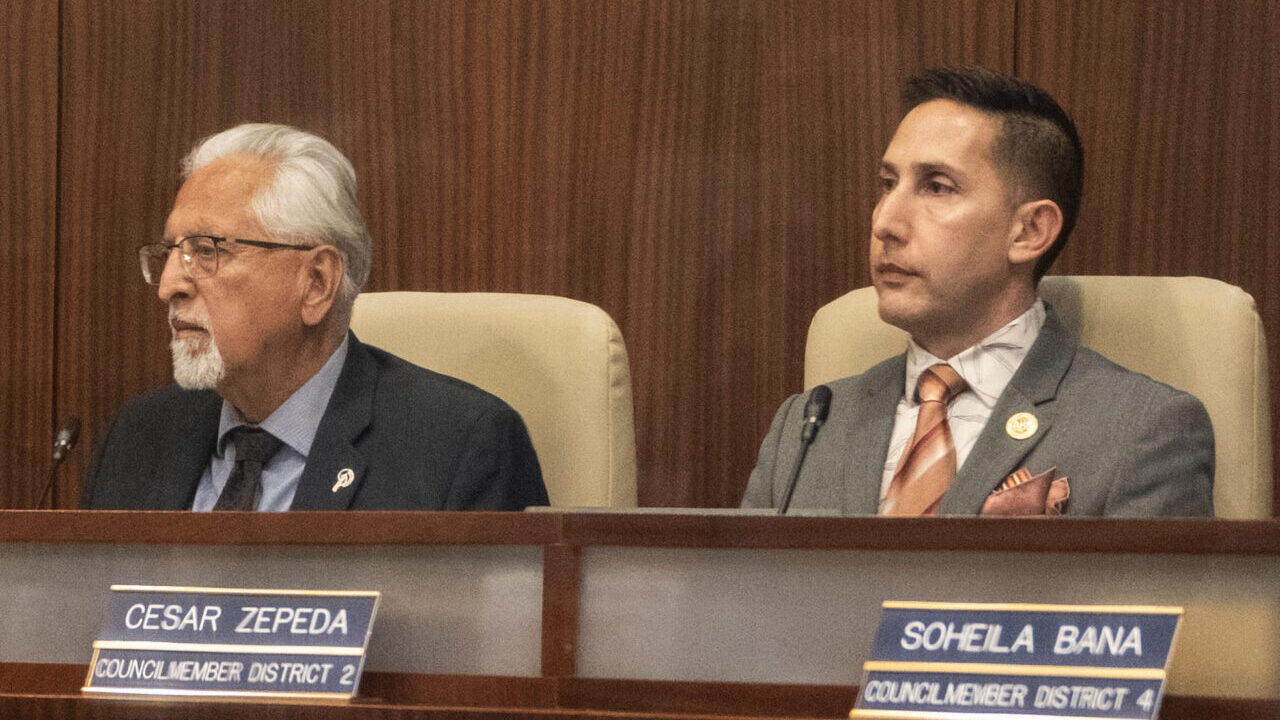
Cesar Zepeda is still bristling over the Richmond City Council’s recent failure to censure the mayor over antisemitic posts on social media.
Zepeda, the councilmember who introduced the censure motion at the Jan. 20 meeting, told J. on Friday the censure wasn’t for “one little hiccup” but for a “pattern” of wrongdoing by Mayor Eduardo Martinez.
“People are saying, ‘Oh you’re doing this because of politics,’” Zepeda said. “But I didn’t tell him to post those things. He chose to.”
Zepeda, a self-described “pragmatic” Democrat, introduced a motion at that meeting to formally censure Martinez for “engaging in conduct that reinforced antisemitic narratives.”
The motion failed 4-3. Martinez, who sits on the council, voted against it, as did three political allies: councilmembers Sue Wilson, Claudia Jimenez and Soheila Bana. Like Martinez, both Wilson and Jimenez are leaders in the Richmond Progressive Alliance (RPA), a political organization representing the city’s left flank. Bana often votes in favor of measures backed by RPA and in 2024 co-authored a resolution that divested the city from companies doing business in Israel. The resolution passed 6-0, with Zepeda abstaining.
Zepeda, 45, is in the final year of a four-year term on the council and plans to run again. He describes himself as a progressive but is not a member of the RPA, a powerful force in city politics.
Like scores of other Bay Area elected officials, Zepeda criticized social media posts shared by the mayor in December that drew accusations of antisemitism and made national headlines. The posts relayed conspiracy theories about the Dec. 14 Bondi Beach massacre in Sydney; one described it as a “false flag” and another suggested it was committed by a “former IDF soldier.” A third post suggested that the victims of the attack in Australia were, by celebrating Hanukkah on the beach, engaged in “performative assertions of dominance” of a public space.
Days after those posts came to light, J. published a handful more social media posts shared by Martinez that echoed antisemitic tropes about Jews and money. A few months prior, Martinez likewise faced criticism from Jewish organizations after he delivered a speech at the People’s Conference for Palestine in Detroit comparing the actions of Hamas on Oct. 7, 2023, to someone who had been bullied on a schoolyard playground.
Last week Zepeda, along with councilmembers Jamelia Brown and Doria Robinson, voted to support a formal censure of Martinez. After that motion failed, the council instead voted 6-1 in favor of a “restorative process,” which requires the mayor to publicly apologize, participate in antisemitism training and meet at least twice with a local rabbi. It was Martinez who proposed the restorative process, and he issued an apology at the Jan. 20 meeting.
“I failed to meet the responsibility my position requires,” Martinez said in part.
During a 45-minute interview with J., Zepeda said a censure would have drawn a clear line “between what is acceptable and what is not acceptable.”
The vote came after two bruising, lengthy council meetings, where droves of people — Jewish community members, concerned Richmond residents, diehard progressives, pro-Palestinian activists, defenders of Martinez and vociferous opponents — came to view the proceedings or speak.
Zepeda, who is gay and Latino and works as a health insurance consultant, described the ways in which normal business has been interrupted as a result of the scandal, why he supports censure, and how the controversy has affected relationships on the council.
The interview has been edited for length and clarity.
Why did you support the censure of Mayor Martinez?
I was hearing a lot from the community, and then also I understood how antisemitic this was. I know how it feels when somebody says homophobic stuff, or other racist stuff. Combined with the various emails and conversations with the community, I felt something had to be done.
There was an article where one of my colleagues, Sue Wilson, said that everyone deserves a second chance. And I agree, everyone deserves a second chance and the opportunity to make things better. However, this was not his first time, nor his second, nor his third, nor his fourth. He stepped on it a long time ago.
Censures should not be taken lightly. You don’t just throw those around. If somebody has one little hiccup, you don’t just censure them. It has to show a pattern.
One part of the censure is for the individual who’s getting censured. But just as important, if not more important, is that the council draws a line between what is acceptable and what is not acceptable.
Do you think the council would have reacted differently if the mayor had spread bigotry toward a different group, say, if he had spread homophobia or anti-Black racism or Islamophobia?
Most likely, yes. Maybe, maybe not. But I believe, yes.
The “maybe” is because they’re not just trying to save Eduardo. They’re trying to save their movement. They’re progressive, and I’m a progressive as well. But they’re trying to say that if they were to censure him, that is going to censure the much bigger movement they’re creating.
How has this episode impacted the work of the council?
We’ve gotten thousands of emails. We’ve had to focus on this instead of on fixing potholes, or fixing public safety, fixing the lights, fixing the issues that our individuals in Richmond care about on a day-to-day basis.
It took a lot of time — and not just time — creating a censure, which also takes a lot of energy. It’s not something that I just did lightly, like, “Oh, that’s a fun thing to do today.” I had to put other agenda items aside so I could work on this one. Listening to the community, reading emails, trying to figure out, what is it that I put here? What else did he do? I had to research. So it took my time away from other stuff.
Obviously the mayor has very firmly held political commitments when it comes to being an anti-Zionist and a pro-Palestinian advocate. Do you think that is interfering with his ability to apologize in a way that feels sufficient?
His ignorance is interfering. He doesn’t understand what is going on. He’s trying to. In a way, his heart is in the right place. And I agree, no one should be killing anyone, across the board. Doesn’t matter what group you are, it doesn’t matter who you hate, who you love. No one should be killing anybody.
But when he chose to get into this international conflict conversation, he did not understand it. People around him were telling him to do it, even though he did not understand the conflict. He surrounded himself with people that have very similar opinions and thoughts, and that’s where he stayed.
If you’re going to get into this, you might as well go talk to the other side and make sure that you’re understanding. You might disagree with the other side, but that’s where you might be able to learn something.
How has this whole controversy impacted relationships among councilmembers?
A lot. On Tuesday [Jan. 20], you could definitely feel the tension between the majority of the council and myself and councilmember Brown.
People are saying, “Oh you’re doing this because of politics,” but I didn’t tell him to post those things. He chose to. I’m not doing this because [Martinez] is up for re-election. He did this to himself.
I’m trying to see if he might go after me. Try to take [away] my commissions that I sit on. They’ll probably vote down all of my items because they disagree with me. We’ll see what they do.
I’m not holding anything personal. I’m saying let’s do this because it’s part of our job. It’s business. And then we’ll just move forward afterward. If you don’t like me for this today, let’s work on an item tomorrow that we can agree on. But I think it’s going to take a while.
The Bondi Beach posts weren’t the first time Martinez had said inflammatory things. In August, at the People’s Conference for Palestine, he wore a hat calling for death to the IDF, the Israel Defense Forces. He posted routinely on LinkedIn, harshly criticizing Zionists, Zionism and Israel. He published posts that echoed antisemitic tropes that said Zionists were motivated by “shekels,” which is a Hebrew word for money. Did you or the council ever push back on any of this? Or was it only after these particular Bondi Beach posts got a lot of attention that the council took notice?
You’re not wrong. I didn’t even know he had LinkedIn. So I didn’t know about these posts that he’s been making. Nobody had brought them forward to me. When he attended the conference, I did hear [about] comments he made that I thought were inappropriate, and I saw the pictures.
To answer your question, we should have done actions sooner.
He made those horrible comments. Yeah, the council should have also done something then. And we failed to do something then. And we still are failing to do something now.