

Stanford University junior Jessica Korobkin set out to give her fellow students a chance to practice tikkun olam, the Jewish concept of repairing the world.
What she got back were dozens of ingenious proposals reflecting Silicon Valley’s innovation ethos — everything from making bricks out of fungi to reducing the carbon footprint of oyster farms.
This was the startup mentality behind the Social Impact Entrepreneurship Competition, a program conceived by Korobkin, 21, and sponsored by Hillel at Stanford. The competition invited undergraduates to submit ideas for businesses or technologies aimed at benefiting society and the environment.
The top prize: $30,000 and a one-hour meeting with Daniel Lubetzky, the Jewish founder of Kind Snacks, a judge on ABC’s “Shark Tank” and a Stanford Law School graduate.
On flyers posted across the Palo Alto campus, Korobkin challenged students to “create innovative solutions to repair the world.” By the February deadline, she had heard from 44 applicants, each of whom was required to submit a business plan and a 90-second video pitching their idea. The competition was open to all students, regardless of religion, although it specifically required that the projects “demonstrate a social or environmental mission aligned with the value of tikkun olam.”
As Korobkin and other organizers narrowed the field, the five finalists were given the option of meeting with Rabbi Eliezer Weinbach, Stanford Hillel’s director of student well-being, so they could better understand the meaning of tikkun olam. All five of them took up the offer, even though only one of them is Jewish.
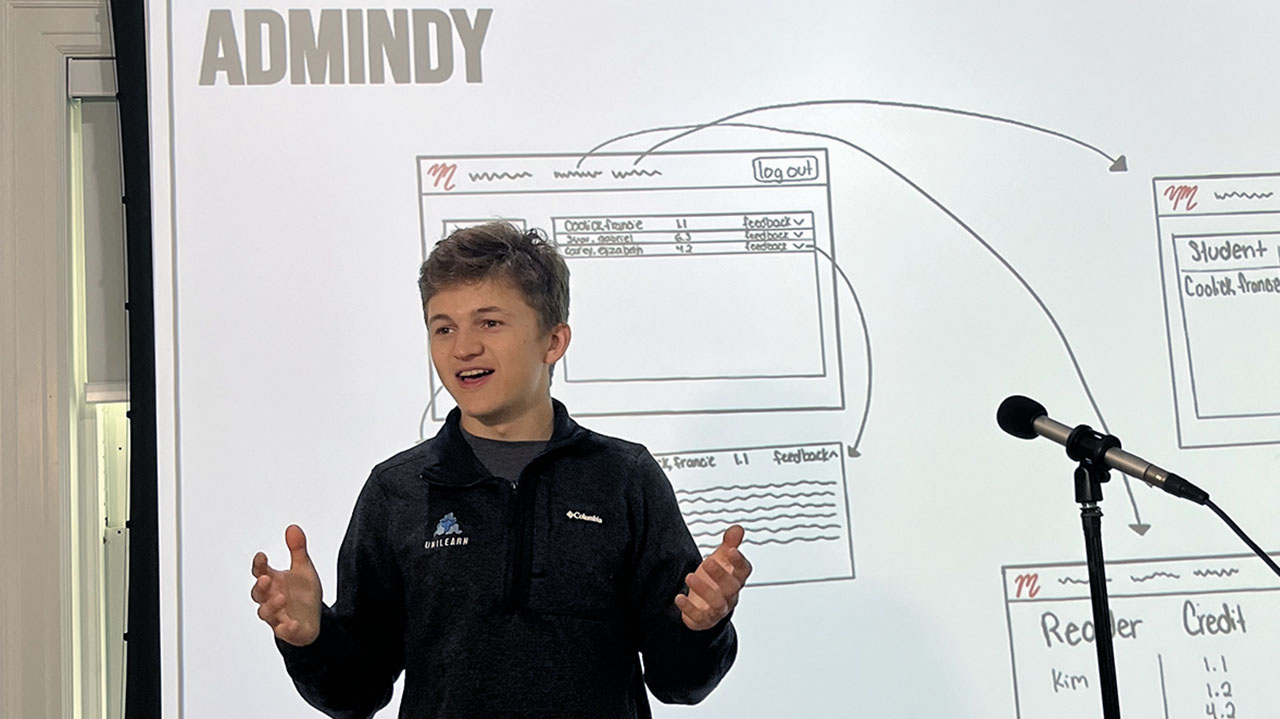
At the final event March 1 at Stanford’s Koret Pavilion, five finalists delivered live pitches to a panel of three judges in a format modeled after “Shark Tank.” The winner was Niko Ustin, a sophomore majoring in computer science, whose concept uses artificial intelligence to help utility companies determine areas at high risk of wildfire. Ustin had already launched his company, Foliage, to bring his idea to life. The $30,000 prize will give him a boost.
“I thought, ‘What if we use street-view imaging to assess power lines,’” said Ustin. “Trees are the leading cause of power outages and wildfires. Utilities spend billions going tree by tree to assess risk. [Foliage] uses AI and satellite imagery to predict risk.”
Ustin, who is Jewish, said he was thrilled to win and admires how the competition was run.

“Jessica and Hillel were good communicators,” he said. “They had a cool stage setup. We put together a quality presentation, and I felt confident.”
Korobkin, a pre-med student, said she created the competition to highlight Jewish values.
“I wanted to find a way to show what Jewish values are at their core, what centuries of Jewish tradition has brought,” she said. “That’s where the idea of the entrepreneurship competition came from. I wanted to convince non-Jews to do something Jewish.”
She knew she needed help getting the competition off the ground, so she turned to Hillel late last year. “I asked them, ‘Are you willing to help me?’ Their reaction was, ‘Yes, of course,’” Korobkin said.
“Jessica came to us with an idea rooted in tikkun olam, leveraged with Stanford innovation,” said Branden Johnson, Hillel’s associate director. “We try to support students in executing their vision. She and I met on a weekly basis, talking about what she envisioned, both the structure of the competition, and who would be good judges.”
Korobkin also got an assist from the Affiliated Stanford Entrepreneurial Students (ASES), a campus group that offers programs on entrepreneurship, design and venture capital. Together with Hillel, they got the word out about the competition.
Korobkin said securing funds was a crucial step.
“I knew I had to get funding for it,” she said. “There wouldn’t be [a competition] without prize money.”
She reached out to alumni networks in the venture capital and nonprofit sectors, which led to her connecting with Lubetzky.
“The first thing they did was invite me to meet with Daniel Lubetzky to pitch my idea,” she said. “I was overwhelmed by how excited he was. He said it was the best idea he’d heard in a long time.”
Her search led to an anonymous donor pledging to support not only this year’s competition, but $25,000 annually for two more years. Lubetzky contributed funding and offered a one-hour meeting with the winner.
“I’m a human biology major,” Korobkin said. “I’m not used to being with these people way above my pay grade, but it’s amazing how generous they were.”
Korobkin, who is from Los Angeles, said having her bat mitzvah ceremony at the Kotel in Jerusalem was a game-changer, ramping up her commitment to Jewish life. She was a counselor at Camp Ramah Galim, a Conservative Jewish summer camp near Santa Cruz, and took a Birthright Israel trip. Once enrolled at Stanford, she became active with Hillel, working as the chapter’s tikkun olam chair.
“Tikkun olam to me is an overarching value a lot of people can relate to, and it doesn’t necessarily have to be religiously based,” she said. “It’s what our ethical responsibilities are.”
She said she also hoped the competition would foster connections across campus during a period of heightened political division around the Israeli-Palestinian conflict.
Like many U.S. college campuses, Stanford was roiled by protests following the Oct. 7, 2023, Hamas massacre in Israel and resulting war.
In early March, threatening emails were sent to Jewish leaders and students on campus. The Stanford Daily, the student newspaper, reported that the messages “accused Jewish community members of numerous unfounded and conspiracist claims” and threatened to “monitor” their behavior.
A report last year by the university’s subcommittee on antisemitism and anti-Israeli bias detailed several dozen instances of antisemitism on campus. Despite the tensions, both Korobkin and Johnson said they encountered no hostility over the competition.
“You would think there would be some pushback or even potential mobilization,” Johnson said. “Everyone who participated came from a broad cross-section of the campus community. It didn’t seem like external politics had any bearing.”
Although she is set on attending medical school and becoming a physician, Korobkin said she hopes the competition continues after she graduates.
“It was one of the most amazing things,” she said. “I worked so hard in fall and winter. I wondered, ‘Would anyone want to be in this?’ Now I’m thinking I can mentor someone to take this over. This is a scalable idea.”