

JERUSALEM — Walk in the front door of the National Library of Israel, and you’re immediately hit with noise.
On a recent Sunday morning, kids from five local school groups ran up and down the curved staircases, laughing and shouting gleefully at each other, while on the main floor a group of teenage girls from a Bedouin school in the Negev chatted excitedly, pulling their hijabs across their faces to hide their giggling from a tourist trying to take their picture. Visitors were coming and going from the cafe and bustling about in the gift shop inside the library entrance.
Not what you might expect from a library. But it’s all part of the plan at Israel’s magnificent national library in Jerusalem.
“I hope you’re taking in the noisy atmosphere, appreciating the vibe,” said Dafna Siegman, a Biblical researcher and Judaica specialist who was acting as a tour guide that morning. “The notion is that this is a shared space for all visitors as well as readers.”
The institution itself is more than 130 years old, but the move to its new building in October 2023 marked a significant change in intentions. For decades the library had been tucked away in a corner of the Givat Ram campus of Hebrew University, less than a mile from its current location but off the beaten path and housed in a building that did not meet the needs of a 21st-century library.
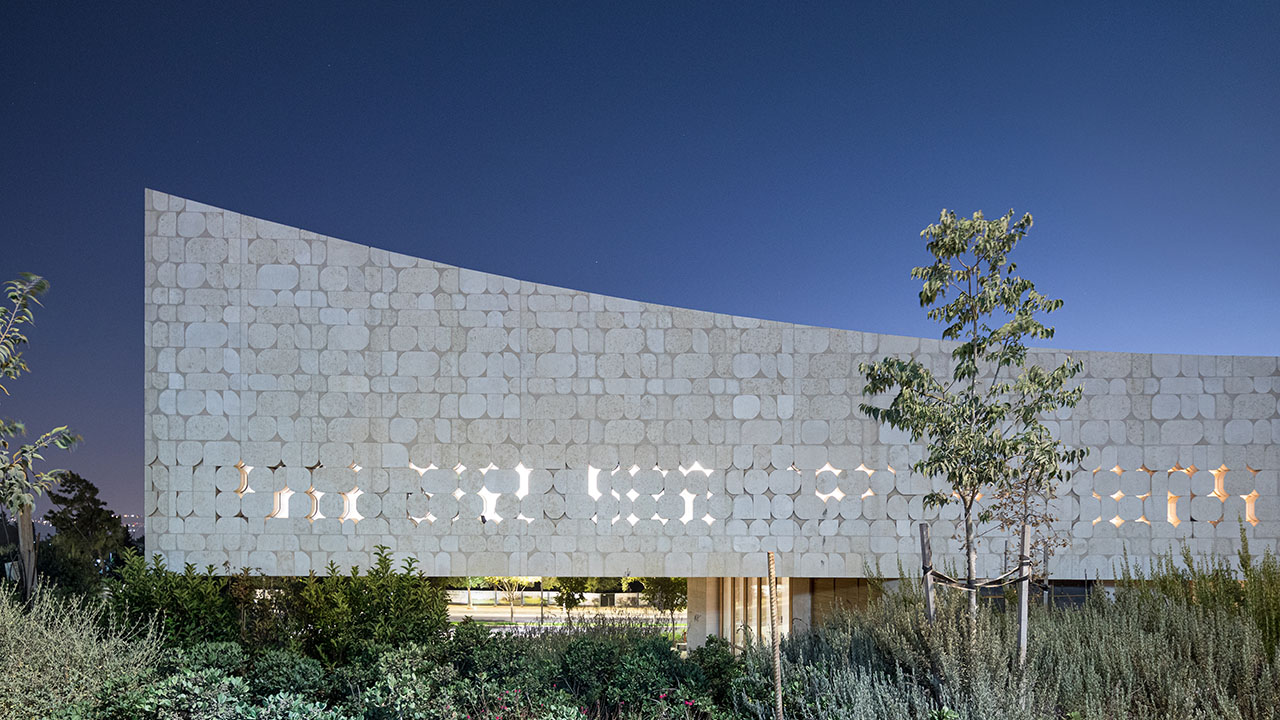
Now the $225 million, 480,000-square-foot building designed by Swiss architects Herzog & de Meuron sits in a prime position between the Israel Museum and the Knesset, part of Jerusalem’s so-called Museum Mile. It is a soaring structure, composed of grayish-white Jerusalem stone with a swooping roof. Like the Kotel, the exterior has gaps here and there, but instead of holding notes placed there by visitors, the gaps let light pour in from the outside, and out from the inside. It all fits into the library’s theme of accessibility, Siegman said.
Bay Area philanthropists are well represented at the library. There’s the Anne Germanacos Prayer Room, a chapel used by worshippers of all religions as well as for private contemplation; the Nancy and Stephen Grand Automated Stacks, where robots collect and reshelve books; the Koum Family Foundation Letters of Light Sculpture Garden; the Helen Diller Family Rotating Exhibition Gallery; the Taube Family Book Shop; the Reinhard-Powembrovsky Early Zionism Collection; and the Pritzker Family National Photography Collection. In addition, Moses Libitzky and Jeanette Reinhard sit on the board of NLI USA, the library’s affiliate in the U.S.

More than half a million visitors pass through the library annually, taking advantage of its permanent and rotating exhibits, grand event spaces and reading rooms, wandering through its lush gardens, enjoying its artwork, grabbing a bite to eat in the cafe. In the summer, up to 1,200 people can fit into its open-air concert space.
It is, finally, a library worthy of the people of the book.
Stretching 11 stories, with most of that actually underground where the library’s collections are stored, the main floors resemble the interior spiral of Manhattan’s Guggenheim Museum. The central cylinder has four floors of reading rooms, where quiet prevails. The rooms have plate-glass walls, so people walking and talking around the outside perimeter have a clear view of those reading or studying inside.
“The sacred center of the library is the reading rooms,” said Siegman. “They fill up as soon as we open. There’s a line of people waiting to get a seat.” Journalists, writers, scholars. Students from the nearby Hebrew University. Researchers from other countries. They bring their own work with them, or request materials from the library’s collection that are delivered by underground robots in about 15 minutes.
In the old library, it could take three to four days to get a requested book, as many were stored offsite.
“The reading rooms are called the well of knowledge,” Siegman said, noting that the cylindrical shape also resembles a well. “From the bottom of the well, we literally draw up the treasures — our books.”
The bottom floor of the reading room hosts a circular shelf in the center where a complete Talmud is displayed. Siegman notes that the non-Jewish Swiss architects came up with that idea to reflect the place of the Talmud as the center of Jewish tradition.
The library is dedicated to collecting and preserving the cultural heritage of Israel and the Jewish people. Its stacks hold some 4.5 million books, manuscripts, maps, archives, photographs and other items, including the world’s largest collections of Hebraica, Judaica, Kabbalah and Hasidism. It is Israel’s oldest national institution, tracing its roots back to some 22,000 books and rare texts of Jewish interest donated by Polish bibliophile Joseph Chasanowich to Jerusalem’s tiny Midrash Abarbanel Library, which opened in 1892.
In 1925 the library merged with the recently founded Hebrew University and went through a series of iterations and name changes until 2007, when the Knesset enacted the National Library Law. That law, among other things, dramatically expanded the library’s role from the collection and preservation of texts to educational outreach and fostering cultural creativity among the public.

In addition to its extensive Jewish holdings, after the founding of the state in 1948 the library’s focus grew to include written (and now digital) materials related to all the country’s minorities, particularly its Islam and Middle East Collection.
Through its Historical Jewish Press project, the library is the repository of millions of pages of Jewish newspapers from around the world, accessible for free to the public. (J.’s own digital archives are hosted there.)
With music, photographs, posters, maps, greeting cards, rare manuscripts, digitized versions of key texts, the formats of its collected works are as varied as the works themselves.
One of the most compelling parts of the library is the climate- and light-controlled permanent exhibit “A Treasury of Words,” which displays some of the rarest books and manuscripts in the library’s collection. The objects rotate every six months, to minimize their exposure to the elements.
On display this Sunday was the Daniel Bomberg publication of the Babylonian Talmud from 1520 to 1523, the world’s first complete printed edition of the Talmud. There was also a handwritten Bible from the ninth century in Syrian Aramaic, originally intended for Jews and most recently used by Syrian Christians.
Visitors gasped at the only surviving copy of the first haggadah ever printed, from Spain in 1482 — 30 years after the invention of the Guttenberg printing press and 10 years before Jews were expelled from that country.
Key manuscripts from the Islamic collections were also on display. Several beautifully illustrated Qurans from the Middle Ages were under glass, as was a handwritten copy of “The Spiritual Couplets” by Rumi, arguably the greatest Sufi poem ever written, dating from 1619 to 1620.
The oldest artifacts in the room are not texts, but clay objects called “incantation bowls” dating from the fourth to seventh centuries. “They’re also called ‘demon-busting bowls,’” Siegman said. People seeking to get rid of a demon would go to a scribe, usually a woman, who would compose spells in Aramaic and inscribe them on the bowl.
“You’d take the bowl home, place it upside down and trap the demon,” she said. “That’s the real power of words.”
In the former building, there were few display cases, Siegman said. Rare manuscripts were only taken out to show VIPs. The National Library Law of 2007 requires ongoing public display of such significant items, she said.
Such displays also pose significant security challenges. In the days after the Oct. 7, 2023, Hamas attack, library staff rushed to dismantle all the exhibits and take the precious items downstairs for safekeeping.
The same thing happened again in June, during the 12-day war with Iran. And when conflict with Iran resumed at the end of February, the library operated with limited capacity with most staff working from home, no tours or school groups, and only up to 50 accredited researchers in the reading room at a time. Nonetheless, the cafeteria was packed with people on laptops taking advantage of the Wi-Fi, coffee and pastries — and bomb shelters conveniently located nearby.
When the war entered its third week, a series of small in-person cultural events launched. Then during Passover break, the library added family activities and building tours. The treasures, however, remained safe in the underground vaults.
During the tenuous ceasefire in the war with Iran, the regular tour schedule resumed and most items were restored to the galleries — with the exception of those deemed most precious. These will stay in the vaults until the security situation further stabilizes.
Siegman said it is all part of safeguarding the most precious heritage of the Jewish people and Israel, both physically and culturally.
“Who needs a library in the 21st century? I think we are showing the need,” she said.