

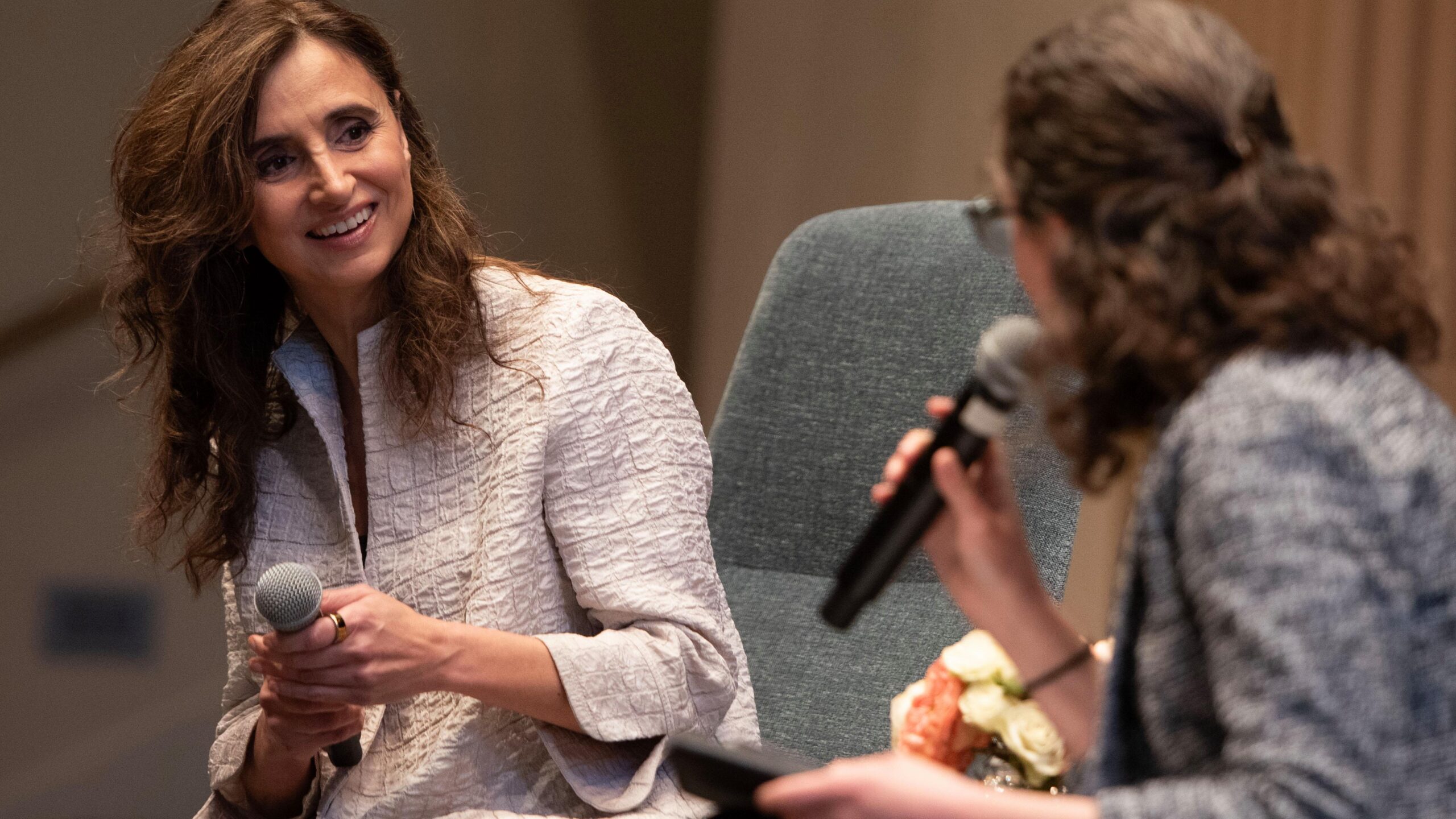
The assassination of Iranian Supreme Leader Ayatollah Ali Khamenei in late February brought complicated feelings to the surface for many Iranians living in the diaspora, Jewish Iranian writer and commentator Roya Hakakian among them.
The exhilaration she felt over the fall of one of the world’s longest ruling dictators was quickly followed by rage. Why, she asked, had it taken decades? Just weeks before, the Islamic Revolutionary Guard Corps had violently cracked down on dissidents, killing thousands.
“What does this mean that a superpower can solve a problem so instantly, but a nation can suffer, or has to suffer, for decades?” Hakakian said before a crowd of some 150 people at Congregation Emanu-El on April 9, referring to the U.S. role in the Israeli airstrikes that killed Khamenei.
Although she is firmly in favor of bringing down the Islamic Republic, she is less confident about whether the Trump administration will be able to end the war decisively. In her onstage conversation with Associate Rabbi Sarah Joselow Parris, Hakakian threaded a fine line between favoring American intervention in Iran and cautioning against unintended consequences from any missteps by President Trump.
“This is not Trump’s war. This is America’s war,” Hakakian said. “This is a bipartisan war that everybody else has been just delaying, and he being sort of the impatient, petulant person that he is, just decided that he was going to finish it.”

Hakakian was born and raised in Tehran until her late teens, when she and her mother fled the country for the United States about six years after the 1979 overthrow of Shah Mohammad Reza Pahlavi.
She has dedicated her life to advocating for women and political dissidents under authoritarian rule, serving on the board of Refugees International and as a writing and public policy fellow at Yale. In 2004 she co-founded the Iran Human Rights Documentation Center, a nonprofit that keeps a historical record of human rights abuses in the country.
Among Hakakian’s greatest concerns for the current war is the potential for the Iranian regime to dictate terms for a permanent ceasefire that would keep the ruling republic intact.
If that happens, the war will have the “absolute opposite effect of what it intended to do,” Hakakian said, and will spur political narratives that will further empower Iran.
“The narrative war at this moment is, according to them, that ‘the greatest evil in the world, the Great Satan, and its bastard child, the Little Satan, Israel, attacked us, and we resisted and survived,’” she said. “And that means that they will be able to recruit from all over the Islamic universe and beyond.”
To avoid that outcome, Hakakian believes it’s imperative for the war to end in a definitive win for the U.S. and Israel. Any assumption that the initial bombardments of Tehran would trigger a government overthrow on the ground was, in her eyes, naive.
Getting accurate news out of Iran has been particularly challenging since the regime cut off internet access on Jan. 8, so the death count from the citizen protests varies widely.
The editorial board of Iran International, a London-based Persian news outlet, accused the Iranian government of severely underestimating the number of those killed, which the regime has claimed is just over 3,000. Citing forensic data and the accounts of doctors working on the ground, the outlet said the correct number is over 36,000.
Other activist groups have individually verified over 7,000 executions that resulted from the regime’s crackdown on the protesters.
Government repression has only gotten worse since the ayatollah’s assassination and the launch of the war, according to the Center for Human Rights in Iran, which in late March estimated that more than 50,000 people had been arrested.
“Just picture this: Bombs are falling and the military that’s supposed to be protecting the citizenry is out on the streets to make sure that the citizenry don’t dare do anything, or come out of their homes to protest,” Hakakian said. “This is the situation that people are coping with on a day-to-day basis.”
One attendee echoed Hakakian’s concerns about how Trump is waging the war, specifically that he acted unilaterally and without congressional approval.
“I somewhat take issue with the framing of intervention being the right thing to do when this is a democracy, and the public has had absolutely no say on whether, once again, they want their tax dollars spent on a war,” the attendee said. “It seems like a big gamble to do anything at all, given our horrible track record. And even if intervention was the right call, this is absolutely the wrong person to be in charge.”
Hakakian pushed back, urging the audience to look at the current war in the context of previous successful U.S. military interventions abroad.
“Under normal circumstances, does the American president go to war without the consent of Congress? No. And is Trump my ideal president to wage war? Also no. But here’s where we are. And this guy is the one who waged this war that should have been waged a long time ago,” she said. “We can’t quit,” she added, “because when we quit, our vacuum gets filled by China and Russia.”
Shirin Lyons, a Christian Iranian who attended the April 9 talk, is on board with that view. She told J. she welcomes dialogue about America’s role in global conflicts, but when it comes to the Islamic Republic of Iran, which she called a “terrorist regime,” the lives of Iranian citizens hang in the balance — including those of her family.
“This war should have been fought a long time ago, before the IRGC [Revolutionary Guard] and the Islamic republic ever got this powerful to create nuclear weapons, missiles, and fund terrorist groups in the rest of the region,” she texted J. the next day. “Attending this event helped me to heal in a way that my thoughts and emotions were validated … and meet many people who felt what I have been feeling for many years since I left Iran.”