

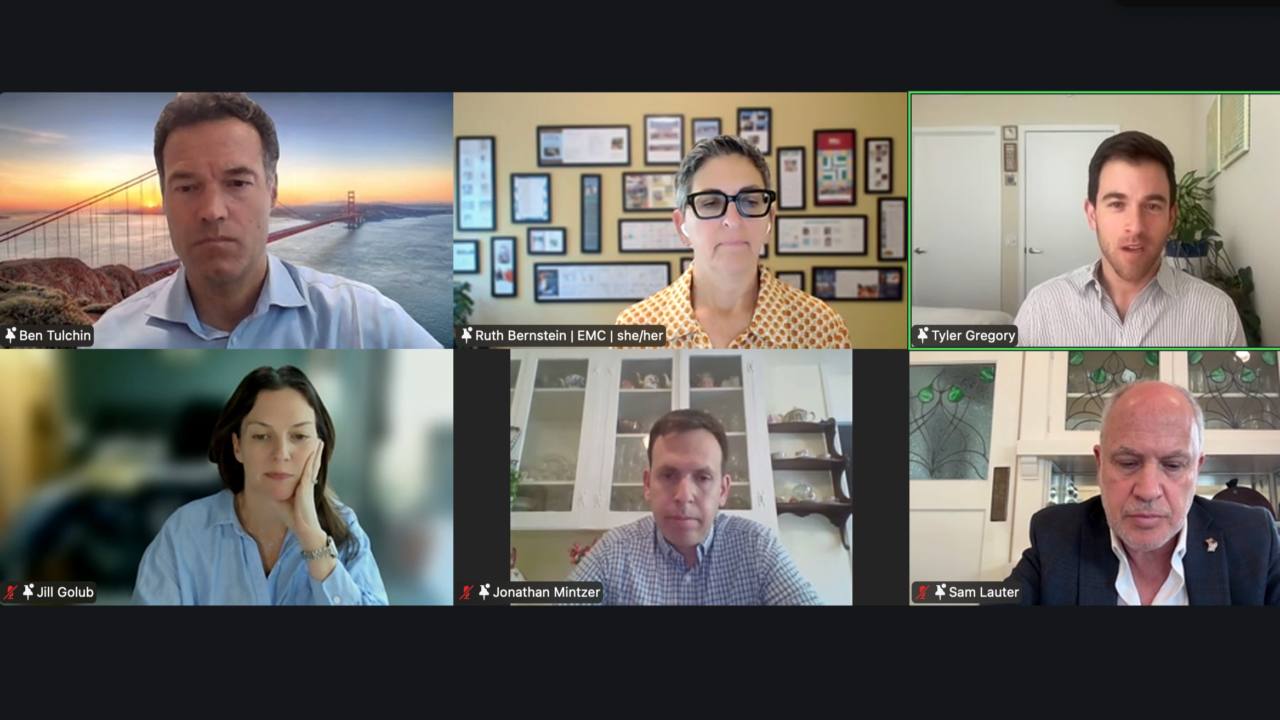
The candidates vying to replace Rep. Eric Swalwell, who resigned from Congress this week amid sexual misconduct allegations, were a topic of discussion during a webinar Friday on issues of concern to Jewish voters.
Bay Area Jewish Action (BAJA), a political advocacy offshoot of the Jewish Community Relations Council Bay Area, convened the webinar to share insights from recent polling data and offer advice to politically minded Jews.
Among the topics of concern were comments about Israel made by candidates in the race to represent Swalwell’s former East Bay district, which includes Hayward, Fremont, Dublin and Livermore. The election for the seat was already in full swing; Swalwell was not on the ballot because he was running for governor, a bid that came to an ignominious end this week.
Four Democratic candidates participated in a recent online forum: nonprofit executive Carin Elam, former Democratic campaign strategist Matt Ortega, state Sen. Aisha Wahab and BART board member Melissa Hernandez.
At the April 7 forum, hosted by Indivisible Tri-Valley, the candidates were asked by a viewer whether Israel had committed genocide in Gaza, a claim that Israel and many of its supporters reject. Elam, Ortega and Wahab all answered “Yes.” Hernandez declined to give a yes-or-no answer.
“As a democracy, Israel had the right to defend itself after the terrorist attacks on Oct. 7 a few years ago, and the right to secure the release of hostages,” Hernandez said. “However, the destruction in Gaza has gone too far and the people are paying the cost, and so are the civilians.”
The “genocide question” has become a political litmus test in certain Democratic Party races, said Jill Golub, principal at BMWL, a public relations firm that focuses on political campaigns.
“I think it’s upon us as a Jewish community to explain and raise awareness on why that’s a triggering term, why that term doesn’t make sense,” she said.
Israel and the genocide question have emerged this cycle as a major policy issue.
“We’re seeing an increasing trend of candidates that are being asked questions about the Israeli-Palestinian conflict running for local and state offices,” said Tye Gregory, JCRC’s executive director.
Gregory said the intense focus on Israel is worrisome. He said some candidates, in his view, are not well-versed in how Jewish identity and discussions about Israel connect.

“Educating candidates and elected officials about how [the Israeli-Palestinian conflict] factors into our Jewish identity has been evergreen, but we are concerned in the ways in which foreign policy issues are impacting local races,” he said.
Democratic voters, meanwhile, have become increasingly hostile to Israel in recent years.
A late March Pew Research Center national survey found that a majority of Democrats (84% of voters ages 18 to 49 and 76% of voters older than 50) have an unfavorable view of Israel.
Ben Tulchin, who runs a polling and strategic consulting firm, attributed the decline to Israeli Prime Minister Benjamin Netanyahu’s conduct.
“[Netanyahu] has alienated himself with Democrats and a lot of independents in this country, and that’s brought down Israel’s numbers in the U.S.,” Tulchin said.
Overall, Jewish voters in the Bay Area tend to have similar priorities as non-Jews (such as housing, cost of living and transportation), recent polling data has shown. But antisemitism is a prominent concern, according to Ruth Bernstein, senior principal researcher at the data analysis firm EMC research.

According to EMC polling in late 2024, 41% of Bay Area Jewish responders said they believed antisemitism was the most important problem the community faces today, and 42% said they personally witnessed or experienced antisemitism in recent years.
In total, 85% of respondents in the 2024 survey agreed that a candidate’s positions and actions in addressing antisemitism is an important consideration when they vote. And 84% responded similarly regarding a candidate’s positions on Israel.
“Bay Area Jews say these issues matter when they go vote,” Bernstein said.
JCRC launched BAJA, a 501(c)(4) political nonprofit, in August 2024. Leadership described the organization as an effort to mobilize voters in local races and lobby for policies on behalf of the Jewish community, amid a rise in antisemitism post-Oct. 7.