

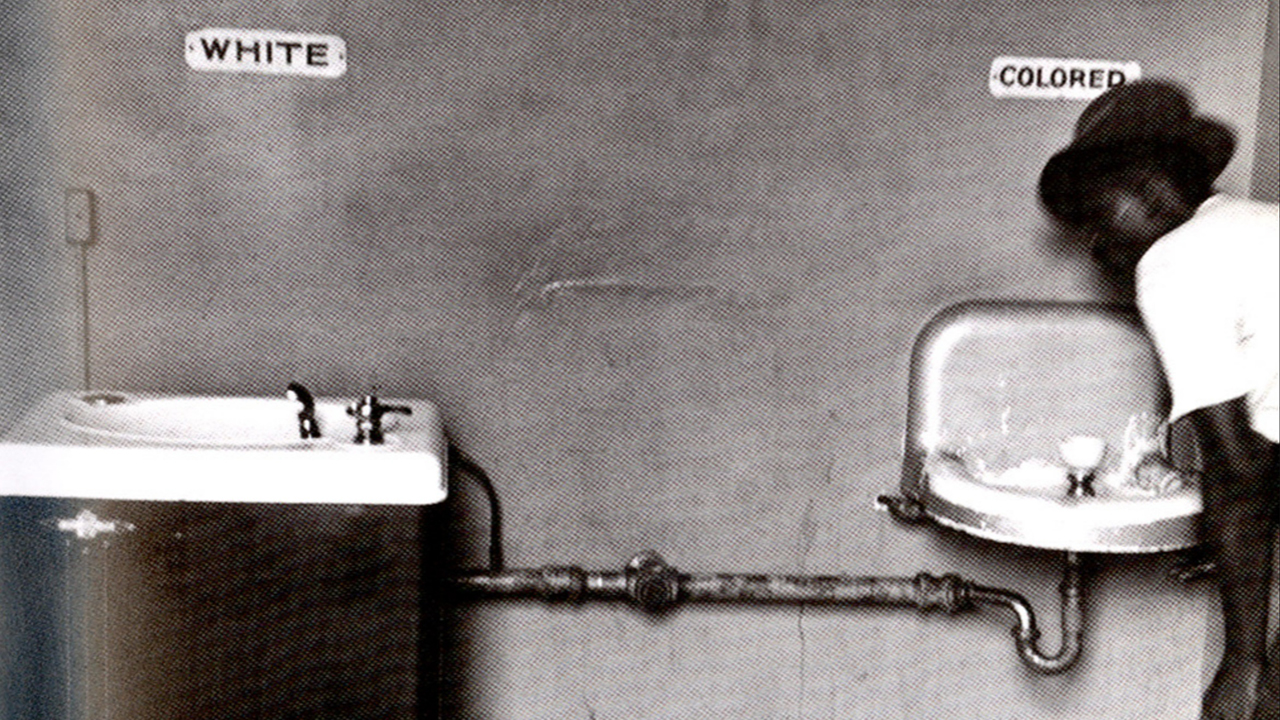
Driving south of the Mason-Dixon Line, my family stopped at a park where I saw signs on drinking fountains: “White Only” and “Colored Only.” The signs were also attached to restroom doors.
“What does that mean?” I asked my mother.
It was 1950. I was all of 7, and it was my first trip outside the Northeast.
My mother paused, and her eyes clouded. She told me that the “colored people” in the South were first brought over as slaves from Africa. President Abraham Lincoln freed the slaves after the Civil War, when the South had separated from the North. But even though we were one country now, and the North had won the war, the South had different laws: Segregation was legal, and discrimination was rampant.
“Why?” I asked.
My mother just shook her head.
The summer before, we had shared a beachside cottage in Connecticut with close family friends from the Bronx. When I got into a fight with housemate Lewis Goodman, I said, “You’re a Jew and you never grew.”
Lewis responded, on cue, “I know you are.”
We had picked up the playground retorts from an Irish Catholic kid on our street. We had no idea what they meant. I knew the word “Jewish,” but I hadn’t made the connection with the word “Jew.”
My mother set me straight. “You and Lewis are Jews,” she said. “You should never repeat that taunt, to anybody.”
How was I to know? I grew up in a nonobservant family but in a majority-Jewish section of Queens called Rego Park-Forest Hills. I didn’t know that outside of New York, in greater America, Jews were a tiny minority, about 3 percent in 1960. (Now we’re only 2 percent.)
My family prided itself on being assimilated, Americanized. While we never denied we were Jewish, we didn’t exactly advertise it either. I was not allowed to wear a Star of David.
Before another road trip to the South, my parents were leafing through motel brochures. My father pointed out the code phrases: “Churches nearby.” “Christian ownership.” “Restricted.”
Translation: Jews aren’t welcome.
“Why?” I asked.
“That’s just the way things are,” I was told. “We’re a minority, and you need to understand that. There are barriers.”
My father noted that those barriers existed beyond the South, too. Entire communities in the Northeast, like Darien, Connecticut, excluded Jews from buying homes. Those barriers also penetrated the Ivy League, which had Jewish quotas. There were also Christian country clubs and Jewish country clubs, Christian fraternities and Jewish fraternities.
“We don’t want to go where we’re not welcome,” my father said.
What I also didn’t know at the time was that discrimination was written into club and neighborhood bylaws even in the North. What’s more, some Jews harbored the same prejudices, toward Christians, Black people and even toward Jews who “looked different.”
Just before I went away to college, a co-counselor at the summer camp where I worked introduced me to David, a wealthy Wharton student. His parents and hers belonged to a largely Jewish country club in Westchester, New York. She thought we’d get along because we were both short.
At the end of a date with David, he parked his red sports car in front of a diner where we stopped for coffee. When we came out, he saw several Black men leaning on his car.
“In the South,” he said to me, “Negroes wouldn’t do that. They know their place.”
If I was supposed to stick to my own kind, I didn’t see David as my kind. Then I left for Oberlin College, where I discovered folks of various faiths, identities and ethnicities who despised discrimination. They turned out to be my kind.
Today, I’m part of a multiethnic, multinational, multireligious family that my parents and grandparents could never have imagined. We are Jews and Christians. Republicans and Democrats. White, Black and Asian.
Maybe folks like us will never be the majority, but six decades after the Civil Rights Movement, I remain hopeful.