

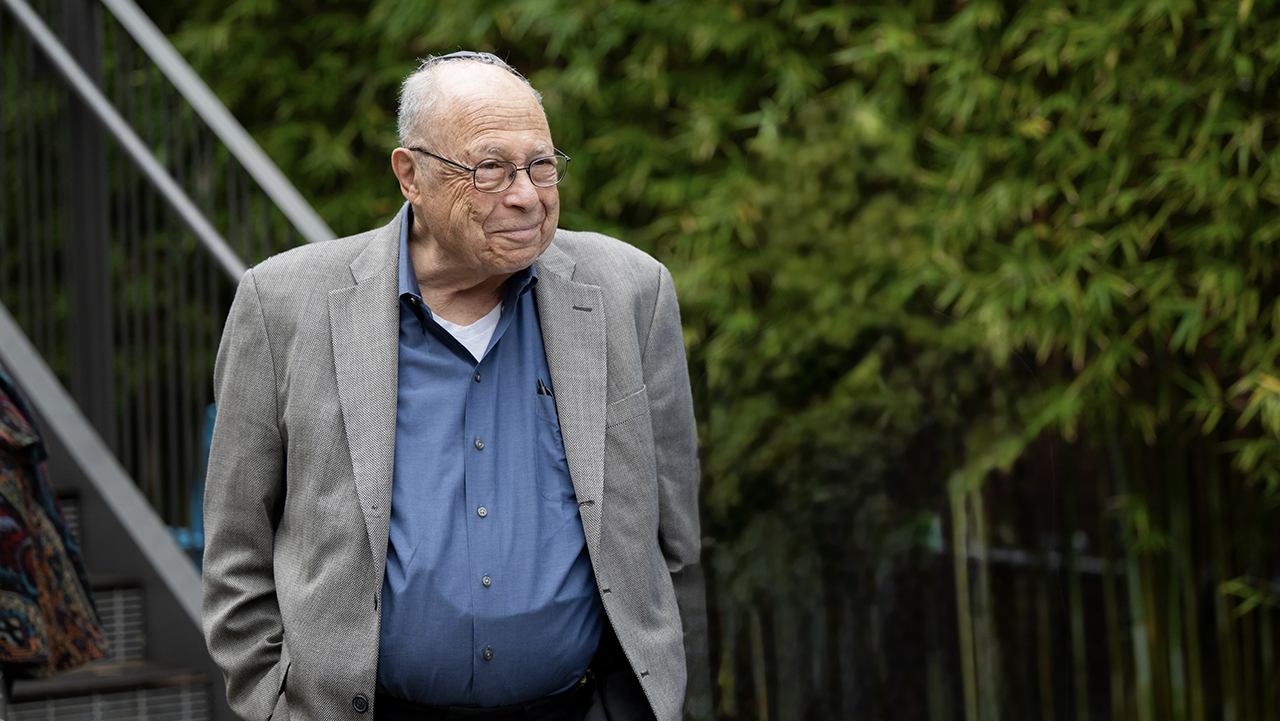
Rabbi Stuart Kelman, the founding spiritual leader of Congregation Netivot Shalom in Berkeley, was known as much for reviving interest in traditional practices as for innovation in Jewish life.
Prominent nationally, he was a pulpit rabbi, Jewish educator, authority in Jewish law, pastoral counselor, mentor to many and advocate for traditional burial practice as well as the green burial movement.
Plus, he played a mean jazz sax and clarinet.
Kelman died suddenly in his Berkeley home on June 1. He was 84.
“I learned everything about being a congregational rabbi from him,” said Rabbi Chai Levy, who interned under Kelman as a rabbinic student and has led Netivot Shalom since 2018. “He had an impact on my life that can’t be measured.”

His son Ari Kelman, a professor of education and Jewish studies at Stanford University, spends a lot of time on the speaking circuit and said he constantly encounters people who knew his father.
“They learned with him, or he did their conversion, he did their wedding, he did their children’s baby namings,” Ari Kelman said. “Hardly a day goes by that I don’t run into somebody who says, ‘Oh, send your parents my best.’ And probably more than anything else, that speaks to the kind of person he was.”
Stuart Kelman was born in 1942 in Bridgeport, Connecticut, to Esther and Wilson Kelman. He grew up at Congregation Rodeph Shalom, the local Conservative synagogue, where his mother was executive director, and played in his high school marching band.
He spent summers at Camp Ramah, which is where he met Vicky Koltun. They married in 1964.

He completed a dual-degree program at Columbia University and the Jewish Theological Seminary in New York, where he was ordained as a Conservative rabbi in 1969. He began his career in Jewish youth education, serving as director of the Conservative movement’s United Synagogue Youth for the Pacific Southwest from 1969 to 1974, and then as assistant professor of Jewish education at the Reform movement’s Hebrew Union College in Los Angeles from 1974 to 1984.
In 1984, he and Vicky moved their growing family to Berkeley, where Kelman spent a decade as executive director of the Agency for Jewish Education of the Greater East Bay.
It was in 1988 that he joined a group of Berkeley Jews who gathered in members’ homes for Conservative style, egalitarian Shabbat services. That minyan became Congregation Netivot Shalom, which hired Kelman as its first rabbi in 1993.
Kelman was adamant about not taking credit for founding the congregation, according to his son.
“He would be the first person to say that he didn’t start Netivot Shalom,” Ari Kelman said. “He was the founding rabbi, and he was very proud of that title. But it was very important to him that everybody knows that it was not his plan to start a shul.”
He noted that his father’s character and career were intertwined.
“He was very humble. He had a strong moral, ethical compass but never wielded it in an overbearing way,” he said. “He was a really good listener and a great teacher. He really knew how to engage people, how to get them to think for themselves and do for themselves. I think that’s really a hallmark of his whole professional life.”
Longtime congregant Ann Swidler, a former sociology professor at UC Berkeley, praises Kelman’s “deep commitment” to helping others become more Jewishly literate. She recalls how every year during the High Holidays he would come up with a new idea to bring the congregation closer together as a community, such as forming a chevra kadisha, a group of volunteers who prepare and watch over the dead until burial.
“He was committed not just to halachah in the formal sense, but what it means to build a true Jewish community,” Swidler said.
Netivot Shalom was a pioneer in recognizing same-sex marriage within Conservative Jewry, a decision announced by Kelman in a groundbreaking teshuvah, or rabbinic response, that he wrote in 1995. That, too, was a collective effort, Swidler recalled, describing a booklet of Jewish texts on marriage that Kelman put together for the congregation to study together.
“He didn’t just impose his view as the rabbi but worked his way through the texts with us before coming to a position,” Swidler said.
Beyond his congregational work, Kelman was deeply involved in championing traditional practices around death and burial, helping other local congregations launch chevrei kadisha. He served as president of Kavod v’Nichum, the national organization of chevrei kadisha, and co-founded the Gamliel Institute, an online training program for chevra kadisha leaders.
“He brought zeal and passion to a Jewish tradition that had few advocates outside the traditional Jewish community at the time,” said Sam Salkin, retired executive director of Bay Area Jewish funeral home Sinai Memorial. “In the 1980s, it was a tradition pretty much gone from Reform Judaism and had just a nascent interest in the Renewal community.”
The Bay Area may have the largest number of congregational chevrei kadisha of any Jewish community in the country, which Salkin called a “testament to his commitment.”
Kelman was also a pioneer in the Jewish green burial movement, instrumental in creating Gan Yarok in Marin County, the country’s first environmentally focused Jewish cemetery. Gan Yarok was technically established by a consortium, Salkin noted, “but he was the spark plug — it would not have come into being without him.”
While at Netivot Shalom, Kelman collaborated with singer-songwriter Debbie Friedman in the Jewish healing movement and helped establish the Coalition for Alternatives in Jewish Education, a national organization dedicated to Jewish educational innovation.
After retiring as Netivot Shalom’s rabbi in 2007, he continued as an active presence in the congregation.
Levy said that Kelman continued to serve as her mentor and adviser until his final days, often stepping in to share pastoral duties and teaching liturgy at Netivot Shalom. He and Vicky, a retired Jewish family educator, regularly attended services, often with children and grandchildren in tow.
“Just watching that family was inspiring,” said Swidler, noting that Kelman’s tallit had his grandchildren’s names embroidered on it, each name inside a pomegranate. “Those who live here come to every service with him and Vicky. They run up to him, they hug him, they sit on his lap. It’s clear the kind of love they have for each other.”
Ari Kelman said that his father often told him if he hadn’t become a rabbi, he’d have been a musician.
Two days before he died, Netivot Shalom’s Saturday morning service was led by graduating middle and high schoolers, including three of Kelman’s grandsons. Kelman spent the next day recording music with friends.
“He was there and really beaming,” Ari Kelman said of the service. “Shabbat in shul, Sunday playing music, and Monday morning he passed away. He spent his last days doing things he really loved.”
Kelman is survived by his wife, Vicky Kelman; children Navah Becker (Michael), Ari Kelman (Eva Jordan), Etan Kelman (Alison) and Elana Naftalin-Kelman (Rabbi Adam Naftalin-Kelman); and 10 grandchildren. His funeral will take place at 11 a.m. Thursday, June 4, at Congregation Netivot Shalom, followed by burial at Gan Yarok.