

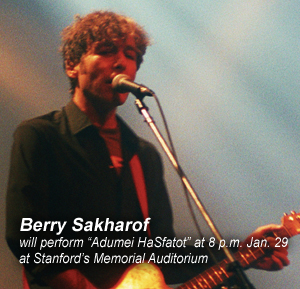
Some musicians might flippantly call their music “Jewish roots music,” but for Israeli rock star Berry Sakharof, it’s not a frivolous description.
His latest conceptual project reaches back nearly 1,000 years, to the Golden Age of Spanish Jewry, for its lyrics — taking the kabbalistic poetry of a Spanish medievalist and then marrying it to the electric and exotic sounds of current-day Middle Eastern rock.
Sakharof, a singer-guitarist who will play a concert Jan. 29 at Stanford’s Memorial Auditorium, says the poetry in his new project and accompanying 2009 album, “Adumei HaSfatot” (Red Lips), comes from “a time when Jews and Muslims were living in harmony and Jews were influenced by Muslim culture.” The music, on the other hand, reveals the cultural mix of modern Israel, he adds.
On stage, Sakharof will be joined by his partner, producer-arranger and drummer Rea Mochiach, and seven other musicians. Stanford Lively Arts is presenting the event, part of an expansive 2010-11 season, in partnership with the Israel Center of the S.F.-based Jewish Community Federation and with support from the Consulate of Israel in San Francisco, Hillel at Stanford, the Taube Center for Jewish Studies at Stanford and the Israel Cultural Connection of the Oshman Family JCC.

Israel has experienced a revival of piyutim, songs to God that express joy, anguish and devotion that have been written since Temple times, Sakharof says during a phone interview from his home in Tel Aviv.
That revival led him to the inspiration for “Adumei,” the poetry of Shlomo (Solomon) Ibn Gabirol, an 11th-century Spanish Jew whose verse reveals timeless themes of love, despair and the search for union with God. While Ibn Gabirol’s native language was Arabic, he wrote his poetry in Hebrew, “a language he did not speak,” Sakharof explains. Through Hebrew, the poet connected to the language of Judaism, as well as to “philosophic and mystic and kabbalistic ideas,” he adds.
“To have a rock star breathe new life into these archaic texts is pretty incredible,” says Donny Inbar, associate director for arts and culture of the Israel Center.
Inbar calls it a “rare combination” — setting rock music to “high-brow poetry, particularly poetry with complicated texts.” The album has become a big seller in Israel, a bit surprising for a work that originally was seen as “something for the soul and not for the charts,” Inbar says.
Known as the “prince of Israeli rock,” Sakharof began his musical career in the 1970s at the age of 16 and became a rock star in Israel and Europe in the 1980s, winning numerous awards for his albums, performance and compositions.
“I was brought up on very modern music,” notably the Rolling Stones and Western bands, says Sakharof, who was born in Turkey in 1957 and moved to Israel with his family at age 3. His surname is Russian — from a paternal grandfather who, on the way to the U.S., got off the boat in Turkey and decided to stay — but he is also a descendant of Sephardi and Mizrachi.
To American ears, the music of “Adumei” is unorthodox. The songs often begin improvisationally with a taskim, the Arabic word for an extended introduction, featuring one or two instruments or perhaps just percussion. Slowly, other instruments join in, and eventually Sakharof introduces the lyric, with vocalist Shai Tzabari adding harmonies, counterpoints and high-pitched trills. The song might end in the same manner, with a single instrument.
Sakharof says the poetry of Ibn Gabirol is “touching to the heart,” as titles that translate to “With Lowly Spirit,” “Winter With its Ink,” “My Words are Driven” and “What’s Troubling You, My Soul” would seem to indicate.
Discussing his own religious bent, Sakharof considers himself liberal. However, he doesn’t perform on Shabbat. It’s “not so much about the religion, but the idea of having one day of week of doing nothing,” he says.
He also feels a deep connection to his nation and its language. He sings in Hebrew, but the program will include translations.
“I’m in love with Hebrew,” he says. “I think it’s a very special language. Every word and every letter has a lot of history and hidden meanings, which to me is amazing. I bring all that I can to this language.
“That Israelis are speaking a 2,000-year-old language … is one of the foremost successes of Zionism.”
Berry Sakharof will perform “Adumei HaSfatot” at 8 p.m. Jan. 29 at Stanford’s Memorial Auditorium. $28-$68 adults, discounts for youth, students and Stanford students. Information: livelyarts.Stanford.edu or (650) 725-ARTS.