

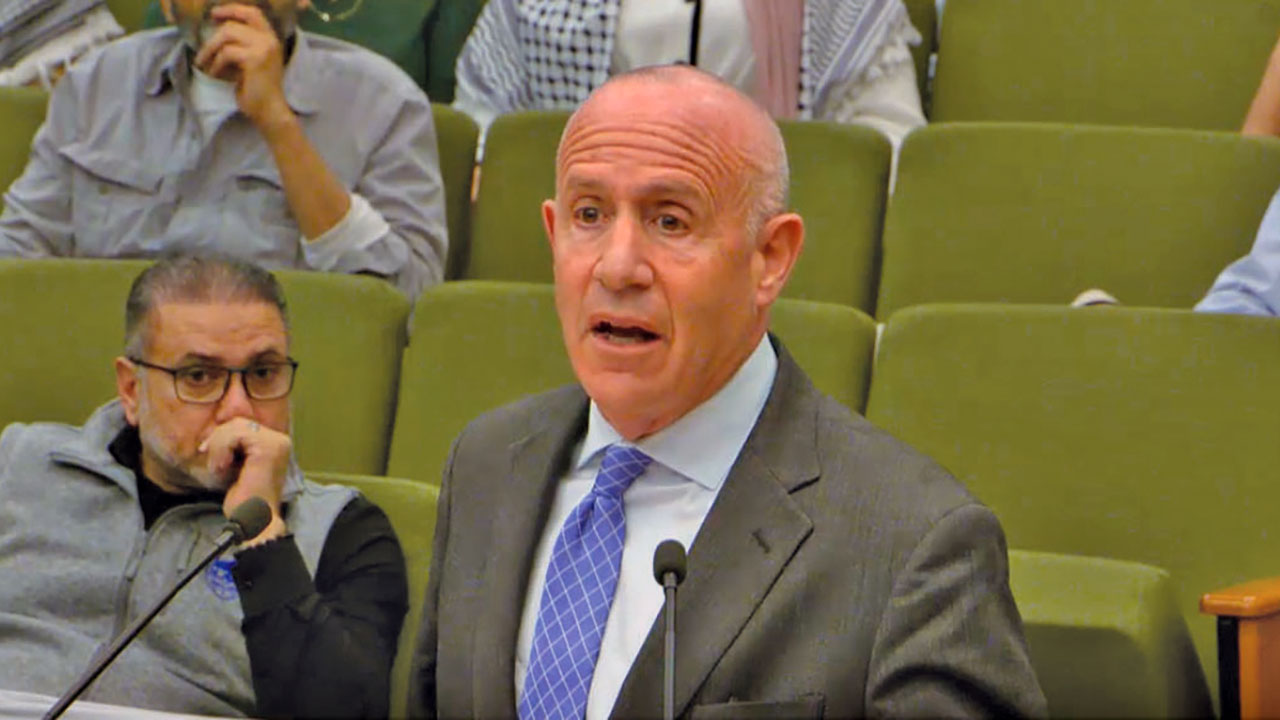
After five hours of public comment on Tuesday night that ran the gamut from calm to agitated, the Sacramento City Council passed a resolution calling for a “bilateral cease-fire” in the Israel-Hamas war.
The resolution, which also seeks the release of the hostages and “unrestricted humanitarian aid” for Gaza, was in sharp contrast to measures approved in Bay Area cities such as Richmond that wholly condemned Israel.
Sacramento’s measure was put forward by Mayor Darrell Steinberg, who is Jewish, and stated that “Israel remains the hope that Jews can live safely and freely and never again face threats to their very existence.”
Steinberg left the dais to stand at the lectern in front of the council to speak passionately for his resolution.
“Try to look beyond the words you don’t like in the resolution,” he urged, calling it a “principled compromise” that, while not affecting U.S. foreign policy, had the possibility of bringing the community together.
“Please try tonight to hear each other, to respect the process, and to respect the outcome,” he said.
The resolution passed 6-1 at around midnight, with one council member absent. The lone “no” came from Lisa Kaplan, who has been targeted and harassed for her pro-Israel stance.
“It was a difficult and sometimes painful evening,” Steinberg told J. the next day. “I have absolutely no regrets. It was the right thing to do.”
Steinberg had to use the gavel to quiet the crowd several times during the meeting. The Sacramento Bee reported that 12 people were arrested after the city council exited the chamber before returning to vote. Videos posted on social media showed primarily pro-Palestinian supporters chanting inside the chamber. Kaplan posted on X/Twitter that police ordered the protesters to leave and arrested those who did not comply.
According to Sacramento police, “Numerous protesters remained in the council chambers, refusing to comply with the order. At approximately 10:40 p.m., additional officers entered the council chambers, and unlawful assembly and disbursement admonishments were given. All but twelve of the protesters left on their own accord. The remaining individuals who chose to stay in the chambers and disobey the lawful orders to disperse were arrested for unlawful assembly and failing to disperse and were booked at the Sacramento County Jail.”
The resolution contained some wording that aligns with what mainstream Jewish groups have been asking to hear from local governments and institutions regarding the Hamas massacre on Oct. 7 and the subsequent war. But the resolution also made points generally put forward by pro-Palestinian cease-fire advocates.
The resolution condemns the Oct. 7 attack and its “horrific atrocities,” including weaponized sexual violence, the loss of “innocent civilians” and the capture of hostages. It also mentions that in response, the “Israeli government has carried out military operations that have killed 25,000 Palestinian civilians and injured over 70,000 more.”
The measure states that a “two-state solution must exist, with one Jewish state and one Palestinian state existing side by side; where each side recognizes the others’ historic ties to the land, and the right for both peoples to peacefully exist in that land.”
It also attempts to address the feelings of local Jews and Palestinians.
“Many in the Jewish community are rightfully offended by the spoken views of some that … the plight of the Palestinian people in fact justified the Oct. 7, 2023 terrorist massacre,” the resolution states. It adds, “Many in the Muslim and Arab communities are rightfully offended by the spoken views of some, that the ongoing slaughter of innocent Gazans is justifiable due to the attacks on Oct. 7, 2023.”
Please try tonight to hear each other, to respect the process, and to respect the outcome.
The mayor said this attempt at balancing the issue was designed to bring the community together. He introduced the team of six who worked on the resolution with him, including three Jewish members: Jay Schenirer, a former city councilmember, Rabbi Seth Castleman, a member of the Sacramento Board of Rabbis, and Judy Heiman, a public policy consultant. There were also three Arab American members, including a director of the local branch of the Council on American-Islamic Relations. Both Schenirer and Heiman serve on the board of Congregation B’nai Israel, a Reform synagogue where the mayor’s wife, Cantor Julie Steinberg, works.
Despite the display of unity, some commenters on both sides considered the attempt at balance to be the problem, finding fault in what they saw as a false equivalence between the acts of Hamas and the acts of Israel. There was also criticism of what the resolution did not include.
In addition, several members of the organized Sacramento Jewish community spoke against proposing a resolution at all.
Marion Leff, co-president of the Jewish Federation of the Sacramento Region, said she understood Steinberg’s position but disagreed with him.
“We respect the heartfelt intent and reasoning of our mayor, who we count as a member of our Jewish community, in bringing this resolution forward,” she said. “But we respectfully disagree that it will achieve its aims. In fact, we believe there are significant consequences of this resolution, should it pass. We fear for the safety of our community.”
Deborah Gonzalez, a past president of the Federation, also took issue with the idea of calling for a cease-fire.
“There was a cease-fire Oct. 6,” she said, adding that it was not Sacramento’s business to weigh in on foreign affairs.
Steinberg told J. he was “disappointed” that the Federation and Sacramento Jewish Community Relations Council did not support the resolution.
“This was not intended to try to affect or influence the war,” he said. “We don’t have that power. But it was to make sure that all voices are heard in our community and to make a statement about our values.”
There were also substantial voices against the resolution from the pro-Palestinian side. Personal criticism of the mayor drew applause, as did speakers who claimed there were “there are no two sides to this conflict” and demanded wholesale condemnation of Israel.
However, there were also speakers on either side who made a plea to support the resolution, even if they found it less than perfect.
Miriam Joffe-Block, a Sacramento Jewish resident, was in tears as she spoke of her desire that Israel should live up to its Jewish values of respecting life.
Castleman, who co-presented the measure, noted that his Jewish values motivated him to support the resolution.
“These values instruct us to condemn the violence of Oct. 7,” he said. “These values teach us to call for bilateral cease-fire. These values implore us to demand far more aid be flown to Gaza.”
The resolution was a pivot for Steinberg, who previously held out against putting any resolution on Gaza in front of the city council.
On Jan. 27, Steinberg wrote an op-ed in the Sacramento Bee in which he said he would not support a resolution suggested by councilmembers Katie Valenzuela and Mai Vang.
“I oppose the current resolution because it is far too one-sided and will further inflame the already high tensions in our community,” he wrote.
He also used the op-ed to obliquely address the Jewish community, saying “to those who believe that defeating even a one-sided resolution will make the anger and division go away, that is wishful thinking.”
At that time, Steinberg wrote that he preferred that there be no resolution on foreign policy before the city council. Perhaps to address that change of tone, at Tuesday’s city council meeting he stressed that the resolution was about repairing intercommunity strife in Sacramento rather than having an impact beyond city borders.
“We are not at war with each other here in Sacramento,” he said.
Vang did not attend the meeting, citing a previous family commitment. That angered some protesters, who preferred Vang and Valenzuela’s resolution, which leaned against Israel. Valenzuela voted to support Steinberg’s resolution.
Kaplan, who voted against the resolution, posted earlier in the day on X/Twitter that she opposed it and that the conflict was “a million times more complex than rooting for teams and hoping one side will win.”
Castleman told J. that he felt the resolution’s passage was a statement of interfaith solidarity and was more popular than it might seem by the criticism it received during the meeting.
“I think a lot more people in both communities support it than were represented,” he said.