

Food coverage is supported by a generous donation from Susan and Moses Libitzky.
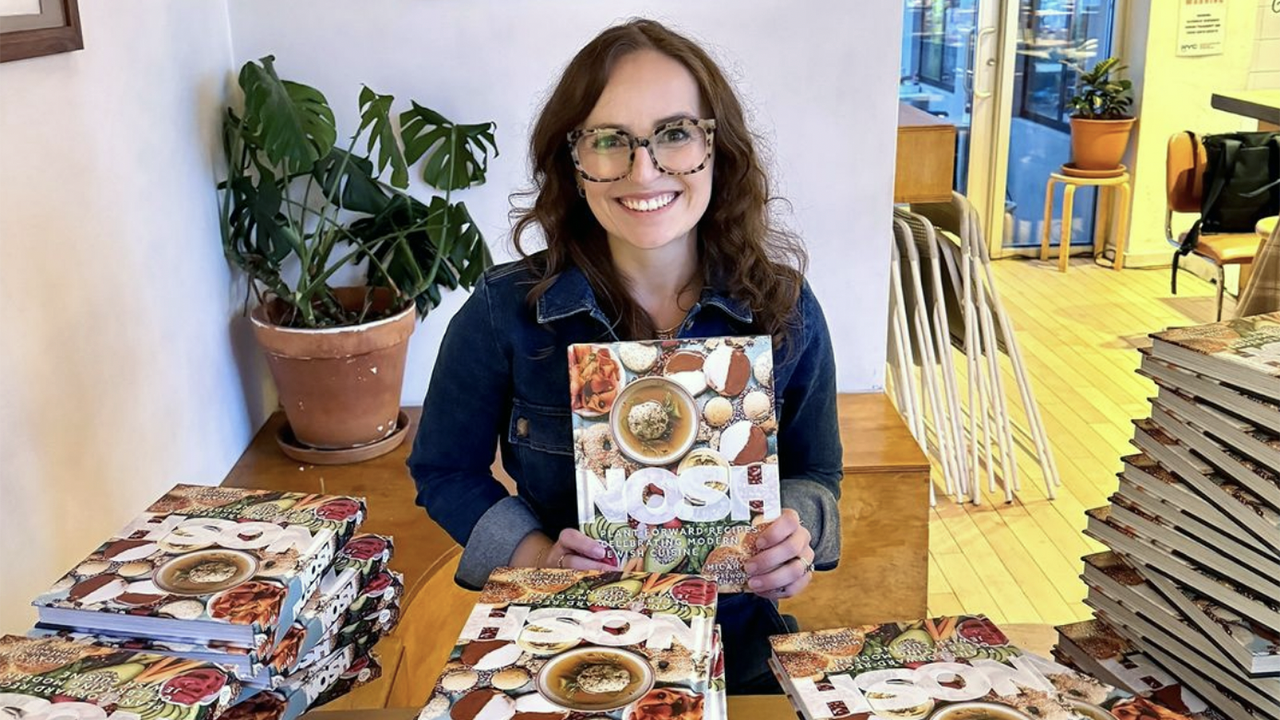
J. food columnist and newly published cookbook author Micah Siva says she was blessed in the Passover department, with a mother who loved to experiment with kosher-for-Passover recipes in all kinds of ways.
Her mother made matzah lasagna, of course, but that’s pretty old hat by now. Not so for her more experimental matzah baklava and matzah taco shells.
The one meal Siva’s mom struggled with most around the holiday was breakfast. A box of kosher-for-Passover cereal was outrageously expensive and left them “feeling like garbage all morning,” she recalled. So the rise of alternative flours was very exciting to her mom because it allowed her to experiment with breakfast foods that actually tasted good.
Siva feels the same way. In fact she has a rule with her husband, Joshua — even inscribed in their ketubah, she joked — that they eat pancakes every Sunday morning. They normally use wheat flour, but for Passover and sometimes at other times of the year, she makes her pancakes with almond flour.
“They’re nutritious and delicious and Passover-friendly, and I’ve been making those for a long time,” the San Francisco resident said. They’re gluten-free, too. She also uses almond flour as the main ingredient in her black and white cookies.
Siva’s recipe for almond flour pancakes is included in her first cookbook, released March 5, “Nosh: Plant-Forward Recipes Celebrating Modern Jewish Cuisine” (Collective Book Studio, $35).
Siva spoke to J. from Philadelphia while on an East Coast book tour with her husband and infant son, then 3 months old, in tow. (Her husband waited until now to take paternity leave so he could travel with them.)
Last year, the couple co-authored “1, 2, 3, Nosh with Me,” a picture book that teaches children to count while introducing them to Jewish foods.
Siva acknowledged that she’s just a wee bit insane for starting a book tour so soon after giving birth.
“You don’t know what you don’t know,” she explained. Being up with a feverish baby most of the night before her D.C. appearance wasn’t something she could have planned for, she said. But they’ve been to six states now, and he’s “going with the flow, more or less. I’m hoping this will turn him into a resilient little dude.”
Siva, 32, began contributing her plant-based recipes to J. two years ago, and she especially shines on @noshwithmicah on Instagram. She took most of the photos in the book, and one of them graces the cover of J.’s April 5 print issue. A graduate of New York’s Natural Gourmet Institute, as well as a registered dietitian, she is a proponent of the plant-based diet, though some of her recipes have dairy versions, too.
She maintains that you don’t need to give up the flavors of Jewish comfort foods like brisket, pastrami or whitefish salad when going vegan or eating less meat. You just need to be more creative — and that’s where she comes in.
“Vegetarians and people wanting to eat less meat are asking, why should I have to be excluded from this dish, or why shouldn’t it be on my table?” said the native of Calgary, Canada. “There are so many ways we can re-create these food memories. There’s no reason to exclude these dishes from our culture and diet.”
Some of her recipes are deviations from concepts seen elsewhere. Lox made from carrots and pastrami made from celery root have been embraced by the plant-based crowd for the past few years (and have been written about in this very column in profiles of two different chefs). But other recipes are entirely her own.
Given her dietitian background and emphasis on nutrition, her cookbook was not going to feature recipes using any of the highly processed meat products now on the market.
Her brisket is made from trumpet mushrooms and tofu. Her shwarma is made from jackfruit. Her whitefish salad is made from hearts of palm and white beans.
Whitefish salad is one of my favorite flavors, and my curiosity got the best of me. I brought it to a friend’s house and we both appreciated its novelty and found that it made a delicious appetizer on crackers. Did it taste exactly like whitefish salad? Of course not. But was it tasty? Absolutely.
Siva’s vegan gefilte cakes are made with cauliflower, parsnips, raw cashews and seaweed, which gives them a bit of fishiness.
“I have never eaten gefilte fish which was not homemade. I was very blessed that I avoided that my whole life,” Siva said. “My great-grandmother Freda’s recipe is a family treasure.”
Siva said she was inspired by that recipe, but worked on her approximation using a variety of vegetable combinations until she arrived at something that is “true to the original but is veganized and exciting and something new.”
Her cookbook is a great balance between traditional Jewish holiday foods from around the diaspora and dishes that can be made any day of the week.
Of course, challah, matzah ball soup and hamantaschen — she loves to come up with original fillings — are all in “Nosh.” But so are recipes like Tempeh and Artichoke “Marbella” and Pomegranate Lentil Tabbouleh.
During the four years she worked on the book, she kept a Google document with over 200 recipes that she could have included. Ultimately, she pared them down to about 80, zeroing in on holiday-specific ones and those tied to her childhood. But just as important were recipes inspired by Jewish ingredients for the rest of the year.
“If you only use this cookbook for three holidays a year, then I didn’t do my job right,” she said.
While Siva couldn’t have anticipated her cookbook coming out at such a fraught time politically, she said, “We really need positive Jewish experiences right now. It feels good to be able to celebrate something so important and to preserve our culture and make sure it carries on.”
Siva will be talking about “Nosh” throughout the Bay Area:
- Tuesday, April 16: Napa Bookmine, 6 p.m.
- Wednesday, April 17: Omnivore Books in SF 6:30 p.m.
- Friday, April 19: JCCSF, OneTable Shabbat Dinner, 6 p.m.
- Saturday, April 20: Berkeley Public Library Demo, 2 p.m.
- Saturday, May 11: Foodwise Demo, S.F. Ferry Building, 11 a.m.
Micah Siva’s Vegan “Gefilte” Cakes
Makes 10 cakes
On the table in 1 hour, including 10 minutes resting time

Gefilte fish is a delicacy in my family; my great-grandmother Freda was famous for her homemade gefilte. My mom and grandmother spent years trying to replicate her recipe, which was passed down verbally with measurements of handfuls and a bisl (“a bit”). The key to replicating the taste was in the fish itself and tasting the raw mixture before cooking. After years of trying, they were finally able to nail it down. I couldn’t make a Jewish cookbook without paying homage to this family tradition, but instead of whitefish, I made a vegan recipe using a mixture of vegetables, seaweed and spices to mimic the flavor and textures of Freda’s gefilte.
- 2 medium carrots, scrubbed, 1 roughly chopped
- ¼ head cauliflower, cut into florets
- 1 medium parsnip, peeled and roughly chopped
- 1 medium russet potato, peeled and roughly chopped
- ¼ white onion, roughly chopped
- ¼ cup raw cashews
- 1 sheet sushi nori, finely chopped
- ¼ cup matzo meal
- 3 Tbs. flax meal
- 4¼ to 6¼ cups water, divided
- ½ tsp. black pepper
- ½ tsp. sea salt
- 1 tsp. lemon zest
- 1 tsp. potato starch
- ½ tsp. baking powder
- ¼ cup extra-virgin olive oil
- Flaky sea salt, for serving
- Horseradish, for serving
Preheat the oven to 350°F. Line a sheet pan with parchment paper.
In a food processor, pulse the chopped carrot, cauliflower, parsnip, potato, and onion until they are the size of peas. Add the cashews to the food processor and pulse until well combined.
Transfer the vegetables to a medium bowl. Add the nori, matzo meal, flax meal, ¼ cup of the water, pepper, salt, lemon zest, potato starch, and baking powder and mix until combined. Let sit for 10 minutes.
Using a ¼-cup measure, form the mixture into 10 patties.
Heat the olive oil in a nonstick pan over medium-high heat. Cook the patties until golden, 3 to 4 minutes per side. Transfer the patties to the prepared sheet pan and bake for 15 minutes. Sprinkle with flaky sea salt.
Meanwhile, cut the remaining carrot into ¼-inch slices. Combine the carrots and enough water to cover by 1 inch in a medium saucepan and bring to a boil over medium-high heat. Lower the heat to a simmer and gently cook the carrots until tender. Drain and set aside.
Top the patties with the sliced carrot and serve with horseradish.
Note: The gefilte cakes can be frozen for up to 3 months and reheated on an aluminum foil–lined sheet pan in the oven at 400°F until heated through.
Variation: The secret to a “fishy” flavor is the use of sushi nori. You can substitute it with 1 Tbs. of dulse flakes, 2 Tbs. of furikake seasoning or 2 Tbs. of kelp granules.
Substitution: If making these outside of Passover, feel free to use breadcrumbs or panko.