
Updated April 28
Palo Alto just tripled its number of kosher restaurants — to three.
Holy Sushi and The Ma’lawah Bar, both of which operated out of the Oshman Family JCC’s kitchen until last summer, joined Izzy’s Brooklyn Bagels in Palo Alto as kosher brick-and-mortar eateries at the end of March.
“Leaving the JCC has turned into an unbelievable blessing,” said Rabbi Joey Felsen, the force behind Holy Sushi and founder of the Jewish Study Network. (Felsen also is also a J. board member and Torah columnist.) “At first, I would tell people, ‘We landed on our feet.’ But now, we’re growing wings.”
Ma’lawah Bar chef and owner Doreet Jehassi concurred.
“My business plateaued at the JCC,” Jehassi said of her Yemenite eatery. “It was a great steppingstone, but now I’ve become a true commercial business owner.”
Holy Sushi and Ma’lawah Bar are less than a mile from each other and from Congregation Emek Beracha, an Orthodox shul in Palo Alto.
Both eateries have been through numerous iterations since their founding and are certified by Sunrise Kosher, aka Va’ad of Northern California.

Holy Sushi began in 2013 at Meira Academy, the Orthodox girls high school at the JCC, when Felsen partnered with sushi chef Wilson He to create a lunch option for students.
Jehassi started her business, which is named for a type of Yemenite bread, as a delivery service out of her Santa Clara home in 2019. She was a burnt-out tech worker, looking for more meaningful work.
In 2021, during the pandemic, Felsen spearheaded an effort to bring kosher businesses into the kitchen at the JCC. When the JCC said that it would not renew their leases last July so that it could provide more diverse food options at different prices, Holy Sushi and Ma’lawah Bar found spots elsewhere. Jehassi moved into Stanford Hillel’s kitchen, knowing it was temporary.
“That gave me the gift of discovering that this is really what I want to do,” Jehassi said. It also introduced her wraps and breads to Stanford students.
Holy Sushi began sharing space with Te Amo, a boba tea shop, whose owner told Felsen that he planned for it to become kosher. While Holy Sushi expanded with wider exposure there, Te Amo’s owner decided he would rather not pursue kosher certification.
Jehassi soon set her sights on a former gyro shop, while Felsen inquired about a former Starbucks sitting empty. And even though opening a kosher restaurant had never been part of his plans, He decided to take the leap after working with Felsen for the past 10 years.

It’s almost unheard of that a sushi chef of He’s caliber would choose to serve the kosher community, according to Felsen. The respect is mutual.
“When someone fully trusts you, you’re really happy to work for him,” He said. The sushi chef is not Jewish and doesn’t consider himself religious but said he has a lot of respect for religious people.
“I place complete and total trust in him,” Felsen said. “He makes all the decisions as to how the restaurant is run.” Meira Academy, which is set to close this summer, is officially the owner of Holy Sushi. Felsen has been involved as Meira’s board president, and He is an employee.
The menu at Holy Sushi, a sit-down restaurant, is four pages long and has expanded at least 400 percent since leaving the JCC, Felsen estimates. Felsen is still slowly working his way through all the items, as most of them are new to him.
“In most kosher communities of this size, sushi is like fast food,” Felsen said. “This is more like what you’d have in New York or L.A.”
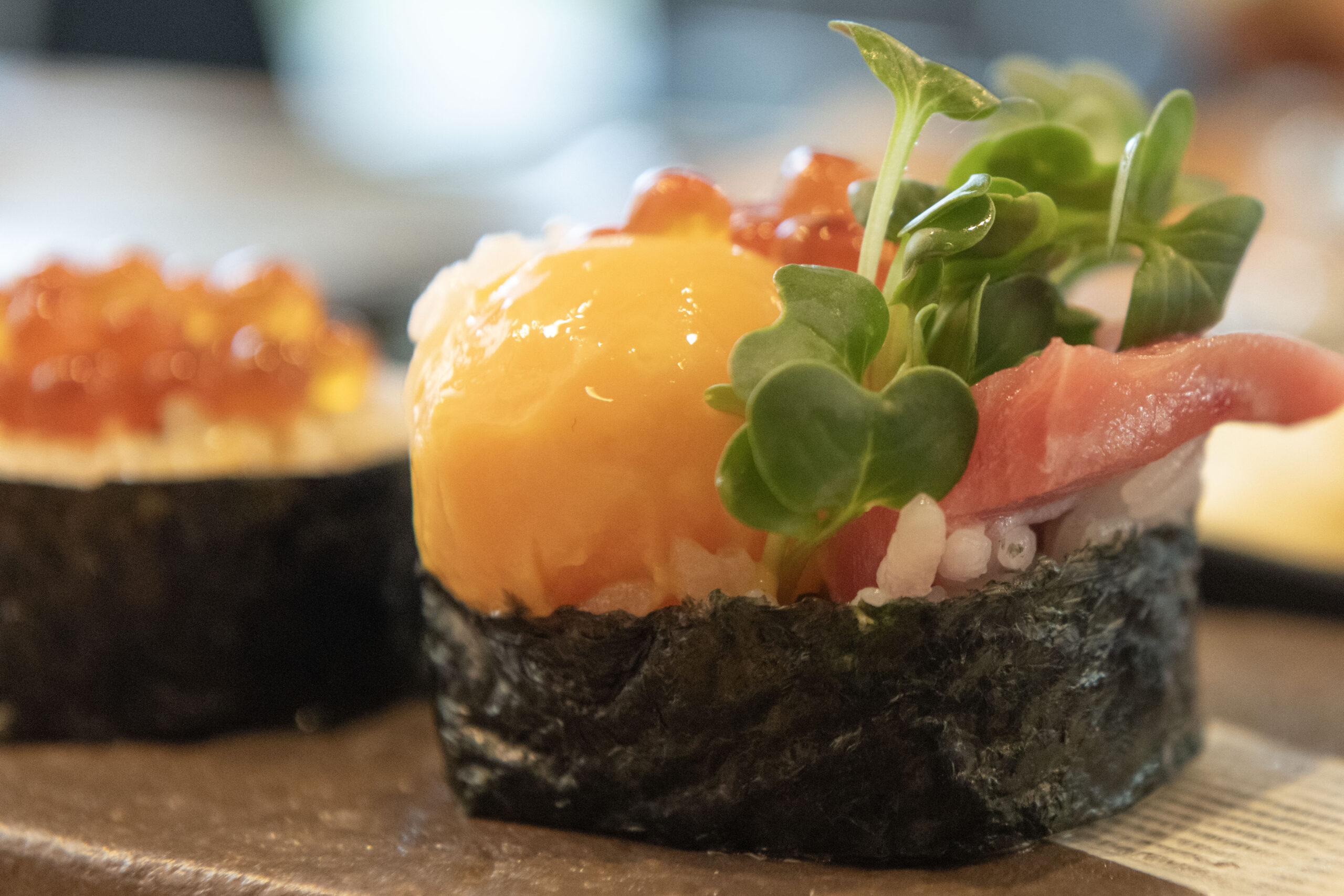
But don’t take Felsen’s word for it. Take mine. I had just been out for excellent sushi a few nights earlier. I found the delicateness of the fish at both restaurants to be indistinguishable from each other. At Holy Sushi, I tried a hamachi “shot,” bluefin tuna crudo, salmon, tuna and hamachi sashimi, and an orange roll with cooked sweet potato and carrot.
The five-star Yelp reviews don’t lie — nor does the sight of plenty of non-Jews eating there, many of them Japanese. The restaurant plans to eventually obtain an alcohol license and will serve sake.

Holy Sushi is also catering large events and has regular contracts to feed kosher employees of some tech companies, as well as Stanford students.
While unintentional, one recent review gave Holy Sushi incredible exposure. In reviews on both Yelp and Google, a woman wrote that if she had known the restaurant was Jewish-owned and run by a rabbi, she never would have tried it. The review got picked up in April by the StopAntisemitism account on X (Twitter), which has more than 300,000 followers.
“This is the greatest gift,” Felsen said. “People are coming in wanting specifically to support us, and everyone around the world now knows there’s kosher sushi in Palo Alto.”
Meanwhile, Ma’lawah Bar, a fast-casual restaurant, is serving falafel, shakshuka, vegan pizza and sabich, the Iraqi Jewish eggplant sandwich, all on house-made Yemenite bread. There are also a number of salads and incredibly creamy, rich shakes with a tahini base.
While I’ve eaten my share of sabich sandwiches, having it on ma’lawah was new for me with so many flavors coming together on a flaky pastry. It was decadent and delicious.

Some of the dishes come with a hard-boiled egg. Without it, Ma’lawah Bar’s menu is entirely vegan, and the place has quickly been embraced by the meatless crowd.
“This has been really eye opening for me,” Jehassi said.
Given that she’s on a busy, major thoroughfare like El Camino Real, she gets many curious people who are simply passing by.
“Everyone is eager to try something new and unique,” she said.
At first, Jehassi will describe her food as Middle Eastern — and has a definition of ma’lawah in a huge font on one wall — she’ll go more in depth if someone seems interested.
“I’m American first and Israeli second and Yemenite third, and I’ve really found my identity through this business,” she said. “This is such a transient, diverse area. And I love talking about my culture and do so with happiness. People have been very accepting and they love my food.”
The Ma’lawah Bar, 4131 El Camino Real, Suite 100, Palo Alto. Opens at 11 a.m. daily except Saturday. Closes at 7 p.m. Monday through Thursday, 2 p.m. Friday and 5 p.m. Sunday.
Holy Sushi, 3441 Alma St., Suite 100, Palo Alto. Open 10:30 a.m. to 2:30 p.m. and 4:30 to 9 p.m. Sunday through Thursday, and 10 a.m. to 4 p.m. Friday.
The restaurants are also available on delivery apps — though they are both closed for Passover until May 1.