

“A $200,000 Per Year Shlemiel.”
That was a real headline in our paper 100 years ago this week, in November 1924. Who was this high-earning “shlemiel”? None other than San Francisco native son Rube Goldberg. For years the cartoonist was a household name across America, and he’s still known today, although less for his political work and more for his namesake concept of a “Rube Goldberg machine,” or an overcomplicated, inventive and usually entertaining contraption.
But before he was any kind of famous, he was just Reuben Lucius Goldberg, born in 1883, a Lowell High School graduate and, to his family and friends, a “shlemiel.”
His father, Max Goldberg, was no slouch himself.
“In reply to my query about his forbears and early life, ‘Rube’ had spoken humorously of his father’s arrival in this country sixty years ago with an old trunk and about fifteen cents,” Harry Harrison wrote in 1924. “As he was about to land the trunk disappeared, so that the practically penniless boy of thirteen made no auspicious debut in this glorious country of ours. ‘Rube’s’ father found New York a friendless, unsympathetic place, and sailed on for sixty days to California, where he settled down to a peaceful, happy life.”
Trunk or no trunk, Max made good in San Francisco. According to the Contemporary Jewish Museum, which had an exhibit on Rube Goldberg in 2018, Max Goldberg was at some point the city’s sheriff. According to the Healdsburg Tribune, he had been a police and fire commissioner of San Francisco. Max Goldberg is mentioned in our social columns often and seems to have been a Freemason. In 1909 we succinctly described him as “a well known citizen in this community” and, in a 1934 profile, as one of the city’s “notable personalities.”
He told our paper he’d seen the cortege of Abraham Lincoln in 1865: “His body was lying in state at the City Hall where people filed by for a last look at the care-lined face of the dead leader. I was among them, viewing him as I went by with indescribable feelings of emotion.”
Max Goldberg was a success and, according to Rube, was not thrilled about his son’s desire to be a professional cartoonist. But he did eventually accede.
“I went to school in Frisco, where I made quite a record in drawing,” Rube Goldberg said in 1924. “My folks considered my efforts in that line as foolish and useless, but being kind-hearted people, they didn’t object strenuously, and so I kept on drawing and doing other art work because I really loved it.”
He studied engineering at UC Berkeley and got a city engineering job that paid $100 a month, but he soon gave that up for newspaper cartooning, earning $8 a week and eventually heading to New York in 1907.
“I asked Rube whether the name Goldberg hadn’t impeded his progress any,” Harrison wrote in the 1924 piece.
“‘One of my friends, also a newspaper man who had come to New York previously, urged me to change my name,” Goldberg answered. “‘Rube, you’d better change that name to something more American. It’ll only stand in your way.’ But I refused, primarily because I felt I would be a traitor to my father, who had brought nothing but honor to it. It would probably have broken his heart had he learned that his son, in order to avoid rebuffs, had taken another name.’”
Interestingly, it seems Rube Goldberg himself changed his mind on that front by the time his children were born.
He had two sons, Tom and George. According to George’s 2007 Boston Globe obituary, Rube encouraged his eldest to adopt a new last name when heading off to college as a way to avoid the antisemites. Tom became Tom George, taking his brother’s first name as a second one. Then when young George went to college, he became George George.
Interestingly, George George went on to become a writer and Broadway producer, who also produced the film “My Dinner With Andre.”
Although Rube Goldberg made his name in New York, there are traces of him still in his native San Francisco.
A building at 182-198 Gough Street is one that Rube Goldberg commissioned in 1911, after he moved to New York; in 2015 it was designated a historic landmark. According to a city report, one of the two residential units possibly was used by Goldberg as his residence and studio during visits to San Francisco, while the other was occupied by his father.
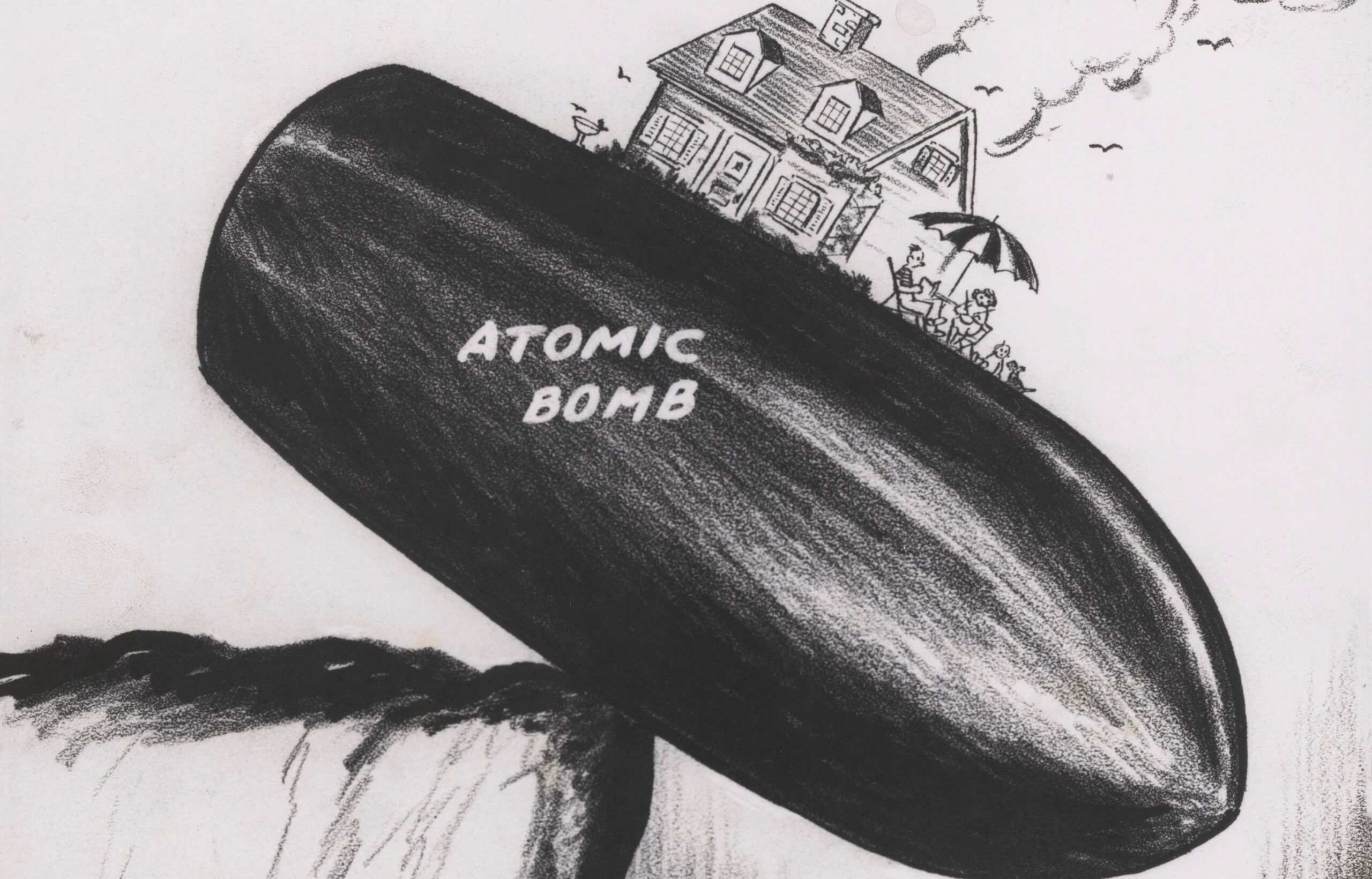
In that century-old piece about Rube Goldberg, we noted that he made an astonishing $200,000 per year. That’s about $3.6 million today, which is impressive. He didn’t make that money only with humorous cartoons, but with serious political ones, including several about British Mandate Palestine and about Israel. He even won a Pulitzer for his political work.
But this paper was proudest of all that he was a local. Just read this summation in 1928.
“Whether with pen or pencil, Reuben Lucius Goldberg, San Francisco Jewish boy, has become the artist supreme and from what we have been reliably informed, the highest paid man in his profession in America.
“We hereabouts feel very proud of him, not so much because of the fame and fortune that has become his by his own unaided efforts, but because throughout the vicissitudes of an artist’s life he remained the same kind, genial, unassuming Reuben we knew of old.”