

Solomon Lezin-Schmidt doesn’t remember his first summer at Camp Tawonga. Why would he? He was only 2 at the time.
His mother was then a staffer at Tawonga, which explains his early introduction to the popular Jewish summer camp. Nearly every summer since, Lezin-Schmidt has returned, first as a camper, then as a counselor, drawn to the beauty and communal spirit of the site near Yosemite National Park.
“It creeps up on you. After a few days, you feel this deep satisfaction being in a natural space,” said Lezin-Schmidt, now 19. “I found all of my deepest friendships and connections at Camp Tawonga after years of shared memories and inside jokes, being able to exist without any stressors, forming bonds when you’re the best version of yourself.”
Now a sophomore at Whitman College, he represents the latest of many generations of Tawonga alumni.

This year, those generations will celebrate Tawonga’s 100th anniversary.
Campers, staffers and supporters past and present will mark the centennial with a party and fundraiser on March 8 in San Francisco. Money raised will bolster year-round camp programming, provide financial assistance to needy camp families and fund forest stewardship and maintenance.
“As we celebrate 100 years of Tawonga, I feel so grateful to generations of past leaders, family, staff, campers and supporters who made this possible,” said Tawonga CEO Rebecca Meyer. “People see the value of investing in Jewish camps and Tawonga specifically. They know the payoff is that you raise a generation of people who grow up to be involved in Jewish life.”

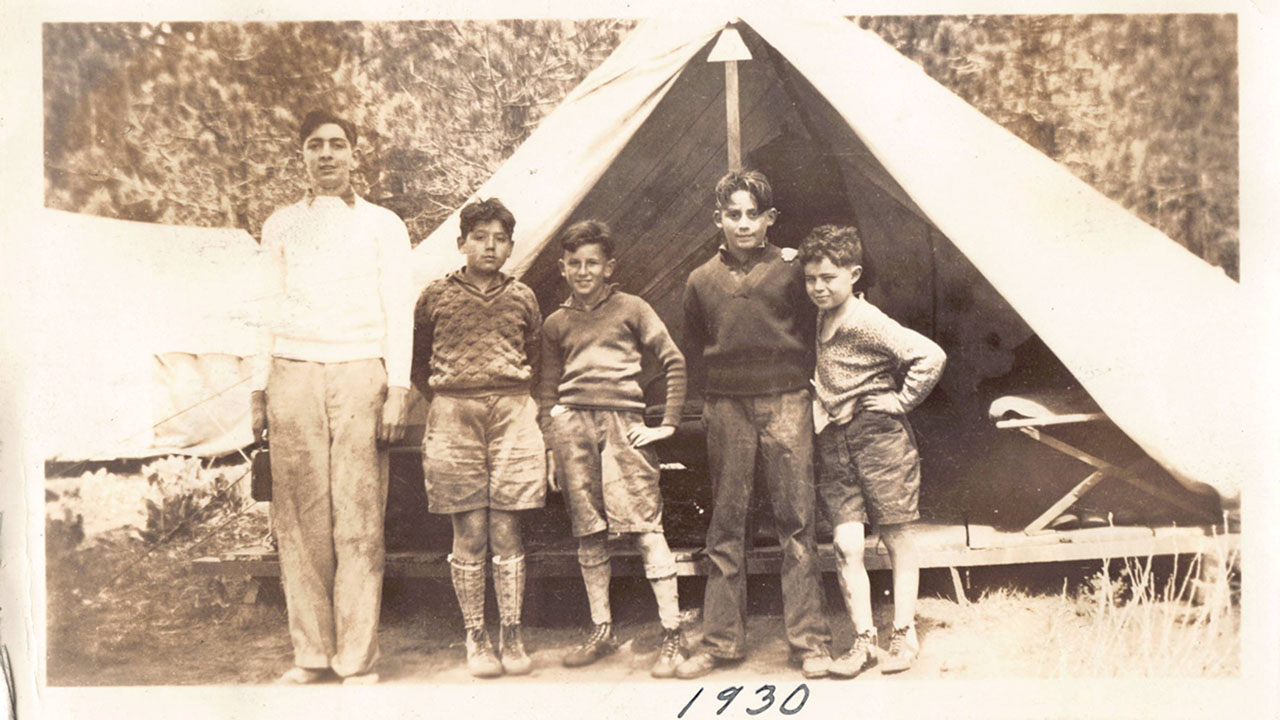
A century ago, a group of Bay Area Jewish summer camp enthusiasts launched Tawonga, initially at Lake Tahoe. In 1964, the camp relocated to its current 160-acre Groveland location, on the Tuolumne River. Over the years, a Tawonga ethos took shape, embracing reverence for nature, fostering community and celebrating Jewish life.
Rabbi Deborah Newbrun is director emerita of Tawonga. As a teen, she worked there as a counselor. After graduating college she returned in 1983, becoming assistant director and eventually director, a post she held until 2006. She still adores the camp.
“I became a mentor and educator for camp directors around the country, so I’ve traveled to no less than 40 camps,” said Newbrun, who serves on J.’s board. “Camp Tawonga is the most spectacular. In the middle fork of Tuolumne, with black oaks, pines and incense cedar, I just loved the place. I just loved that Judaism could be taught in the outdoors.”

Early in her tenure, Newbrun started Adventure Quest, a Tawonga program that offers teens backpacking, rock climbing, rafting and kayaking experiences in Big Sur, Canada and up and down the Sierras. It was one of many innovations that expanded Tawonga’s menu of activities, which now include family camps such as Keshet for LGBTQ+ families, a b’nai mitzvah program and High Holiday celebrations.
Shabbat is made extra special, with white linen tablecloths in the dining hall on Friday nights and only-on-Saturday sugar cereals offered on Shabbat morning.
“At Tawonga I learned the love for Judaism,” said David Coffman, 48, a San Francisco accountant who grew up a Tawonga camper and joined the board as an adult. “Singing prayers and Jewish songs, being in a loving Jewish community really grabbed me.”

Coffman traces his family history back to the Gold Rush days in San Francisco. His great-grandfather served as a rabbi at what was then Congregation Beth Israel (and now Am Tikvah). His father was a Tawonga board member, which meant he started going to camp early. He was 8 when he attended his first three-week summer session. Coffman was a camper for eight years and later served as a counselor and assistant unit head.
He credits camp with helping him get through one of the most traumatic periods of his life.
“My father passed away when I was 13,” Coffman said. “After he passed away, I felt really taken care of [at camp] — that support I got in a difficult time in my life, the intentionality of Tawonga, the canon of ethics, that the children come first. My years as a counselor, what I learned and practiced with other people’s kids, made me the parent I am today.”

Meyer has been serving in the camp’s top post since 2023 when she replaced longtime CEO Jamie Simon, who will become interim CEO of the Foundation for Jewish Camp in March. Meyer, who has been on Tawonga’s year-round staff for 20 years, said that one of her goals has been to preserve what has always been unique to the camp.
“People feel very separate and disconnected from nature,” she said. “We spend most of our time indoors, in paved concrete jungles, and a lot of time on screens. When you have the opportunity to see the stars at night, to hike to the top of a mountain and look at the view, to lean against a tree and read a book, to swim in fresh water, to hold a frog in your hands: These are the experiences people have at Tawonga. It makes you feel part of something bigger.”

For Lezin-Schmidt, that also meant a stronger sense of Jewish identity. “When I say the prayers I feel a sense of pride in the shared tradition and experiences,” he said. “One of the best experiences of my life was being on staff. Giving back to [Tawonga] felt so good because I was deeply shaped by my counselors. They taught me about healthy masculinity. That drove me to be the best counselor I could be.”
Tawonga has endured its share of tragedy. In 2013 and 2018, the camp evacuated because of nearby wildfires, the first of which burned several structures on the property. In 2013, 21-year-old arts instructor Annaïs Rittenberg died after a tree branch fell on her. And in 2021, counselor Eli Kane of Berkeley drowned in a nearby swimming hole while he was off duty.

Some key people will be missing from the 100th birthday celebration. In 2022, longtime camp executive director Ken Kramarz, who did much to shape camp culture over the last 40 years, died at age 69. In 2023, former assistant director Ann Gonski who together with Newbrun and Kramarz formed what Coffman affectionately dubbed “the three-headed monster” of Tawonga, also passed away.
“I think about Ken every single day,” Meyer said. “I’m so inspired by his vision. We truly have brought to life his vision to grow from being a summer camp to being year round. He envisioned investing in our beautiful property: We built cabins, expanded the dining hall, built a health center, created a development department and hired a communications director. It’s all part of the secret sauce that helped Tawonga thrive.”

Now that Camp Tawonga is turning a spry 100, its admirers are singing its praises. “It speaks to a Bay Area ethos of loving nature,” Newbrun said, “of loving Judaism, of wanting to connect Jews to each other in a clean, healthy ideal environment. This summer oasis fortifies them for life.”
Lezin-Schmidt said that to him, Camp Tawonga “means everything in terms of how we will rebuild our world. It continues to demonstrate such important values to generation after generation. I wish there were more outlets like Camp Tawonga in the world.”