

What does it mean not just to grow old, but to grow into an elder?
That’s the question at the heart of From Older to Elder, a nine-month program that invites participants 64 and up to explore the challenges and opportunities of aging, all through a Jewish lens. The program is run by Wilderness Torah, a Berkeley-based nonprofit that focuses on earth-based Jewish experiences, traditions and teachings.
Ellie Schindelman, a longtime Wilderness Torah participant and From Older to Elder’s organizer, said the program is rooted in two central themes: radical acceptance and resilience.
“Instead of thinking only about all the problems and difficulties and things we don’t like about getting older, it’s thinking about the opportunity to be of service, to harvest what we’ve learned in our lives and find our calling in this last part of life,” said Schindelman, 75, a personal coach and organizational consultant who has lectured at UC Berkeley’s School of Public Health.
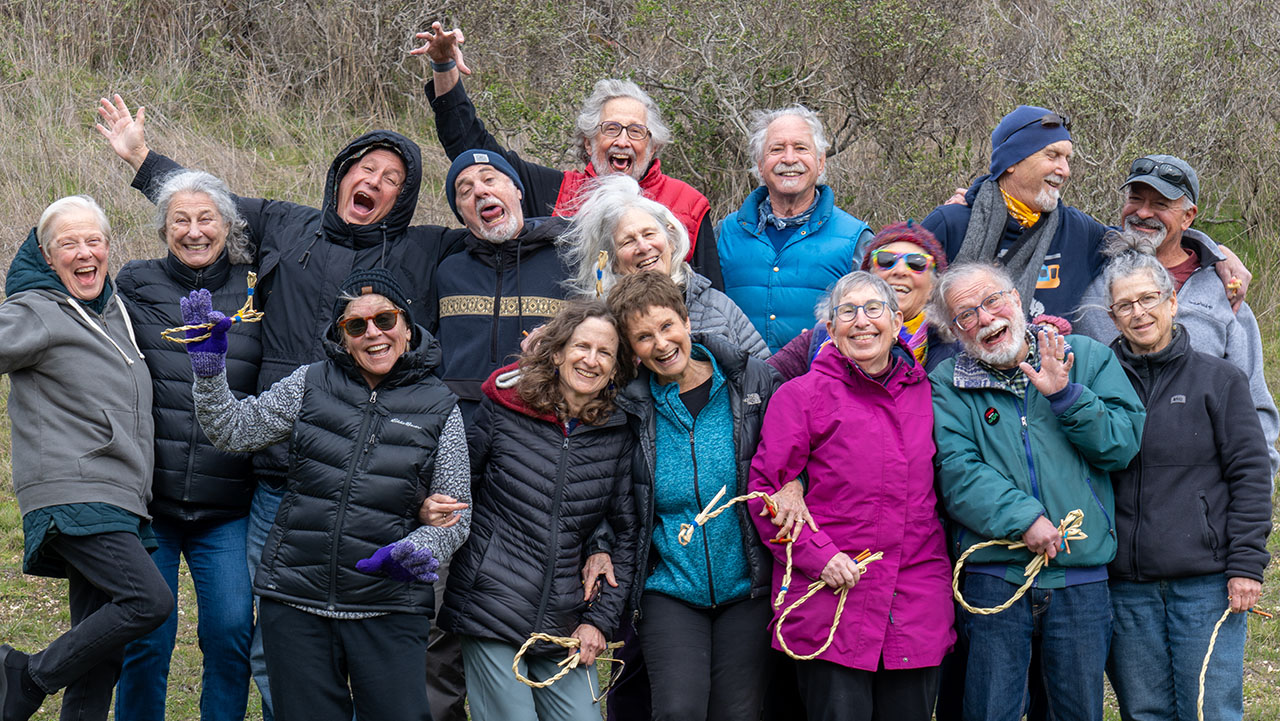
From Older to Elder wrapped up its inaugural session in March with almost 40 participants, ages 64 to 86, and will start up again in September for its second. Two information sessions about it are set for early June.
The program explores multiple facets of aging in classes led by rabbis and other Jewish thought leaders — as well as through discussions, readings, art projects, movement, song circles and rituals. Some activities take place at beaches, in parks and in other natural settings.

Attendees share their visions for the later stage of life and the legacies they want to leave. They reflect on ways to nurture intergenerational relationships and embrace their accumulated knowledge and newfound freetime. They also confront tough topics, such as internalized ageism, fears around declining health and death, and concerns about the world their children and grandchildren will inherit.
Being an elder means “embracing a view of ourselves where we have a responsibility to bring our wisdom and what we’ve learned in service to the world,” Schindelman said.
The program is open to anyone who identifies as Jewish or is connected to Jewish life. The first session drew some participants with little Jewish practice, others highly involved in synagogue life and one who was finishing cantorial school at 82.
Naomi Baran, an Oakland psychotherapist who belongs to the East Bay Renewal congregations Chochmat HaLev and Kehilla Community Synagogue, was drawn to the program as a way to widen her circles and to consider the complexities of aging from a Jewish perspective.
“Being with my tribe was deeply meaningful for me,” said Baran, 70. “And to be telling my grandparents’ stories and reflecting on them and my heritage with other Jews was poignant in a particular way.”
Baran said she also appreciated the bonds she forged with fellow participants and the honest, vulnerable exchange of ideas.
“There were sometimes difficult conversations, there was curiosity, there was a sense of humor, there was thinking about how to grow your own intuition and expand your own wisdom,” Baran said. “It was rich.”
She participated in the “hybrid” version of From Older to Elder with in-person classes and two four-day retreats where group members built ancestral altars full of photos and keepsakes, sang Jewish music, recited Hebrew prayers and called one another back from solo outdoor wanderings by sounding the shofar.
There’s also a virtual-only option for those who live outside Northern California or may not be mobile.
Shelley Riskin, a 75-year-old librarian from the Chicago area, joined the online program last year.
“I really, really would have loved to go on an in-person retreat, because when I heard about what they were, they just sounded phenomenal,” she said. “Having said that, I felt very connected.”
Schindelman co-created the program with Jerry Falek, a storyteller and movement teacher. The pair studied similar programs and conducted focus groups to see which topics would resonate most before crafting their own curriculum.

Many people who are growing older feel invisible and disempowered, Schindelman said.
The program “actually leads you to have a positive perspective about what it means to be older and not just, ‘Oh dear, my aches my pains, my this my that,’” she added. “It’s a beautiful transition, a transformation actually.”
Bob Smith, 68, a retired law enforcement executive from Davis, said the program helped him clarify who he wants to be in this next phase of life.
“I have a deeper understanding and awareness of my capacity and role as an elder, and a greater sense of how I wish to harvest my own personal wisdom and life experiences,” Smith said. “That mindfulness feels more present and integrated in my day-to-day living and serves as a backdrop in many, if not most, of my interactions with others.”
A guitarist, Smith led the music component of From Older to Elder alongside Baran, a singer. Both alums remain connected to the program and, come September, they’ll serve as mentors to the smaller peer groups that meet in break-out sessions.
Guest teachers in the upcoming group will include Rabbi Dan Goldblatt, co-founder of the AriYael Jewish Healing Center and his wife, Zoë Francesca Goldblatt, a facilitator at AriYael, who will talk about dying as a sacred transition. In addition, Rabbi Tirzah Firestone, an author and Jungian therapist, will speak about staying connected to ancestors, both living and deceased.
The hybrid program costs $2,600 to $3,500, based on housing arrangements at two four-day retreats at Mt. Tamalpais in Mill Valley. The virtual-only program comes with a suggested sliding scale from $475 to $675.