
A long-forgotten event featured significantly in this publication 82 years ago when San Francisco played host to two Jewish leaders from the Soviet Union during World War II.
The Jewish Anti-Fascist Committee was formed in the USSR in 1942 to solicit international Jewish support for the forces battling Nazi Germany on the Eastern Front.
The committee chairman was Solomon Michoels, director of the Moscow State Jewish Theatre and the nation’s most celebrated Yiddish actor. (He is also referred to as Shloyme Mikhoels today.)
The committee vice chair was the popular Yiddish poet Itzik Feffer, who was also a lieutenant colonel in the Red Army.
This was a time when the USSR still offered a degree of support to secular Yiddish culture, while suppressing Hebrew and religious expression.
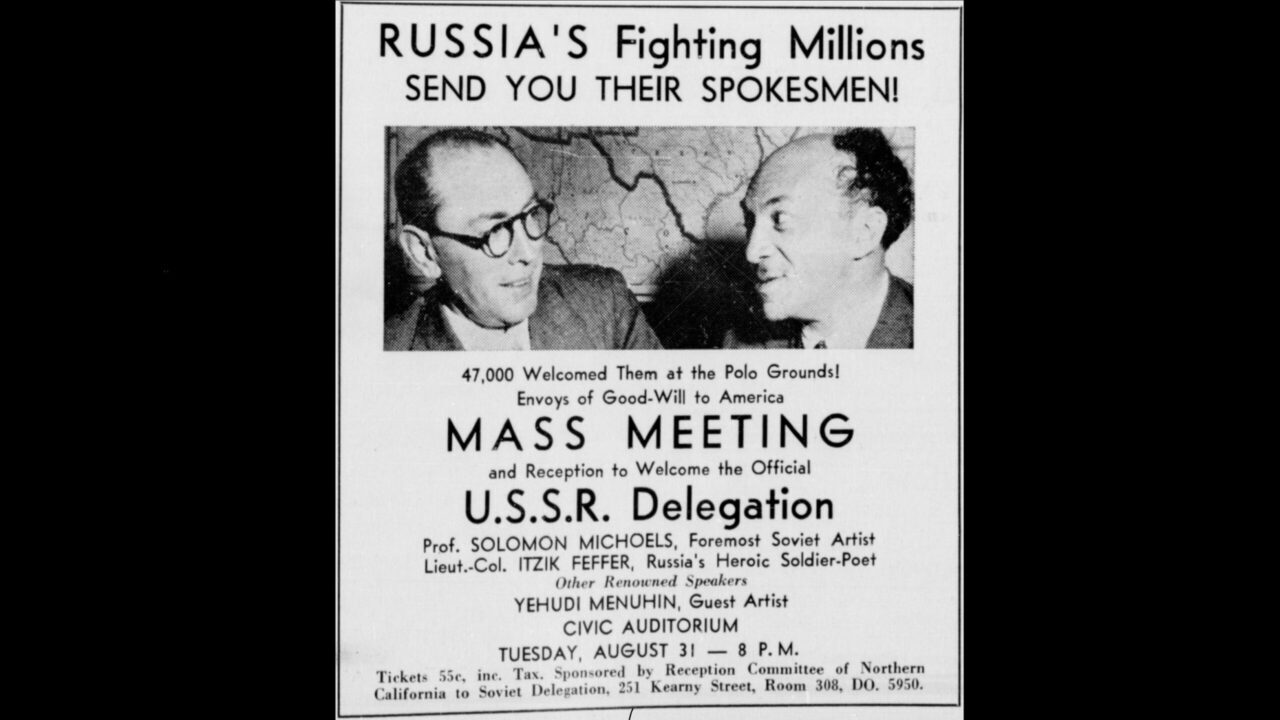
In 1943, the two men embarked on an international speaking tour to seek solidarity and funds, which included an event in San Francisco’s Civic Auditorium on Aug. 31.
This publication first mentioned the visit on July 29, noting that the men would be coming “to bind up the American Jews into one anti-fascist bloc in common with Russian Jews for two purposes: one, to win the war against the fascist dictators; two, to win the peace for all of those human rights and decencies that are implied in the term of civilization.”
An editorial the following week highlighted the significance of the USSR sending Jewish leaders as ambassadors: “At a time when … Nazi Germany holds the Jew up to be scorned by the world and to be exterminated by every diabolical scheme known to savage hate, the mighty Russian government delegates two Jews to be its spokesmen.… It indicates a respect for the American Jewish community that perhaps it often lacks for itself.”
The editorial goes on to assert that the “visit has nothing to do with ideology” and that “San Francisco’s Jewish community must not and will not fail to extend a hand of fellowship.”
This insistent tone hints at tensions, likely akin to ones that accompanied the tour nationally, with some Jewish organizations refusing to offer their blessing. For example, the American Jewish Committee expressed concern that promoting the emissaries would reinforce the popular association of Jews with communism, which they sought to combat. And many socialists were unwilling to contribute to a propagandistic victory for the communist nation.
However, an article the following week implied that dissension had been managed, as the “Jewish community of San Francisco is united in its extensive plans to warmly welcome Russia’s two Jewish emissaries. This unity is in itself an achievement.”

The Aug. 20 issue included an advertisement for the event, which, conspicuously, mentioned nothing Jewish-related. This was in contrast to the Yiddish language flyer, visible online through the Magnes Collection, which used the identical layout, but whose text translates to: “To all the Jews in San Francisco! In New York’s Polo Grounds 47,000 people greeted the Soviet Jewish delegation, Shlomo Michoels, director of the Moscow Jewish Theater, and Itzik Feffer, Colonel and the greatest Yiddish writer in the Soviet Union, who bring us greetings from our six million Jewish sisters and brothers, and from the Red Army. Come greet our great Jewish artists.”
One wonders at the motivation in stripping the English ad of any Jewish references.
After arriving in San Francisco, Feffer and Michoels were welcomed at a reception led by Mayor Angelo Rossi. Their speaking engagement, which also featured music from violinist Yehudi Menuhin — who grew up in the city’s Fillmore District — was a great success. An editorial proclaimed that the “Civic Auditorium was veritably a hallowed hall last Tuesday evening as a capacity crowd gathered to pay tribute to a gallant ally through two of Russia’s most worthy sons.”
Noting that Michoels and Feffer spoke only in Yiddish, another article observes that “perhaps one-third of the audience did not literally understand the language. But their interest was indubitably sustained by the alternate laughter and solemnity of the audience, as well as by the grace and gesticulations of the speakers.”
The author further reflected on the psychological impact for the audience: “At a time when the American-Jewish community is still reeling defensively from the punches relentlessly thrown by the Axis nations against them, Russia steps into the ring with smelling salts to help restore the American-Jewish community to its sense, its pride, its prestige.”
Even the Society column chimed in, highlighting the Nob Hill reception where “Dr. and Mrs. Louis Bloch were hosts on last Monday evening at their Brockelbank Apartments to Soviet Russia’s two distinguished envoys.”
The paper’s final mention of the event was a snippet recalling that, when asked about the Soviet position on Palestine, Michoels and Feffer responded, “Stalin will always be on the side of ‘yosher.’”
Coming into Yiddish from Hebrew, “yosher” means upright and is used in an ethical sense. It’s a haunting pronouncement, in light of the tragic epilogue.
In 1948, having hardened his views concerning Jews and Jewish culture, Stalin ordered the death of Michoels.
Four years later, Feffer was executed for “counterrevolutionary crimes” along with other Jewish intellectuals, all active in the Jewish Anti-Fascist Committee, on what became known as the Night of the Murdered Poets.
The 1943 San Francisco event can be viewed as one when Jews came together across differences to fight fascism, as one when Jews fell for Soviet propaganda or as both. I’m grateful for the archives that allow us to examine this history at all.